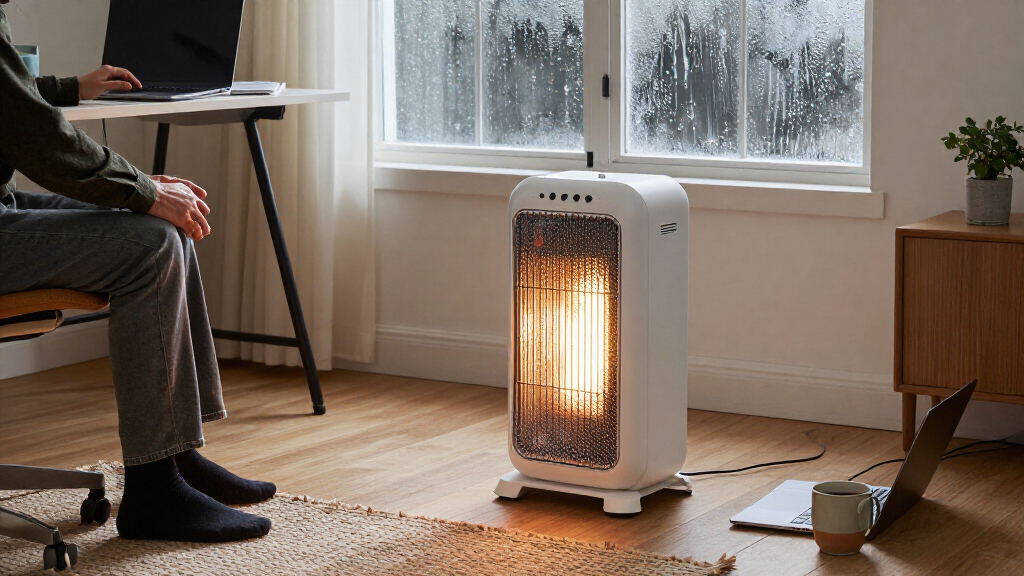

Portable space heaters are usually a choice between quick heat where you need it and quieter warmth that lasts. Ceramic heaters use an electric element and fan to push heat into a small area; oil-filled radiator heaters warm internal oil and release heat gradually. Both convert electricity into heat at the point of use, but they feel different in a bedroom, home office or chilly corner. Ceramic models suit short sessions and targeted comfort, while oil-filled radiators make more sense when you want a room to stay warm for hours. The deciding factors are how quickly you need heat, whether fan noise bothers you, how much floor space you can spare and whether the heater will run while you are nearby.

Get the latest gadgets delivered free with Prime
- Fast, free delivery on millions of items
- Prime Video, Amazon Music and more included
- Member-only deals all year

DREO Space Heater, Portable Electric Heaters for Indoor Use with Thermostat
- ✔ Power: 1500W
- ✔ Heating element: PTC ceramic
- ✔ Stated coverage: 200 sq. ft.

Space Heater, WINHL Portable Electric Heaters for Indoor Use, 70° Oscillation
- ✔ Power: 1500W
- ✔ Heating element: PTC ceramic
- ✔ Oscillation: 70°

Amazon Basics Ceramic Space Heater, Portable Indoor Heating Solution
- ✔ Power settings: 1500W high, 900W low, fan-only
- ✔ Heating method: Ceramic heater; listing also identifies infrared heating
- ✔ Noise claim: 43dB
At a Glance
| Criteria | Ceramic space heaters | Oil-filled radiator heaters | Winner |
|---|---|---|---|
| Heat-up speed and reach | Fast fan-driven warmth; best for a person or small zone nearby. | Slower warm-up; steady radiant and convective heat suits longer sessions. | A |
| Noise | Fan noise is audible and can disturb quiet work or sleep. | Near-silent operation because there is no fan. | B |
| Warmth after switching off | Heat drops quickly when the heater is switched off. | The radiator retains heat and releases it gradually after shutoff. | B |
| Portability and placement | Usually compact and easy to move between rooms. | Heavier and bulkier; casters help, but frequent room changes are less convenient. | A |
| Thermostat and comfort | Direct airflow can feel warm quickly but may be uneven across a room. | Gentler, more even-feeling warmth without a strong air stream. | Depends |
| Typical purchase cost and value | Often lower upfront cost; good value for short, targeted use. | Often costs more upfront; worthwhile for quiet, sustained use. | Depends |
| Safety features and use | Look for tip-over shutoff, overheat protection and a cool-touch exterior; keep clear of fabric. | Surface can become hot; keep clear of children, pets, curtains and furniture, and check for tip-over and overheat protection. | Depends |
DREO Space Heater, Portable Electric Heaters for Indoor Use with Thermostat
The DREO earns the top spot by pairing portable size with the most detailed control package in this lineup. Its 41–95°F thermostat range in 1°F increments gives us more flexibility to set a preferred temperature than the other listings describe. That finer control is particularly useful when a heater sits close to a desk or bed, where a small change can affect comfort. DREO also lists ECO, high-heat and fan-only modes, a remote, 12-hour timer, child lock and memory function.For a bedroom or quiet work area, its stated 34dB noise level and brushless DC motor are distinguishing claims. The Amazon Basics model lists 43dB, while WINHL emphasizes oscillation rather than a noise figure, so DREO is the clearest choice here for buyers prioritizing quiet operation. Its heat funnel design is claimed to extend warm-air reach, but the provided information does not establish that it can heat a large room evenly. Treat the listed 200 sq. ft. coverage as a product specification, not a guarantee for every room.At three pounds and about 10 inches tall, the DREO is easy to reposition between indoor spots. Its tilt detection, overheat protection, V0 flame-retardant materials and safety plug provide a more detailed safety feature list than the other descriptions, and it is stated to be ETL certified. Still, like the others, it is a corded 1500W heater and needs a suitable outlet and sensible placement. Buyers who mainly want broad side-to-side airflow may prefer WINHL’s oscillation, while those who want basic controls may find the Amazon Basics unit less involved.
Pros:
- Thermostat adjusts from 41–95°F in 1°F increments.
- Lists a 34dB noise level and brushless DC motor.
- Includes remote, 12-hour timer, child lock and memory function.
- Three-pound body and integrated handle make it easy to carry.
Cons:
- No oscillation is listed, unlike the WINHL.
- Its many modes and controls may be more than a buyer seeking simple operation needs.
- The 200 sq. ft. coverage claim depends on room conditions and placement.
Best for: People who want a portable heater for a bedroom or home office with precise thermostat adjustments, a remote and a quieter stated operating level.
Not ideal for: Buyers who need independently verified whole-room heating, or who would rather have oscillation than a detailed thermostat and convenience controls.
Bottom line: We recommend the DREO as the most versatile pick for close-range indoor warmth when fine thermostat control and quiet operation matter.
“We recommend the DREO as the most versatile pick for close-range indoor warmth when fine thermostat control and quiet operation matter.”
Space Heater, WINHL Portable Electric Heaters for Indoor Use, 70° Oscillation
WINHL has the most distinct role in this group: it moves warm air from side to side. Its 70° oscillation gives it an advantage over both the fixed Amazon Basics heater and the DREO, which does not list oscillation. That movement can be useful when one small heater needs to serve a desk and nearby chair, or when we want to avoid a single stationary stream of air. The benefit is distribution across a nearby area, not proof of whole-room heating.Like the DREO, WINHL combines 1500W PTC ceramic heat with a thermostat, remote and 12-hour timer. Its five modes and ECO setting add adjustment options, although the supplied listing gives less thermostat detail than DREO’s explicit 1°F increments and temperature range. The remote requires two AAA batteries, which are not included, a small but practical setup detail. At roughly 5.9 inches deep and 9.9 inches tall, its compact tower form is intended for a desk, nightstand or other small surface.The listing includes overheat and tip-over shutoff and says the unit is ETL listed. It also gives unusually specific electrical guidance: plug directly into a 15A wall outlet, avoid extension cords and power strips, and do not share the circuit with other high-wattage appliances. That guidance matters for a 1500W appliance and should factor into placement. Compared with the DREO, WINHL is the better airflow choice but has fewer listed quietness details; compared with Amazon Basics, it adds oscillation and remote controls but also asks us to manage remote batteries and follow explicit outlet instructions.
Pros:
- 70° oscillation moves airflow across a wider nearby area.
- Includes a remote, thermostat, ECO mode and 12-hour timer.
- Compact tower shape is designed for desks and nightstands.
- Lists tip-over and overheat shutoff and ETL listing.
Cons:
- Remote requires two AAA batteries that are not included.
- The listing specifies personal-space use rather than whole-room heating.
- The product information provides no numeric noise level.
Best for: People who want a compact heater to sweep warmth across a nearby desk, chair or bedside area rather than point airflow in one direction.
Not ideal for: Buyers who need documented low-noise operation, dislike replacing remote batteries, or cannot plug the heater directly into an appropriate wall outlet.
Bottom line: Choose WINHL when oscillating airflow is more useful to you than DREO’s finer thermostat detail or Amazon Basics’ simpler controls.
“Choose WINHL when oscillating airflow is more useful to you than DREO’s finer thermostat detail or Amazon Basics’ simpler controls.”
Amazon Basics Ceramic Space Heater, Portable Indoor Heating Solution
The Amazon Basics heater is the straightforward choice: it offers high heat at 1500W, low heat at 900W and fan-only mode. That covers the basic situations many buyers have in mind without the five-mode menu of WINHL or the broader thermostat and timer feature set of DREO. At three pounds and about 9.5 inches tall, it is easy to carry from a home-office desk to another indoor spot, and its tabletop form can be convenient when floor space is limited.This model is explicitly non-oscillating, so its heat stays directed rather than sweeping across a seating area. That makes it less suited than WINHL when several nearby positions need airflow, and its listed 43dB noise level is higher than DREO’s stated 34dB figure. On the other hand, a buyer who simply wants to select a heat level may appreciate the simpler setup. The product description mentions an adjustable thermostat, but it does not supply the same detailed temperature range and increments listed for DREO.Amazon Basics includes tip-over and overheat protection and a power indicator light. The listing also warns against using it in bathrooms, laundry rooms or other high-moisture environments. That caveat narrows where this portable heater belongs, and it should be treated as a dry indoor appliance. Compared with DREO, it gives up the remote, timer and finer temperature control; compared with WINHL, it gives up oscillation and its remote-operated controls. Its appeal is simplicity, not a particularly broad feature set.
Pros:
- Three clear settings: 1500W high, 900W low and fan-only.
- Compact three-pound size is easy to move and place on a table.
- Includes tip-over and overheat protection.
- A 43dB noise figure is provided for comparison.
Cons:
- Non-oscillating airflow covers a narrower direction than WINHL.
- Fewer listed convenience controls than DREO or WINHL.
- The listing says not to use it in bathrooms, laundry rooms or other humid areas.
Best for: Buyers who want a compact indoor heater with simple high, low and fan-only choices for a dry home-office or personal space.
Not ideal for: People who want oscillation, remote operation, a timer, detailed thermostat increments or a heater for damp rooms.
Bottom line: We’d choose Amazon Basics for uncomplicated supplemental warmth in a dry indoor spot, while accepting fewer control and airflow features.
“We’d choose Amazon Basics for uncomplicated supplemental warmth in a dry indoor spot, while accepting fewer control and airflow features.”
As an Amazon Associate we earn from qualifying purchases.
Key Differences
The biggest difference is how quickly each heater delivers comfort. A ceramic heater pushes warm air into the space around it, so it is the stronger pick when you arrive at a cold desk or need a short burst of heat. An oil-filled radiator takes longer to warm, but its stored heat keeps the room feeling more even and continues radiating after the thermostat stops drawing power. For occasional use, that faster response matters more than heat retention; for long, quiet sessions, the radiator’s slower pace is easier to live with.
Neither type is automatically cheaper to operate. Both use electricity, and the cost depends mainly on wattage, runtime, thermostat setting and your electricity rate. A higher purchase price for an oil-filled model is worth paying only if its quiet operation and steady warmth match how you use the room. If you need quick, localized heat, a less expensive ceramic unit is usually better value. In either case, a space heater adds heat to the room; it does not make electricity inexpensive, and it should not replace safe heating practices.
Detailed Comparison
Heat-up speed and reach (Ceramic space heaters wins — moderate)
Ceramic wins by a moderate margin when you want warmth quickly. Its fan sends heat toward a nearby person or small area, which is useful at a desk or beside a chair. An oil-filled radiator warms more gradually and does not project heat as directly, so it is less satisfying for a brief cold spell. For a room used continuously, the radiator’s steady output can matter more than the initial wait.
Noise (Oil-filled radiator heaters wins — major)
Oil-filled radiators win by a major margin for quiet spaces: they heat without a fan, while ceramic heaters make a steady airflow sound and may click as controls cycle. The difference can matter during sleep, calls or focused work. If a low fan hum does not bother you, ceramic’s faster heat may be the better trade.
Warmth after switching off (Oil-filled radiator heaters wins — moderate)
Oil-filled radiators win by a moderate margin because their heated oil and metal casing release warmth gradually after the power stops. Ceramic heaters cool and lose their direct airflow more quickly. This lingering warmth does not mean the radiator produces more heat from the same electricity; it changes when the heat is delivered, which can make long sessions feel smoother.
Portability and placement (Ceramic space heaters wins — moderate)
Ceramic heaters usually win by a moderate margin. Their smaller, lighter bodies are easier to move from a home office to another room, while oil-filled radiators take more floor space and can be awkward to carry. Many radiator models have wheels, but they are still better suited to a regular spot. Check cord length and stable placement for either style.
Thermostat and comfort (minor difference)
This is a close, model-dependent category. A ceramic fan can make a nearby person comfortable quickly, but the moving air may feel uneven or dry. An oil-filled radiator avoids the draft and tends to create gentler warmth, though it takes time to change the room’s feel. A reliable thermostat and appropriate heat settings matter more than the heater category alone.
Purchase cost and value (moderate difference)
There is no universal winner because prices vary by size, controls and safety features. Ceramic models often have a lower entry price, making them a sensible buy for occasional, short use. Oil-filled radiators can justify a higher upfront cost for someone who values quiet operation and keeps a room warm for extended periods. Since both use electricity to generate heat, do not assume the costlier type will lower the bill.
Safety features and use (major difference)
Neither type wins by category alone; the specific model and how it is used matter more. Look for tip-over shutoff and overheat protection, place the heater on a stable surface, and keep it away from bedding, curtains and other combustible material. Oil-filled units can have hot surfaces, while ceramic units may direct hot airflow toward nearby objects. Follow the manufacturer’s instructions and do not leave a portable heater operating unattended or while asleep unless its instructions explicitly allow that use.
Ceramic space heaters: Pros and Cons
Pros:
- Heats a nearby person or small area quickly.
- Usually lighter and easier to move.
- Often costs less to buy.
Cons:
- Fan noise can interrupt sleep or quiet work.
- Warmth fades quickly when switched off.
- Airflow can feel drafty or uneven.
Oil-filled radiator heaters: Pros and Cons
Pros:
- Quiet operation suits bedrooms and focused work.
- Provides steady warmth and releases residual heat after shutoff.
- No fan-driven airflow.
Cons:
- Takes longer to feel warm.
- Bulkier and harder to move between rooms.
- Surface can become hot, and upfront cost may be higher.
Who Should Choose What
Choose Ceramic space heaters if:
- You want quick warmth at a desk, chair or other small area.
- You use the heater for short periods and move it between rooms.
- You prefer a lower purchase cost and can tolerate fan noise.
Choose Oil-filled radiator heaters if:
- You want quiet heat for a room used over long stretches.
- Fan airflow bothers you or you prefer gentler, steadier warmth.
- The heater can stay in one place and its larger size is acceptable.
Skip both if: Skip both if you need to heat a large or poorly insulated space as your main heating source, or if you cannot place a heater with the clearances and supervision required by its instructions.
Value for Money
Pay more for an oil-filled radiator when quiet, extended use is your priority and you have a suitable place to leave it. The premium buys a different comfort profile, not a guaranteed reduction in electricity costs. For quick warmth at a desk or occasional use, a ceramic heater usually delivers better value because it responds fast and often costs less to buy. Compare wattage, thermostat quality, safety protections and the space the unit occupies before choosing; a feature-rich model in either category can cost more than a basic one.
Final Verdict
Choose a ceramic space heater for fast, localized warmth, especially if you will move it around or use it for short sessions. Choose an oil-filled radiator for a room where quiet, steady heat matters more than an immediate blast, and where the unit can remain in place. For most buyers, the deciding factor is usage pattern: brief comfort favors ceramic, while long quiet stretches favor oil-filled. Do not pay extra for an oil-filled model expecting automatic energy savings; pay for its quieter operation and lingering warmth.
Frequently Asked Questions
Which portable heater warms a room faster?
A ceramic heater usually feels faster because its fan pushes heat into the nearby area. An oil-filled radiator takes longer to warm, though it can provide steadier comfort during a longer session.
Is an oil-filled heater cheaper to run than a ceramic heater?
Not by type alone. Both use electricity, and running cost depends on wattage, how long the heater runs, thermostat cycling and your electricity rate. Compare actual model specifications and expected use rather than assuming one category saves energy.
Which type is better for a bedroom?
An oil-filled radiator is often the more comfortable choice for a bedroom because it runs quietly and avoids fan airflow. Follow the manual’s instructions about unattended or overnight operation, and keep the unit well away from bedding and curtains.
Which heater is easier to move?
Ceramic heaters are typically lighter and more compact. Oil-filled radiators may have wheels, but their extra size and weight make them less convenient to carry between rooms.
Evergreen bestsellers Picks

De'Longhi Stilosa Compact Manual Espresso Machine with Milk Frother

Samsung 65-Inch M70H Series 4K Mini LED Smart TV (2026)

Vitamix 5-Speed Immersion Blender, 625-Watt, Stainless Steel/Black
As an affiliate, we earn on qualifying purchases.