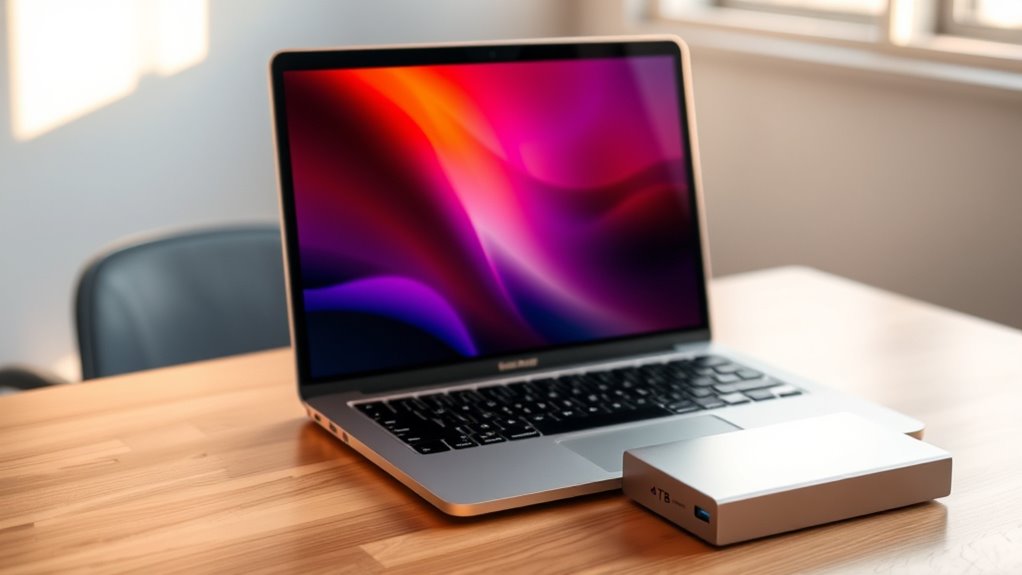

Among these 4TB MacBook Pro laptops, I’d choose the 14-inch M5 Pro with a 15-core CPU, 16-core GPU, and 24GB of memory as the best overall fit for most buyers: it pairs a large SSD with a capable current-generation chip in a portable size. The 14-inch M5 Pro with 48GB of memory suits heavier multitasking, while the 16-inch M5 Max with 128GB is the standout for demanding graphics and memory-intensive work. The main tradeoffs are portability versus screen space, and whether a Max chip or more memory will make a real difference to your workload. I also include an older Intel model, but its age puts it in a separate category from the newer Apple silicon options. Read on for the full comparison and guidance on choosing the right configuration.

Get the latest gadgets delivered free with Prime
- Fast, free delivery on millions of items
- Prime Video, Amazon Music and more included
- Member-only deals all year
Complete the kit



Key Takeaways
- The 14-inch M5 Pro with 24GB of memory is the balanced pick: it offers the target 4TB capacity without the larger memory and graphics configurations that many everyday creative workflows may not need.
- More memory separates the M5 Pro options: the 48GB model is the better fit for heavier multitasking, while the 24GB version makes more sense for less demanding workloads.
- M5 Max configurations vary most by size and memory. The 14-inch models offer more graphics capability in a compact format; the 16-inch 128GB configurations favor demanding sustained work and a larger workspace.
- The 16-inch M5 Max models with 128GB share a high-end performance focus, so choose between them based on finish, listing details, and the exact configuration rather than assuming a major performance difference.
- The 2020 Intel MacBook Pro is the outlier. Its 4TB SSD and 32GB of RAM may suit a legacy-software need, but buyers seeking current-generation performance should prioritize the M5 models.


| 4tb macbook pro laptop | Memory | Storage | Display | Chip |
|---|---|---|---|---|
| Apple 14-inch MacBook Pro with | 36GB | 4TB SSD | 14.2-inch Liquid Retina XDR, 3024 × 1964 pixels, 120Hz | Apple M5 Max |
| Apple 14-inch MacBook Pro with | 48GB | 4TB SSD | 14.2-inch Liquid Retina XDR, 3024 × 1964 pixels, 120Hz | Apple M5 Pro |
| Apple MacBook Pro 16.2-inch wi | 128GB unified memory | 4TB SSD | 16.2-inch Liquid Retina XDR | Apple M5 Max |
| Apple 14-inch MacBook Pro with | 24GB | 4TB SSD | 14.2-inch Liquid Retina XDR, 3024 × 1964 pixels, 120Hz | — |
| Apple 14-inch MacBook Pro with | 64GB | 4TB SSD | 14.2-inch Liquid Retina XDR, 3024 × 1964 pixels, 120Hz | Apple M5 Max |
| Apple 16-inch MacBook Pro with | 128GB unified memory | 4TB SSD | 16.2-inch Liquid Retina XDR | — |
| Apple MacBook Pro 13-inch | 32GB LPDDR4X, 2666 MHz | 4TB SSD | 13.3 inches, 3840 × 2160 pixels | — |
More Details on Our Top Picks
Apple 14-inch MacBook Pro with M5 Max, 18-core CPU, 32-core GPU, 36GB memory, and 4TB SSD
This is my best-balanced pick for buyers who want a 4TB MacBook Pro with strong graphics performance in a more portable 14-inch size. The M5 Max 32-core GPU is the draw for graphics-heavy work, while 36GB of memory and the large SSD leave room for substantial projects and files. Compared with the 14-inch M5 Pro model with 48GB of memory, this configuration favors GPU resources over RAM capacity; I’d choose the Pro instead for memory-heavy workflows that do not need Max-class graphics. The 120Hz Liquid Retina XDR display also makes detailed editing feel spacious and fluid. The tradeoff is that its listed battery estimates conflict—18 hours in product information versus up to 24 hours in the description—so I would not plan around the higher figure.
Pros:- M5 Max chip with 18-core CPU and 32-core GPU for demanding graphics work
- 4TB SSD provides substantial space for active projects and media
- 14.2-inch Liquid Retina XDR display with 120Hz refresh rate and up to 1600 nits peak brightness
- Backlit keyboard and fingerprint reader
Cons:- 36GB memory is less than the 48GB in the 14-inch M5 Pro configuration
- Battery life is listed inconsistently as 18 hours and up to 24 hours
- Some Apple Intelligence features may not be available in every region or language
Best for: Creative professionals who need a portable 14-inch system, 4TB of local project storage, and stronger graphics capability for visual workloads.
Not ideal for: Developers or researchers whose largest workloads need more than 36GB of memory, or buyers who need a dependable battery-runtime estimate.
- Chip:Apple M5 Max
- CPU and GPU:18-core CPU, 32-core GPU
- Memory:36GB
- Storage:4TB SSD
- Display:14.2-inch Liquid Retina XDR, 3024 × 1964 pixels, 120Hz
- Peak brightness:Up to 1600 nits
- Battery life:Listed as up to 24 hours in description and 18 hours in product information
- Dimensions:13.4 × 9.35 × 0.45 inches
Our verdict“Choose this 14-inch model if you want 4TB storage and a powerful GPU in a portable format, but favor the 48GB M5 Pro when memory capacity matters more.”
Apple 14-inch MacBook Pro with M5 Pro, 18-core CPU, 20-core GPU, 48GB memory, and 4TB SSD
I’d pick this configuration when memory headroom matters more than having the strongest GPU in the group. Its 48GB of memory exceeds the 36GB in the 14-inch M5 Max model, which can better suit large codebases, multitasking, and projects that keep many assets active. Both offer a 4TB SSD and a 14.2-inch Liquid Retina XDR screen, but the M5 Max option has a 32-core GPU versus this model’s 20-core GPU. That makes the choice practical: prioritize memory capacity here, or graphics throughput there. The 120Hz display and stated battery life of up to 24 hours support a capable mobile workstation, though runtime varies with workload and configuration. Buyers focused on GPU-intensive creation should compare the M5 Max models before choosing this one.
Pros:- 48GB memory offers more headroom than the 36GB 14-inch M5 Max option
- 4TB SSD accommodates large local files and project libraries
- 18-core CPU and 20-core GPU support demanding professional tasks
- 14.2-inch Liquid Retina XDR display with 120Hz refresh rate and up to 1600 nits peak brightness
Cons:- 20-core GPU is less capable on paper than the 32-core and 40-core M5 Max configurations
- Battery life varies by use and configuration
- Some Apple Intelligence features may not be available in every region or language
Best for: Professionals running memory-intensive applications, large development environments, or many demanding tasks at once who still want a 14-inch laptop.
Not ideal for: GPU-focused editors and 3D artists who would benefit more from the 32-core or 40-core GPU configurations.
- Chip:Apple M5 Pro
- CPU and GPU:18-core CPU, 20-core GPU
- Memory:48GB
- Storage:4TB SSD
- Display:14.2-inch Liquid Retina XDR, 3024 × 1964 pixels, 120Hz
- Peak brightness:Up to 1600 nits
- Battery life:Up to 24 hours, depending on use and configuration
- Operating system:macOS
- Color:Space Black
Our verdict“Choose this model for 48GB of memory and 4TB storage in a 14-inch MacBook Pro, especially if memory capacity outranks maximum graphics performance.”
Apple MacBook Pro 16.2-inch with M5 Max, 18-core CPU, 40-core GPU, 128GB Memory, and 4TB SSD
This is the specialized choice for buyers who need 128GB of unified memory alongside a 40-core GPU and 4TB SSD. That memory capacity separates it from the 14-inch M5 Max with 64GB, making this configuration better suited to very large creative, technical, or data-heavy workloads. Its 16.2-inch Liquid Retina XDR display gives complex timelines and multitasking more room, while Thunderbolt 5, HDMI, SDXC, and MagSafe 3 provide a broad selection of connections. The tradeoff is substantial portability: the listing gives a weight of 8.2 pounds, far above the compact 14-inch options, and it does not specify a battery runtime. I’d choose it for memory and screen area, not for frequent travel; the 64GB 14-inch model is a more mobile alternative.
Pros:- 128GB unified memory is the largest capacity among these listed configurations
- M5 Max with 40-core GPU for demanding graphics workloads
- 16.2-inch Liquid Retina XDR display provides more workspace than the 14-inch models
- Thunderbolt 5, HDMI, SDXC, MagSafe 3, Wi-Fi 7, and Bluetooth 6
Cons:- Listed weight of 8.2 pounds makes it much less portable than the 14-inch options
- No specific battery-runtime figure is provided
- Its memory and display advantages may be unnecessary for buyers with less demanding workloads
Best for: Specialist creators, engineers, and technical professionals who need unusually high memory capacity, powerful graphics, and a large built-in display.
Not ideal for: Frequent travelers or buyers who prioritize a lighter 14-inch laptop and a clearly stated battery runtime.
- Chip:Apple M5 Max
- CPU and GPU:18-core CPU, 40-core GPU
- Memory:128GB unified memory
- Storage:4TB SSD
- Display:16.2-inch Liquid Retina XDR
- Weight:8.2 pounds
- Ports:Three Thunderbolt 5, MagSafe 3, SDXC, HDMI, headphone jack
- Wireless:Wi-Fi 7 and Bluetooth 6
- Camera:12MP Center Stage
Our verdict“Choose this 16.2-inch model when 128GB memory and a larger display justify carrying a substantially heavier laptop.”
Apple 14-inch MacBook Pro with M5 Pro chip, 15-core CPU, 16-core GPU, 24GB RAM, 4TB SSD, Space Black
Among these 4TB configurations, this is the more restrained performance choice: it pairs an M5 Pro chip with 24GB of memory rather than the 48GB in the other 14-inch M5 Pro model. That makes it a sensible fit for professional work where a large local library matters more than maximum memory or GPU capacity. The 14.2-inch Liquid Retina XDR display has a 120Hz refresh rate and up to 1600 nits peak brightness, matching the core screen appeal of the pricier-tier configurations. Compared with the 14-inch M5 Max models, its 16-core GPU is a less ambitious fit for graphics-heavy workloads; compared with the 48GB M5 Pro, it offers less memory headroom. I’d shortlist it for general professional use, but buyers with unusually demanding projects should step up to one of those alternatives.
Pros:- 4TB SSD offers ample internal storage for large project collections
- M5 Pro chip with 15-core CPU and 16-core GPU
- 14.2-inch Liquid Retina XDR display with 120Hz refresh rate
- Listed battery life of up to 24 hours
Cons:- 24GB memory is below the 48GB and 64GB options in this group
- 16-core GPU is less suited to graphics-heavy work than the M5 Max configurations
- Limited post-purchase upgrade options make the initial configuration especially consequential
Best for: Professionals who need a 4TB internal drive for work files and media but have moderate memory and graphics demands.
Not ideal for: 3D artists, high-end video specialists, or users running large memory-intensive workloads who should favor an M5 Max or the 48GB M5 Pro configuration.
- Processor:Apple M5 Pro, 15-core CPU, 16-core GPU
- Memory:24GB
- Storage:4TB SSD
- Display:14.2-inch Liquid Retina XDR, 3024 × 1964 pixels, 120Hz
- Brightness:Up to 1600 nits peak; 1000 nits sustained
- Battery life:Up to 24 hours
- Operating system:macOS
- Color:Space Black
- Power adapter:70W USB-C Power Adapter
Our verdict“Pick this configuration when 4TB storage and a strong everyday professional setup matter more than high memory capacity or top-tier graphics.”
Apple 14-inch MacBook Pro with M5 Max, 18-core CPU, 40-core GPU, 64GB RAM, and 4TB SSD (Space Black)
This 14-inch model brings the 40-core M5 Max GPU into a smaller chassis, pairing it with 64GB of memory and a 4TB SSD. It is the portable high-performance alternative to the 16.2-inch M5 Max with 128GB: the larger model gives you twice the memory and more screen area, while this one is the more compact choice for GPU-heavy work on the move. Compared with the 14-inch M5 Max with a 32-core GPU and 36GB of memory, this configuration adds both graphics resources and memory headroom. That makes it a stronger fit for demanding visual workloads, though its compact screen may feel limiting for long editing sessions. The stated battery life is up to 24 hours, but actual runtime varies, and the product notes that Apple Intelligence features are in beta.
Pros:- M5 Max with 18-core CPU and 40-core GPU in a 14-inch configuration
- 64GB memory provides more headroom than the 36GB 14-inch M5 Max option
- 4TB SSD for extensive local media and project storage
- 14.2-inch Liquid Retina XDR display with 120Hz refresh rate and up to 1600 nits peak brightness
Cons:- Smaller display offers less workspace than the 16.2-inch M5 Max model
- Battery life varies with use and configuration
- Apple Intelligence features are described as being in beta
Best for: Mobile creative professionals who want a 14-inch laptop with a high-core-count GPU, 64GB memory, and 4TB of local storage.
Not ideal for: Users who need a 16-inch workspace or 128GB of memory; the 16.2-inch M5 Max configuration is better suited to those demands.
- Chip:Apple M5 Max
- CPU and GPU:18-core CPU, 40-core GPU
- Memory:64GB
- Storage:4TB SSD
- Display:14.2-inch Liquid Retina XDR, 3024 × 1964 pixels, 120Hz
- Peak brightness:Up to 1600 nits
- Battery life:Up to 24 hours
- Dimensions:12.31 × 8.71 × 0.61 inches
- Included accessories:USB-C to MagSafe 3 cable (2 m), USB-C power adapter
Our verdict“Choose this model for a compact 14-inch MacBook Pro with a 40-core GPU and 64GB memory, unless you need the larger screen and 128GB capacity of the 16-inch version.”
Apple 16-inch MacBook Pro with M5 Max, 18-core CPU, 40-core GPU, 128GB Memory, 4TB SSD, Space Black
The 128GB unified memory is the defining reason to choose this 16-inch 4TB MacBook Pro: it gives demanding creative and AI workflows more room to work with large assets and datasets than the 36GB or 64GB configurations in the 14-inch M5 Max lineup. Its 18-core CPU and 40-core GPU pair that capacity with substantial processing and graphics resources, while the 4TB SSD keeps a large working library onboard. The 16.2-inch Liquid Retina XDR display, with up to 1600 nits peak brightness, also favors detailed visual work over the smaller 14-inch models. The tradeoff is a larger laptop, and the provided details do not state a specific battery runtime. For buyers who do not need 128GB, the 14-inch M5 Max with 64GB offers the same listed CPU and GPU in a more compact form.
Pros:- 128GB unified memory provides substantial headroom for memory-intensive creative and AI tasks.
- M5 Max with an 18-core CPU and 40-core GPU is configured for demanding processing and graphics work.
- 4TB SSD provides ample local space for large project files and media libraries.
- 16.2-inch Liquid Retina XDR display offers up to 1600 nits peak brightness.
Cons:- The 16-inch form factor is less portable than the 14-inch 4TB alternatives.
- The supplied description gives no specific battery-life duration.
- Some Apple Intelligence features may not be available in every region or language.
Best for: Video, 3D, and AI professionals who need 4TB of local storage, 128GB of unified memory, and a large high-brightness screen for demanding projects.
Not ideal for: Frequent travelers or buyers whose workloads fit within 36GB or 64GB of memory; the 16-inch size and unusually high memory capacity may be more than they need.
- Processor:Apple M5 Max, 18-core CPU
- Graphics:40-core GPU
- Memory:128GB unified memory
- Storage:4TB SSD
- Display:16.2-inch Liquid Retina XDR
- Display brightness:Up to 1600 nits peak; 1000 nits sustained
- Contrast ratio:1,000,000:1
- Power adapter:140W USB-C
- Color:Space Black
Our verdict“Choose this model if your work can make use of 128GB of memory and a large XDR display; otherwise, a 14-inch M5 Max configuration is easier to carry.”
Apple MacBook Pro 13-inch (2020), Intel Core i5 2.0 GHz, 32 GB RAM, 4 TB SSD, Space Gray (Renewed)
This renewed 2020 MacBook Pro is the outlier in this roundup: it pairs a 4TB SSD and 32GB of memory with an Intel Core i5, rather than the newer M5 Pro and M5 Max chips found in the 14-inch and 16-inch alternatives. That makes it a fit for buyers who specifically need an older Intel Mac environment, not for shoppers seeking the strongest performance for current demanding workloads. Its compact 13.3-inch display and 1.4 kg weight make it easier to carry than the 16-inch M5 Max model, and the listing specifies a renewed battery above 80% of original capacity. The listed 3840 × 2160 resolution is a clear screen benefit, but the renewed, non-Apple-certified condition and potentially non-original accessories call for more acceptance of uncertainty than a new M5 model.
Pros:- 4TB SSD provides substantial local storage in a compact 13-inch laptop.
- 32GB of memory is more capacity than many older Intel MacBook Pro configurations.
- Listed 3840 × 2160 display resolution supports detailed viewing.
- Renewed battery is rated to exceed 80% of its original capacity, with a 90-day replacement or refund policy.
Cons:- The 2020 Intel Core i5 platform is older than the M5 Pro and M5 Max options in this roundup.
- Renewed condition is not Apple certified, and included accessories may be non-original.
- Integrated Intel Iris Plus graphics are a less suitable match for demanding GPU-heavy work than the M5 Max models.
Best for: Buyers who need a portable 4TB MacBook Pro for Intel-specific software or workflows and are comfortable purchasing a professionally inspected renewed device.
Not ideal for: Creative professionals seeking the latest Apple silicon performance, buyers who need a new Apple-certified laptop, or anyone who prefers a battery at full original capacity.
- Model year:2020
- Display:13.3 inches, 3840 × 2160 pixels
- Processor:Intel Core i5 (I5-1038NG7), 2.0 GHz, 4 cores
- Memory:32GB LPDDR4X, 2666 MHz
- Storage:4TB SSD
- Graphics:Integrated Intel Iris Plus
- Weight:1.4 kg
- Battery:52.6 Wh; renewed battery exceeds 80% of new capacity
- Condition and return policy:Renewed; professionally inspected, tested, and cleaned; replacement or refund within 90 days
Our verdict“Pick this renewed model for a compact 4TB MacBook Pro when Intel compatibility matters more than newer Apple silicon performance or a new-device condition.”

How We Picked
I ranked these models by how well their 4TB storage is paired with processing power, memory, screen size, and practical portability. The SSD capacity is the shared starting point, not a reason by itself to favor one laptop: the chip and memory determine how well a system fits demanding creative work, while size affects how comfortable it is to carry and use for long sessions. I also weighed whether the configuration appears excessive for common workloads and whether an older platform creates a meaningful compatibility or longevity tradeoff.
The order favors balanced current-generation configurations first, followed by options tailored to heavier graphics work, larger screens, and very high memory demands. The 14-inch M5 Pro with 24GB ranks highest for its broad fit; the 48GB M5 Pro follows for buyers who need more working memory. M5 Max models rank by their distinct portability and performance focus, while the 2020 Intel model comes last because its older platform is a sharper compromise for most new purchases. I treat the two 16-inch 128GB models as near-peers, with finish and listing specifics helping break the tie.
| 4tb macbook pro laptop | Chip | Battery life |
|---|---|---|
| Apple 14-inch MacBook Pro with | Apple M5 Max | Listed as up to 24 hours in description and 18 hours in product information |
| Apple 14-inch MacBook Pro with | Apple M5 Pro | Up to 24 hours, depending on use and configuration |
| Apple MacBook Pro 16.2-inch wi | Apple M5 Max | — |
| Apple 14-inch MacBook Pro with | — | Up to 24 hours |
| Apple 14-inch MacBook Pro with | Apple M5 Max | Up to 24 hours |
| Apple 16-inch MacBook Pro with | — | — |
| Apple MacBook Pro 13-inch | — | — |
Factors to Consider When Choosing 4tb Macbook Pro Laptops
A 4TB SSD answers one question—how much local storage you have—but it does not settle which MacBook Pro is right for you. I’d match the laptop to the work that uses its processor and memory, then weigh screen size, portability, and how long you expect to keep it. These broader checks can prevent paying for capacity or performance that your workflow will not use.
Decide Whether 4TB Must Be Internal
Choose internal 4TB storage when you regularly work with large projects away from a desk, need fast access to media, or prefer keeping an active library on the laptop. If most files are archived or accessed at a workstation, external storage or network storage may handle part of the workload more flexibly. The common mistake is treating a large SSD as a substitute for backup: a single internal drive does not protect against loss or failure. Think about how much space your active projects require, not just the total size of your archive. Also allow room for applications, temporary files, and future work so the drive does not become cramped soon after purchase.
Match Memory to the Workload, Not the SSD
Storage and memory solve different problems: the SSD holds files, while memory helps active apps and projects run together. A large 4TB drive does not make a 24GB configuration equivalent to one with 48GB or 128GB of memory. Buyers working with complex timelines, large image files, virtual machines, or many demanding apps open at once should prioritize memory. Lighter editing, office work, and general creative tasks may not benefit enough from the highest memory tier to justify choosing it over a more balanced system. Since laptop memory is not a casual upgrade decision after purchase, estimate your heaviest regular workload before choosing.
Choose Pro or Max by Sustained Graphics Needs
The M5 Pro configurations suit buyers who need a strong general-purpose creative laptop without making the most graphics-heavy workloads their main focus. M5 Max models make more sense when GPU-intensive tasks—such as demanding visual effects, 3D work, or complex graphics pipelines—are central to paid or frequent work. A higher chip tier is not automatically a better choice for every buyer: unused graphics capability adds little to tasks that mainly depend on storage, browsing, or basic editing. Consider how often your work pushes the GPU, and whether waiting on those tasks costs enough time to justify a more specialized configuration. For mixed workloads, a Pro model with sufficient memory can be a more balanced choice.
Treat Screen Size as a Workflow Choice
A 16-inch display gives timelines, code, documents, and tool panels more room, which can reduce the need to rearrange windows during long sessions. That larger workspace comes with a less portable form factor, so frequent commuting can make a 14-inch model the easier daily companion. Do not assume an external monitor removes the difference: portability matters when you work away from a desk, and the built-in display is your workspace on the move. Buyers who spend most of the day at a fixed desk may value the larger screen more than those who travel regularly. Decide where the laptop will be used most often before choosing the size.
Check Platform Age and Software Needs
The 2020 Intel model belongs on a shortlist mainly when a specific legacy workflow, accessory, or software requirement makes an Intel Mac useful. For a general new purchase, the M5 options offer a much newer platform and a clearer fit for current performance needs. Before choosing an older machine, check the operating-system support window, app compatibility, battery condition, and the seller’s renewal and return terms. A large SSD cannot offset an aging platform if the laptop will not support the software you plan to use over its full service life. Buyers comparing renewed equipment should also confirm the exact condition and included components rather than relying on the model name alone.
Frequently Asked Questions
Is a 4TB MacBook Pro worth choosing if I already use external drives?
It depends on whether your active files need to travel with you or stay readily available without connecting another device. Internal 4TB storage can simplify mobile editing and keep large working libraries together, while an external drive may be a better fit for archives and less-used footage. If you already have a dependable storage and backup setup, the internal capacity may offer convenience more than a change to your workflow. I’d compare the cost and hassle of managing external storage against the value of having active projects on the laptop. Keep a separate backup either way; internal capacity is not data protection.
Should I pick an M5 Max model or an M5 Pro model for video editing?
Start with the kind of editing you do and how often your projects become demanding. An M5 Pro can be a sensible choice for many editing workflows, especially when the configuration has enough memory for your footage, apps, and multitasking habits. An M5 Max is better suited to work that leans heavily on graphics processing or requires more headroom for complex effects and demanding visual projects. The Max tier is not automatically the better purchase if your edits are straightforward or occasional. Consider your regular workload, not the most demanding project you might handle once.
Is 24GB of memory enough for a 4TB MacBook Pro?
It can be enough when your 4TB MacBook Pro is used for general work, moderate creative projects, and a manageable number of apps at once. The 4TB SSD provides room for files but does not replace memory when large projects and applications are active. If you routinely work with complex media, extensive multitasking, or memory-heavy tools, the 48GB or 128GB configurations give you more headroom. Think about the largest project you handle often, rather than buying memory only for a rare worst-case scenario. Choose based on the workload you expect to keep using the laptop for.
Does the 16-inch model make sense if I mostly work at a desk?
It may, especially if the laptop’s built-in screen is your main workspace and you often keep several panels or windows visible. A 16-inch display can make long editing, coding, and document sessions more comfortable without relying on an external monitor. If the laptop rarely leaves your desk, compare that benefit with whether a desktop setup or external display already meets your needs. The 14-inch models are easier to carry and still pair with a larger monitor when you are stationary. Choose the larger size for the workspace you will use, not simply because it is the biggest option.
When should I choose the renewed 2020 Intel MacBook Pro instead of an M5 model?
I’d choose the Intel model only when a specific legacy app, workflow, or compatibility requirement calls for an older Intel Mac and its condition has been verified. It has 4TB of storage and 32GB of memory, but those figures do not make it equivalent to the newer M5 systems in platform age or chip generation. Check software support, battery health, renewal terms, and return coverage before committing. For a laptop intended to serve as a primary machine for current creative work, an M5 configuration is the safer direction. The Intel option is a niche fit, not a general substitute.
Conclusion
Best overall: I’d pick the 14-inch M5 Pro with 15-core CPU, 16-core GPU, and 24GB of memory for a balanced mix of current-generation capability, portable size, and 4TB storage. Best value: the same configuration is the most restrained way to get the requested capacity without stepping up to Max-class graphics or very high memory. Best premium: the 16-inch M5 Max with 128GB suits buyers whose demanding graphics work and large projects can use its added headroom. Best for beginners: the 14-inch M5 Pro with 24GB is the easiest recommendation for someone who wants a capable, portable MacBook Pro without choosing a highly specialized configuration. Best for specific needs: choose the 14-inch M5 Pro with 48GB for heavier multitasking, a 14-inch M5 Max for high graphics capability in a smaller chassis, or the 2020 Intel model only for a verified legacy requirement. Match the chip, memory, and screen to your work; the shared 4TB capacity is only the starting point.