
Choosing among these Apple TV devices comes down to whether you want the newest 4K features, a more affordable-feeling 4K alternative, or basic Apple streaming for a 1080p television. I rank the Apple TV 4K (4th Generation) first for its A19 chip, current HDR support, and Find My remote; the Apple TV 4K (3rd Generation, 2022) is the practical pick if its A15 chip and 4K picture cover your needs; and the renewed Apple TV HD suits a Full HD set where 4K output would go unused.

Get the latest gadgets delivered free with Prime
- Fast, free delivery on millions of items
- Prime Video, Amazon Music and more included
- Member-only deals all year
The main tradeoff is straightforward: the two 4K models offer Dolby Vision and HDR10+, while the older HD model stops at 1080p. The newer 4th Generation adds updated hardware and remote-finding features, but the 2022 model still brings 4K, Dolby Atmos, and Thread-based smart home support. I rank the HD model third because it is not a 4K device, even though it remains a possible fit for a particular screen and budget. Check your television’s resolution and the features you will actually use before choosing.
Complete the kit



Key Takeaways
- Best overall: Apple TV 4K (4th Generation) combines 4K Dolby Vision and HDR10+ with the A19 chip, Dolby Atmos, and a Siri Remote with Find My.
- Best previous-generation 4K choice: Apple TV 4K (3rd Generation, 2022) delivers Dolby Vision, HDR10+, Dolby Atmos, and Thread smart home support without the 4th Generation’s newer A19 features.
- Best for a 1080p television: The renewed Apple TV HD supports Full HD video, Siri, AirPlay, and Dolby Digital Plus 7.1, but cannot output 4K.
- Both 4K models support Dolby Vision and HDR10+, so choosing between them is more about chip generation, remote features, and smart home needs than basic format support.
- Buy the HD model only if 1080p meets your needs; it is not a lower-cost substitute for a 4K streamer when you want 4K playback.
| Apple TV 4K (4th Generation) |  | Best Overall | Chip: A19 | Video: 4K, Dolby Vision, HDR10+ | Audio: Dolby Atmos; Enhance Dialogue | VIEW LATEST PRICE | See Our Full Breakdown |
| Apple TV 4K (3rd Generation, 2022), Wi-Fi, 64GB | 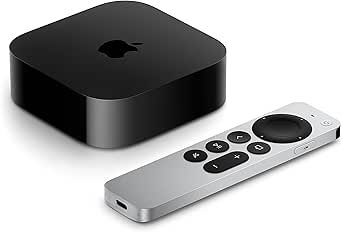 | Best Previous-Generation 4K Choice | Chip: A15 Bionic | Storage: 64GB | Video: 4K Dolby Vision, HDR10+ | VIEW LATEST PRICE | See Our Full Breakdown |
| Apple TV HD (4th Generation), 32GB, Black (Renewed) |  | Best for a 1080p Television | Model: Apple TV (4th Generation), MR912BZ/A | Condition: Renewed | Processor: Apple A8 | VIEW LATEST PRICE | See Our Full Breakdown |
| Apple TV 4K streaming device | Video | Audio | Chip | Remote |
|---|---|---|---|---|
| Apple TV 4K | 4K, Dolby Vision, HDR10+ | Dolby Atmos; Enhance Dialogue | A19 | Siri Remote with touch-enabled clickpad and Find My |
| Apple TV 4K | 4K Dolby Vision, HDR10+ | Dolby Atmos | A15 Bionic | Siri Remote with touch-enabled clickpad |
| Apple TV HD | 1080p (1920 × 1080 pixels) | Dolby Digital Plus 7.1 | — | — |
More Details on Our Top Picks
Apple TV 4K (4th Generation)
The Apple TV 4K (4th Generation) is my first choice for someone buying a current Apple streaming box and wanting the strongest combination of picture formats, updated silicon, and remote convenience in this group. Its A19 chip powers a device that supports 4K with Dolby Vision and HDR10+, and Dolby Atmos adds support for immersive audio when the rest of the system can play it. Those formats matter most to viewers with a compatible television and sound setup; they do not improve a Full HD screen or make incompatible equipment capable of HDR.
Compared with the 2022 Apple TV 4K, this model’s clearest listed advantage is not a new video format: both support Dolby Vision, HDR10+, and Dolby Atmos. Instead, the difference is in its A19 chip and Siri Remote with Find My and Precision Finding on iPhone. If a remote often disappears between sofa cushions, that feature offers a practical reason to favor this generation. The supplied details do not establish how every app or task performs on either chip, so I would treat the A19 as a newer platform, not a promise that every viewing experience will look different.
Smart home control is another part of the package, with a built-in home hub for compatible accessories. That may help a household that already uses supported smart home products, but it is not a reason to buy the box if those functions are irrelevant. There are setup dependencies: Siri personal context features require an iPhone or iPad, and the supplied information says a home theater surround sound setup requires four HomePod speakers. Those conditions make the richer audio and voice-control story less plug-and-play than the headline feature list may suggest.
Against the cheaper-in-feature-scope Apple TV HD, this is the far better fit for a 4K television because it actually outputs 4K and supports modern HDR formats. The HD device may suit an older 1080p set, but it cannot offer the picture capabilities that define this pick. I recommend this model to buyers who want an up-to-date Apple TV 4K, especially those who value the newer remote and already own compatible 4K and smart home gear. Skip it if your television is only 1080p, you do not need Find My, or the HomePod requirement conflicts with your intended surround sound setup.
Pros:- 4K output with both Dolby Vision and HDR10+ support.
- A19 chip makes it the newest-generation option in this comparison.
- Siri Remote includes Find My with Precision Finding on iPhone.
- Dolby Atmos, Enhance Dialogue, and a built-in home hub add audio and smart home options.
Cons:- Siri personal context features require setup with an iPhone or iPad.
- The described home theater surround sound setup requires four HomePod speakers.
- Its 4K and HDR advantages are wasted on a 1080p-only television.
Best for: Buyers with a 4K television who want Dolby Vision and HDR10+, the newer A19 platform, and a remote that can be located with a compatible iPhone.
Not ideal for: People using only a 1080p television, those who do not need its updated remote or smart home features, and buyers expecting a surround setup without the specified HomePod arrangement.
- Chip:A19
- Video:4K, Dolby Vision, HDR10+
- Audio:Dolby Atmos; Enhance Dialogue
- Remote:Siri Remote with touch-enabled clickpad and Find My
- Smart home:Built-in home hub
- Dimensions:3.67 x 3.67 x 1.22 inches
- Weight:7.7 ounces
- Model number:MLFF4LL/A
Our verdict“I recommend the 4th Generation Apple TV 4K as the strongest all-around choice for a compatible 4K setup, especially when the Find My remote and newer chip matter.”
Apple TV 4K (3rd Generation, 2022), Wi-Fi, 64GB
The Apple TV 4K (3rd Generation, 2022) is the sensible alternative for someone who wants the defining benefits of Apple’s 4K streamer without needing every newer feature in the 4th Generation. It supports 4K Dolby Vision, HDR10+, and Dolby Atmos, so the core picture and sound format list is closely matched to the newer model. Its A15 Bionic chip is an older generation than the A19 in the top-ranked pick, but the product details provided do not show a missing 4K or HDR format that would make it unsuitable for ordinary streaming.
The choice between these two devices is therefore more specific than “new versus old.” The 4th Generation has the A19 chip and a remote with Find My, while this 2022 model’s listed remote is a Siri Remote with a touch-enabled clickpad. If losing a remote is a recurring problem, I would pay more attention to the newer device’s locating feature. If the remote-finding capability and newest chip are not priorities, the 2022 model retains the main 4K formats and may be the more appropriate fit among the two, depending on availability and the buyer’s own constraints.
This generation has a notable smart home strength: Thread connectivity and home hub features. That can be useful for buyers with compatible accessories who want the Apple TV to play a role beyond streaming. AirPlay also supports sharing from compatible Apple devices. These capabilities depend on the relevant devices and services, so a buyer with no Apple ecosystem or Thread-compatible equipment should not treat them as automatic benefits. The supplied information also says some features depend on compatible Apple services or devices.
Compared with the Apple TV HD, the 2022 model is the clear choice for a 4K television: the HD model stops at 1080p and lacks the listed Dolby Vision and HDR10+ 4K playback. Compared with the 4th Generation, it gives up the newer A19 platform and Find My remote feature, but it still covers the central job of streaming 4K HDR video. I would choose it for a buyer who wants Apple TV 4K functionality plus Thread smart home support and does not need the newest-generation extras. Skip it if locating the remote is a deciding feature or if you want the latest listed chip generation.
Pros:- 4K playback with Dolby Vision and HDR10+ support.
- Dolby Atmos audio support for compatible home theater equipment.
- Thread connectivity and home hub features support compatible smart home accessories.
- Siri Remote has a touch-enabled clickpad, and AirPlay supports sharing from compatible devices.
Cons:- A15 Bionic is an older chip generation than the A19 in the 4th Generation model.
- The listed remote does not include the newer model’s Find My feature.
- Some smart home and Apple features depend on compatible devices or services.
Best for: Viewers who want 4K Dolby Vision and HDR10+ with Dolby Atmos, plus Thread smart home support, but do not need the newer A19 chip or Find My remote.
Not ideal for: Buyers who specifically want the newest Apple TV generation or remote location through Find My, and people who cannot use its Apple or Thread-dependent features.
- Chip:A15 Bionic
- Storage:64GB
- Video:4K Dolby Vision, HDR10+
- Audio:Dolby Atmos
- Connectivity:Wi-Fi, AirPlay, Thread
- Remote:Siri Remote with touch-enabled clickpad
- Dimensions:3.66 x 3.66 x 1.22 inches
- Model number:MN873LL/A
Our verdict“I would pick the 2022 Apple TV 4K when its 4K HDR, Dolby Atmos, and Thread features meet your needs and the newer model’s A19 and Find My remote are not priorities.”
Apple TV HD (4th Generation), 32GB, Black (Renewed)
The Apple TV HD (4th Generation), renewed, is the outlier in a roundup about Apple TV 4K devices. I include it only for buyers whose television is limited to 1080p and who want Apple TV streaming features on that existing screen. Its 1080p maximum output is the decisive limitation: unlike both 4K models above, it cannot deliver 4K resolution or the listed Dolby Vision and HDR10+ 4K playback. On a 4K television, that makes it a poor substitute for either Apple TV 4K generation.
For a Full HD setup, the feature set still has a clear purpose. The A8-powered box supports Siri voice search, AirPlay sharing, and Dolby Digital Plus 7.1 audio. It also supports private listening with up to two sets of AirPods according to the supplied product details. Those features can make it useful for a household with compatible Apple devices or headphones, but they do not change the resolution ceiling. In comparison, the 2022 Apple TV 4K offers 4K HDR and Dolby Atmos, while the newer 4th Generation adds the A19 chip and Find My remote.
The word renewed matters to the buying decision because this listing is not described as a new unit. Buyers should check the condition information and what is included with the specific listing before purchase; I would not infer unseen details about its refurbishment or accessories from the product description. The listed HDMI connection is also required to connect it to the television. That is a familiar connection for many setups, but it means the box is not a wireless display solution that can avoid HDMI entirely.
I rank this last because the title’s central promise is Apple TV 4K, and this model does not meet that capability. Still, it can be a reasonable fit where the television itself is Full HD, a buyer wants Siri and AirPlay, and 4K output is not needed. Choose either 4K model instead if you have a 4K set or plan to upgrade to one. I would also skip this option if buying a renewed device does not suit your preferences or if you want the newer smart home and HDR feature set of the two 4K boxes.
Pros:- 1080p HD video output suits a Full HD television.
- Siri voice search and AirPlay sharing are included.
- Dolby Digital Plus 7.1 audio support.
- Supports private listening with up to two sets of AirPods, according to the product details.
Cons:- Video output is limited to 1080p, unlike both Apple TV 4K models.
- Requires an HDMI connection to the television.
- The listing is for a renewed device rather than a new one.
Best for: A buyer with a 1080p television who wants Apple streaming, Siri voice search, AirPlay, and HD output rather than 4K.
Not ideal for: Anyone seeking an Apple TV 4K, using a 4K television, or wanting Dolby Vision and HDR10+ playback from the streaming box.
- Model:Apple TV (4th Generation), MR912BZ/A
- Condition:Renewed
- Processor:Apple A8
- Video:1080p (1920 × 1080 pixels)
- Audio:Dolby Digital Plus 7.1
- Storage:32GB
- Connectivity:Wireless; HDMI connector
- RAM:2GB
Our verdict“I would choose this renewed Apple TV HD only for a 1080p television; for any 4K setup, either Apple TV 4K model is a better match.”
How We Picked
I ranked these devices around the question in the title: which Apple TV is the right streaming device for a buyer looking at the Apple TV 4K family? That means 4K picture support carries significant weight, and a 1080p-only model sits below both 4K options, regardless of its usefulness for an older television. I also compared supported HDR formats, audio features, chip generation, remote controls, and smart home capabilities, since those differences affect day-to-day fit rather than serving as spec-sheet decoration.
The 4th Generation Apple TV 4K ranks first because it combines 4K, Dolby Vision, HDR10+, and Dolby Atmos with the A19 chip and a Siri Remote featuring Find My. The 2022 Apple TV 4K remains a strong second: it supports the same headline HDR formats and Dolby Atmos, while adding Thread and hub functionality. Its older A15 chip and lack of the described Find My remote feature make it less current, but do not erase its core 4K strengths.
I placed the renewed Apple TV HD third because the product brief specifies 1080p output, not 4K. Its Siri voice search, AirPlay, and Dolby Digital Plus 7.1 can still suit a Full HD setup, but buyers seeking an Apple TV 4K should not mistake it for one. I have not assumed that a listed feature guarantees support across every app, television, receiver, or smart home accessory; compatibility and setup requirements can shape what works in a particular home.
My ranking does not rely on prices, ratings, or claims of hands-on testing. It reflects the supplied product specifications and the benefits those features offer to different types of buyers. In particular, I distinguish between a device’s maximum video capability and the hardware already in the buyer’s system: a 4K streamer makes less sense on a Full HD television, while a 1080p box limits a 4K television to HD output.
| Apple TV 4K streaming device | Chip | Audio | Remote | Model number |
|---|---|---|---|---|
| Apple TV 4K | A19 | Dolby Atmos; Enhance Dialogue | Siri Remote with touch-enabled clickpad and Find My | MLFF4LL/A |
| Apple TV 4K | A15 Bionic | Dolby Atmos | Siri Remote with touch-enabled clickpad | MN873LL/A |
| Apple TV HD | — | Dolby Digital Plus 7.1 | — | — |
Factors to Consider When Choosing Best Apple TV 4K Streaming Devices
I would start with the television and work outward. The biggest divide in this lineup is not subtle: two boxes output 4K with Dolby Vision and HDR10+, while the renewed Apple TV HD tops out at 1080p. After that, compare remote needs, home theater equipment, and smart home compatibility. Those questions help separate the 4th Generation from the 2022 4K model more usefully than treating either chip name as a guarantee of a visible difference in every app.
Match the streamer to your television
If you own a 4K television, I would focus on one of the two Apple TV 4K models. Both listed 4K devices support Dolby Vision and HDR10+, which gives compatible displays access to those HDR formats when the content and app also support them. A television’s specifications and settings still matter; the box cannot make a non-HDR display reproduce HDR. The Apple TV HD, by contrast, outputs 1080p and is not an appropriate pick if getting 4K playback is a requirement.
For a Full HD television that you intend to keep, the HD model can make sense if you specifically want Apple’s streaming and sharing features. Its resolution ceiling may be unimportant on that screen. If an upgrade to 4K is likely, though, choosing a 4K device now avoids making the streamer the limiting part of the setup later. I would base that choice on your actual display and upgrade plans, not on the HD model’s name or generation label.
Decide whether newer hardware or core 4K support matters more
The 4th Generation model carries an A19 chip, while the 2022 Apple TV 4K uses an A15 Bionic. The provided specifications do not describe a guaranteed difference in streaming speed, picture quality, or app behavior, so I would not claim that one will visibly outperform the other in every use. The more concrete reasons to favor the newer model are its newer chip generation and the Siri Remote’s Find My feature.
If those points matter, the 4th Generation leads this ranking. If they do not, the 2022 model still includes the main 4K HDR formats and Dolby Atmos. That makes it a better value-minded choice by feature fit, without relying on any price comparison. I would choose based on the capabilities you can use rather than assuming the newest model is automatically the right one for every household.
Check your audio equipment before choosing
Both 4K models list Dolby Atmos, while the HD model lists Dolby Digital Plus 7.1. Audio format support is useful only when the streaming content, connection path, and sound equipment can handle it. Check your television, receiver, soundbar, and speaker setup before treating a format label as a guaranteed upgrade. A device can support an audio format while a particular chain of equipment or app does not deliver it as expected.
The 4th Generation product details add an unusual qualification: its home theater surround sound setup requires four HomePod speakers. Buyers who plan to use that specific arrangement should account for the requirement rather than assuming a different speaker configuration will provide the same setup. The HD model’s Dolby Digital Plus 7.1 support may be enough for a compatible existing system, but it does not bring the listed Dolby Atmos capability of either 4K pick.
Pick the remote and voice features you will actually use
The 4th Generation’s Find My-enabled Siri Remote is the most distinct day-to-day convenience difference in this group. Its supplied description includes Precision Finding on iPhone, which may appeal to a household where the remote is often misplaced. The 2022 model also includes a Siri Remote with a touch-enabled clickpad, but the listed details do not give it the same Find My feature. The HD model supports Siri voice search and voice control, but it is an older device and does not offer the described remote-finding benefit.
Voice features also have setup and compatibility limits. The 4th Generation’s personal context features require setup with an iPhone or iPad, and some features on the 2022 model depend on compatible Apple services or devices. If you mainly select apps with the remote and do not use Siri, these differences may not matter much. I would give them more weight if your household already relies on Apple devices and expects voice control to be part of its routine.
Treat smart home support as a compatibility question
The 4th Generation is described as having a built-in home hub; the 2022 model specifically lists Thread connectivity and home hub features. These functions can make either 4K box more useful to someone managing compatible accessories, but they are not interchangeable promises that every device will connect. Before buying for smart home use, check whether your accessories and preferred services support the relevant technology and whether setup requires additional equipment.
If smart home control is not part of your plan, it should not decide the purchase. In that case, compare the 4K picture formats, remote features, and audio setup instead. If Thread is central to your home, the 2022 model’s explicitly listed Thread connectivity deserves attention; if you want the newest overall Apple TV 4K package and remote location, the 4th Generation has the stronger case.
Be clear about buying a renewed HD model
The Apple TV HD in this comparison is marked renewed, unlike the two 4K products described here. That status is relevant to buyers who prefer a new device or want to review the condition and included items for a particular listing. I would check those details rather than infer a refurbishment process or assume accessories that are not specified. Its HDMI connection is required, and its 1080p limit remains the more important question for anyone considering it beside a 4K television.
For a buyer who already has a Full HD set and values Siri, AirPlay, or private listening with compatible AirPods, the HD device has a defined role. For everyone seeking 4K output, it is the wrong category of device even if it shares the Apple TV name. That distinction is why I rank it behind both 4K boxes rather than presenting the three models as equivalent alternatives.
Frequently Asked Questions
Which Apple TV 4K model is the best overall choice here?
I rank the Apple TV 4K (4th Generation) first because it pairs 4K Dolby Vision and HDR10+ with the A19 chip, Dolby Atmos, a built-in home hub, and a Siri Remote with Find My. The 2022 model remains a strong alternative with the same listed 4K HDR formats and Dolby Atmos, so buyers who do not need the newer chip or remote-finding feature can reasonably choose that one instead.
Is the Apple TV HD a 4K streaming device?
No. The renewed Apple TV HD listed here outputs 1080p Full HD, not 4K. It may suit a 1080p television and offers Siri voice search and AirPlay, but anyone who wants 4K playback should choose one of the two Apple TV 4K models. The HD model cannot gain 4K capability through a settings change or a different television.
What is the main difference between the 4th Generation and 2022 Apple TV 4K?
Both listed devices support 4K, Dolby Vision, HDR10+, and Dolby Atmos. The 4th Generation has the A19 chip and a Siri Remote with Find My, while the 2022 model has an A15 Bionic chip and explicitly lists Thread connectivity. I would favor the newer model for its updated platform and remote-finding feature, and the 2022 model when its core 4K features and Thread support better match what you need.
Do I need special speakers to use Dolby Atmos?
Dolby Atmos support on the Apple TV does not by itself mean that every speaker setup will play Atmos. Your content, app, television, receiver, soundbar, and speaker configuration all affect what you hear. The 4th Generation’s supplied product details state that its home theater surround sound setup requires four HomePod speakers, so I would check that specific requirement before planning to use that arrangement.
Should I buy the renewed Apple TV HD for a 4K television?
I would not choose it if your goal is to watch in 4K. The HD model is limited to 1080p, while both Apple TV 4K options support 4K Dolby Vision and HDR10+. It can still be used with a television that accepts an HDMI input, but the output remains HD; choose one of the 4K models if you want the streamer to provide 4K playback on your 4K screen.
Conclusion
For most buyers with a compatible 4K television, I recommend the Apple TV 4K (4th Generation): it has the newest chip in this group and adds Find My to the Siri Remote while retaining Dolby Vision, HDR10+, and Dolby Atmos support. Choose the 2022 Apple TV 4K if you want the core 4K formats and Dolby Atmos, value its listed Thread support, and do not need the newer model’s remote-finding feature. It remains a clearly stronger match than the HD model for a 4K screen.
If your television is Full HD and you do not need 4K output, the renewed Apple TV HD can suit your setup with Siri, AirPlay, and Dolby Digital Plus 7.1. I would skip it for a 4K television or a planned 4K upgrade, since its 1080p ceiling is the defining compromise. The right choice is the one that matches your screen and compatible equipment, not simply the model with the newest generation name.