TL;DR

Get the latest gadgets delivered free with Prime
- Fast, free delivery on millions of items
- Prime Video, Amazon Music and more included
- Member-only deals all year
Anton Frolov commissioned an illustrator to depict his home and turned the artwork into an interactive Home Assistant dashboard. The project uses layered images and device-state displays to make controls more appealing to his household, though the source report does not give cost, completion time or evidence of wider adoption.
Anton Frolov commissioned an illustrator to draw his home and used the artwork as the basis for an interactive Home Assistant dashboard, where lights, air conditioning and other device states appear on a picture of the house. In his report, Frolov said the family-friendly interface addressed a practical problem: other members of his household did not want to use the dashboard he had built previously.
Frolov said he had spent about a year automating his home with Home Assistant, an open-source smart-home platform. Some routines already ran automatically, including turning off air conditioners when everyone left and adjusting the garden sprinkler’s run time according to the weather. But garden lights still needed app-based control, and a timer he had set up switched them off after a period unless someone extended it.
He considered a physical switch but said it would not address the timer and would be inconvenient for some tasks, such as starting a sprinkler and then leaving its controls. Instead, he decided to make a dashboard that would be easier for the household to use. After considering floor-plan interfaces, including 3D and pixel-art designs, he hired an environment artist whose existing work suited the project.
Frolov provided the illustrator with a house plan, room photographs, visual references, examples of dashboards and a technical brief. He requested transparent image files, day and night versions, and separate device layers with off-state images and short on-state animations. The components were to share a canvas and remain aligned to their locations in the house. Frolov said that specification reduced the later work of positioning assets.
A Dashboard Built Around the Home
The project shows one way to address a familiar smart-home usability gap: automation does not remove every need for manual controls, and an interface that works for its builder may not work for everyone in the household. Frolov said his previous dashboard had not persuaded other family members to use it, while the illustrated version was one the family enjoyed using. That is his account of the household’s experience, not a measured usability study.
It also shifts much of the design effort from interface code to commissioned artwork. Frolov said the illustration was the main work, while the Home Assistant setup used a standard picture-elements card to place changing images, icons and status labels over a background. The approach may appeal to users willing to commission bespoke art and prepare detailed asset requirements, but the report does not establish that it is suitable for every home or budget.
As an affiliate, we earn on qualifying purchases.
From Automation to Manual Controls
Frolov described a home that already handled several tasks automatically, but still depended on people to manage devices in certain situations. The garden lights made that tension clear: they were controlled through an app, and his timer could switch them off unless someone extended the run time. The existing interface was a barrier for other household members, according to his report.
His search for a visual alternative included floor-plan dashboards. He found examples using 3D models and pixel art, but preferred to commission an artist whose style suited the rooms. He supplied photographs and plans so the illustration could reflect the actual home, alongside technical instructions intended to make the files usable as dashboard layers.
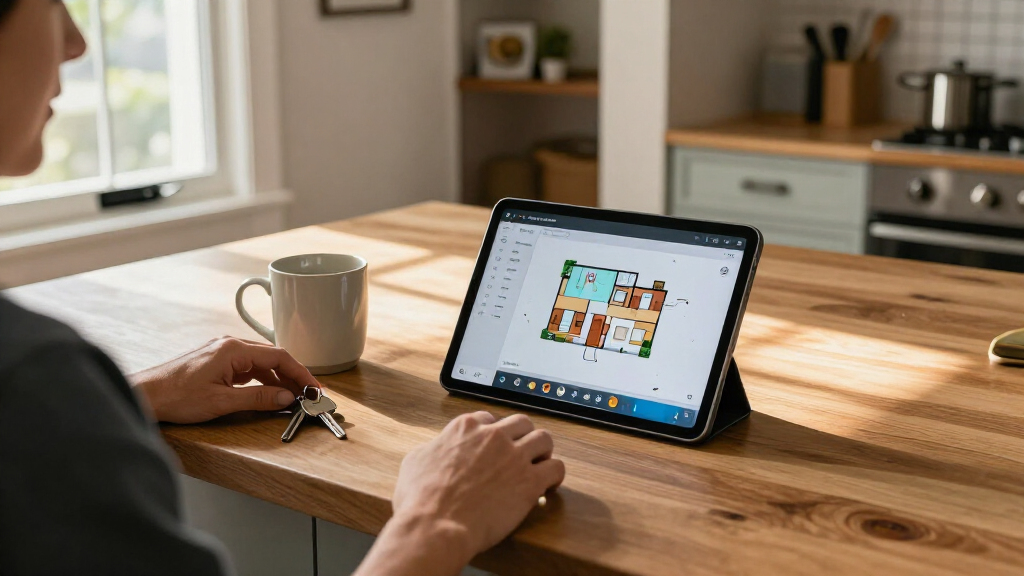
In the implementation described in the supplied portion of the report, the house illustration serves as the background of Home Assistant’s picture-elements card. Separate image elements represent devices, while icons and text show information. Frolov says the elements can display different images according to device state, allowing an off-state still image to change to an animation when a device is on.
interactive home assistant display
As an affiliate, we earn on qualifying purchases.
As an affiliate, we earn on qualifying purchases.
Costs and Results Not Reported
The supplied source material does not state what the illustration cost, how long the commission took, or how much time the dashboard build required. It also does not include a quantified comparison of household use before and after the redesign, so the reported improvement is Frolov’s personal account rather than a measured result.
The available excerpt ends while describing how the image element changes according to device state. It does not provide the full configuration, the complete set of interface details, or information about maintenance and compatibility over time. The report also does not say whether the artist’s work or the dashboard files have been published for others to reuse.
As an affiliate, we earn on qualifying purchases.
How the Interface Is Assembled
Frolov’s report points readers toward the technical implementation: a picture-elements card uses the house illustration as its background, with images, icons and state labels layered on top. He describes using state-based images and conditional elements to reflect device status. The supplied material does not identify a later release, update or public project milestone, so no further development is confirmed.
For anyone considering a similar setup, the reported next step is preparation rather than coding: define the artwork’s layers, day and night states, file formats and shared canvas before the illustration is produced. Frolov also said he converted sprite-sheet frames to animated WebP himself and suggested requesting WebP animations from the artist at the outset. Those points reflect his experience with this project, not a universal requirement for Home Assistant dashboards.
As an affiliate, we earn on qualifying purchases.
Key Questions
What did Anton Frolov build?
He commissioned an illustration of his home and used it as the background for an interactive Home Assistant dashboard, placing device images and status information over the artwork.
Why did he commission an illustrator?
Frolov said other members of his household did not want to use his earlier dashboard. He hoped a more appealing visual interface would make manual controls easier for the family to use.
How does the illustrated dashboard show device states?
In the supplied account, the illustration is used with Home Assistant’s picture-elements card. Images, icons and labels sit over the background, and device images can change according to a device’s state.
What did Frolov ask the artist to deliver?
He requested transparent images, day and night versions, separate layers for devices, and still and animated states. He also asked for each asset to use the same canvas size and positioning so the pieces would align when assembled.
How much did the project cost?
The supplied report does not state the commission’s price or give a total project cost.
Source: hn
Halloween Picks
halloween
As an affiliate, we earn on qualifying purchases.