
TL;DR

Get the latest gadgets delivered free with Prime
- Fast, free delivery on millions of items
- Prime Video, Amazon Music and more included
- Member-only deals all year
Threlmark’s local-first architecture relies on local disk storage as the main data source, enabling offline use, easy sync, and data ownership. It simplifies development and boosts resilience by avoiding central servers and making files the contract.
Imagine working on a project, offline, on your laptop. When you get back online, everything syncs seamlessly, as if magic. That’s the power of Threlmark’s local-first architecture — a radical shift from the cloud-centric model most apps follow.
Instead of relying on a central server, it treats your device’s disk as the single source of truth. This simple idea unlocks a wave of benefits: offline resilience, privacy, and developer simplicity. Today, I’ll walk you through how it works, why it’s a game-changer, and what makes it tick.
Disk is the contract: inside a local-first roadmap hub
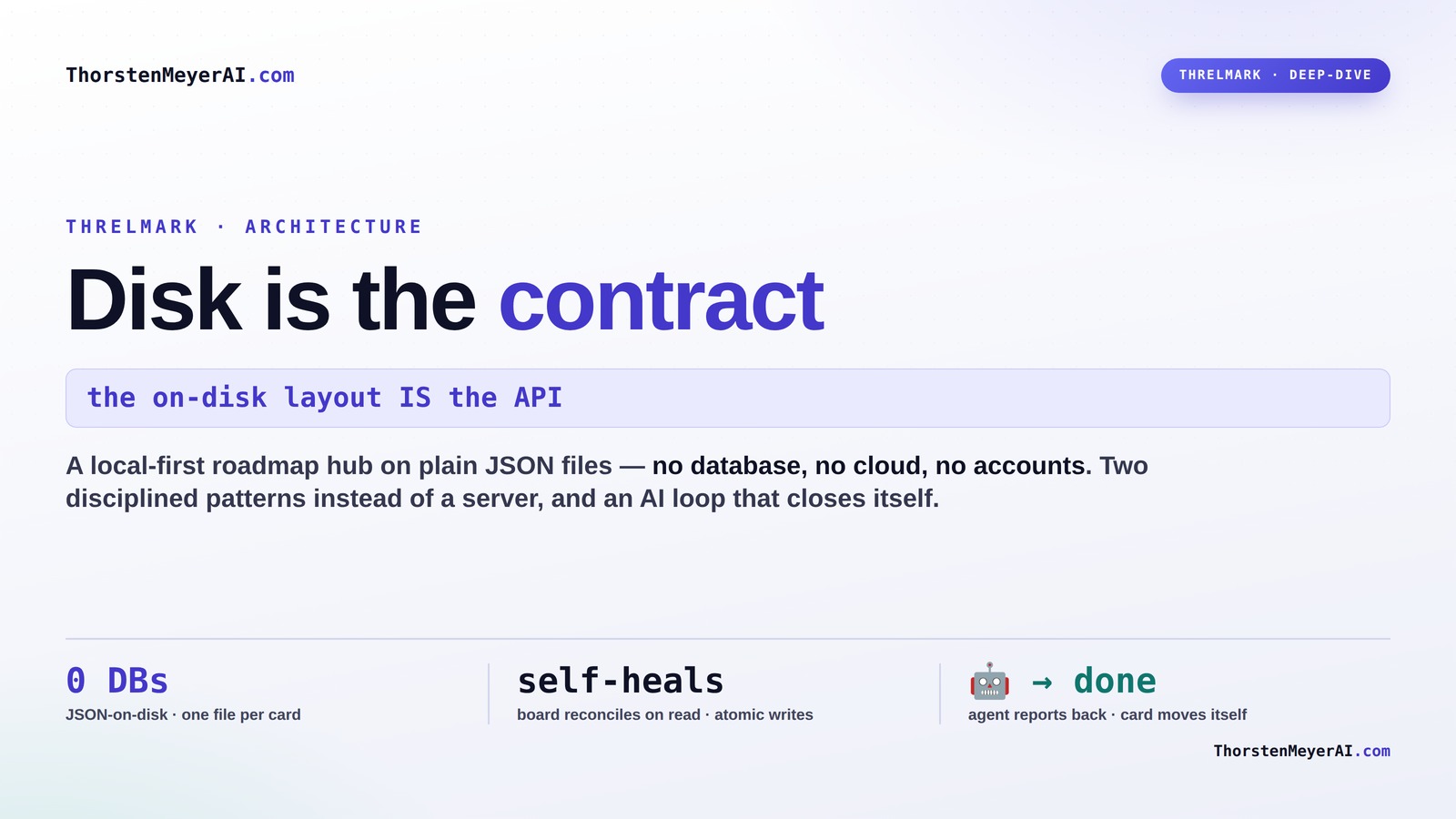
A Next.js app on top of plain JSON files — no database, no cloud, no accounts. The key decision: the on-disk layout IS the API. Everything else cascades from taking that seriously.
There is no server-of-record — the files are the record
The UI and any external tool reach the same files through the same discipline. The data root defaults to ~/.threlmark — home-based, because it’s a shared hub every one of your apps points at.
Inspectable
Every artifact is a file you can cat, diff, grep, commit.
Portable · no lock-in
Back up with cp, sync with Dropbox / git, migrate trivially.
Interoperable
Any tool in any language joins by reading / writing files.
Restartable
No in-memory state to lose — stateless over the files.
Two disciplined patterns instead of a database
“Just use files” is easy to get wrong. These two patterns — ported from a battle-tested sibling app — are what make file-based state sound rather than reckless.
Atomic writes
Write to a temp file in the same dir, then rename() over the target. Rename is atomic on one filesystem — a crash mid-write leaves the complete old file or the complete new one, never a half.
The board heals itself
A single roadmap.json array races when two tools write at once. One file per card makes writes collision-free. Lane order lives in board.json and reconciles on read.
board.json. It writes an item file — the board fixes itself on Threlmark’s next read. Unknown keys are preserved, so the contract is forward-compatible.The numbers can’t drift from the files
Anything computable from item state is computed — so the displayed numbers can never disagree with the underlying JSON. Priority is the clearest example: it’s calculated on read, never persisted.
priority — computed on read
Impact weighted heaviest; effort the only axis that subtracts. Reused verbatim from the original tool, so imported cards rank identically.
A handoff is a first-class flow event
The genuinely 2026-shaped part: most building is done by AI agents, so Threlmark closes the loop. Watch a card go from ranked to Done without anyone dragging it.
Handoff → report → self-move
The brief carries a reporting protocol. The agent reports through REST or the filesystem — and a done report moves the card itself.
POST /api/projects/:id/
items/:itemId/report
Direct call. Applied immediately.
drop reports/<file>.json
→ ingested on read
Robust even if the server’s down at finish time.
A small formula, and an honest hosting caveat
Because items are globally addressable (<projectId>/<itemId>), the Portfolio ranks everything together by a status-weighted score — finishing beats starting, blockers get a boost.
Portfolio ranking — status-weighted
In-flight work floats to the top; bottlenecks cost the most, so blockers get nudged up.
Static read-only demo
Seeded data, writes to localStorage. Try-before-you-clone.
Personal Node instance
Password-gated, persistent backed-up THRELMARK_DATA_DIR.
Multi-tenant SaaS
Add accounts + per-tenant isolation. A separate build.
src/lib/*/store.ts is the natural seam — the same boundary that keeps the local tool simple is the one you’d extend for multi-tenancy. The architecture doesn’t fight that future; it just doesn’t pay for it until you need it.
Key Takeaways
- Treat your device’s disk as the ultimate source of truth, making data resilient and portable.
- Use atomic file writes and tolerant merging to keep data safe during crashes and updates.
- Design your app’s architecture around a simple, predictable file structure for transparency and ease.
- Conflict resolution strategies like CRDTs are essential for multi-device sync, even offline.
- Building with files reduces backend complexity and boosts privacy, control, and longevity.
Products Worth Considering

Bose SoundLink Flex Bluetooth Speaker (2nd Gen), Portable Waterproof Speaker, Black

Jackery Explorer 300 Portable Power Station, 292Wh

Logitech MX Master 4 for Mac, Ergonomic Bluetooth Mouse with Haptic Feedback, Ultra-Fast Scrolling, USB-C Charging, for MacOS, iPadOS, Windo
As an affiliate, we earn on qualifying purchases.
What Does ‘Disk Is the Contract’ Really Mean?
At its core, ‘disk is the contract’ means your device’s storage holds the definitive version of your data. Unlike traditional apps that keep data in the cloud, this system treats local files as the source of truth. When you open Threlmark, it reads from your disk directly, and all changes happen there first.
For example, if you’re working on a task list, the data lives in JSON files on your machine. When you mark something as done, it writes directly to that file. No server needed. That file is the record everyone trusts — not a remote database or API.
This approach flips the usual model — instead of pushing data to a server and pulling it back, the device’s storage becomes the main hub, and sync happens in the background.

How Threlmark’s Local-First Design Outshines Cloud Apps
Traditional cloud apps rely on servers to store and manage data. Your device acts as a thin client, constantly syncing with the cloud. Threlmark, however, puts the disk front and center. Your device’s local files are always up-to-date and authoritative.
Take a real-world scenario: you’re on a plane with no internet. You add a new card to your project. Threlmark writes it instantly to your disk, no lag, no fuss. When you land and reconnect, it syncs with the cloud—automatically and smoothly.
Here’s a quick comparison:
The Mechanics of Sync and Conflict Resolution
Syncing in Threlmark is like a gentle dance—background, automatic, and conflict-aware. The core idea: each device maintains its own set of JSON files. When connected, they reconcile changes using deterministic merge rules.
If two devices edit the same card offline, the system uses conflict-resolution strategies like last-write-wins or CRDTs to merge differences. It’s like two chefs adding ingredients separately—when they come together, the dish still tastes right.
For example, if one device marks a card as ‘done’ and another changes its priority, the system intelligently merges these updates, ensuring all devices converge on the same state without data loss.

Benefits for You and Your Development Team
Using disk as the contract isn’t just a fancy tech trick — it offers real benefits. For users, it means offline access, better privacy, and control over data. For developers, it simplifies the backend, reduces server costs, and makes the app more resilient.
Imagine a team collaborating on a shared project. Each member’s device keeps a local copy. Changes are merged seamlessly, even if someone’s offline for days. When back online, everything syncs without conflict.
It also means fewer surprises: data persists even if the company behind the app vanishes. Your files stay on your device, always accessible.
Building with Files: The Secrets Behind Threlmark’s Architecture
Threlmark organizes data into a simple, predictable file structure. At the root, you find a manifest (`threlmark.json`) and dependency graph (`links.json`). Each project has its folder with metadata, lanes, and a file per card under `items/`. External suggestions land in `suggestions/`, and reports go into `reports/`.
This setup makes it easy to inspect, migrate, or sync data. For instance, if you want to back up your roadmap, just copy the entire folder. Want to add a new project? Drop a new folder with a `project.json`. All files are human-readable and editable, making the system transparent and resilient.

Ensuring Safety with Atomic Writes and Tolerant Merging
Writing to files safely is crucial. Threlmark uses atomic writes — writing to a temp file then renaming — avoiding corruption during crashes. It also reads, merges, and writes back data carefully, preserving important fields and tolerating unknown keys.
For example, if a crash happens mid-write, your data stays consistent. The system’s merge logic means you can add new fields or change existing ones without breaking older tools.
This disciplined approach guarantees your data remains reliable, even in unexpected situations.
Why This Approach Simplifies Developer Life
Building with files rather than a database sounds simple — and it is. You can learn more about this approach at nanomachines.net. It removes the need for complex server-side logic, reduces backend costs, and makes your app more flexible.
Developers can focus on the core features, knowing that the data is portable and easily mergeable. Plus, debugging becomes easier — just inspect the JSON files.
For example, you can host the entire app on a static host and still have real-time sync, simply by watching files and running background sync tasks. Check out tools for QA and testing to help with development.

Common Misconceptions and Real-World Trade-Offs
Some think local-first apps can’t handle real-time collaboration or large datasets. But with conflict-resolution strategies like CRDTs and optimized sync, they can. Still, trade-offs exist.
For instance, conflict resolution adds complexity, and large files can slow down sync. Also, some apps might need server-side logic for compliance or heavy data processing.
Threlmark’s approach is best suited for small to medium projects, where offline use and data ownership matter most.
Getting Started: Tools and Patterns for Local-First Development
If you’re inspired to build or upgrade your app with local-first principles, start with these tools:
- File-based storage with atomic write techniques.
- Conflict resolution strategies like CRDTs or deterministic merges.
- Background sync scripts that run when online.
- Version control or diff tools for human-readable data.
- Use a library like Threlmark for structuring your local-first app.ed file management.
Follow a pattern: local database + background sync + conflict resolution. This combo is the backbone of resilient, offline-capable apps.
Frequently Asked Questions
What does ‘local-first’ actually mean?
Local-first means your device’s storage is the primary source of data, with sync happening in the background. It prioritizes offline access, data ownership, and resilience over relying on remote servers.How is local-first different from offline-first or cloud-first?
Offline-first apps can work without internet, but still rely on a cloud for sync. Cloud-first apps depend on remote servers for everything. Local-first treats disk as the source of truth, with optional sync, making it more resilient and private.How do devices sync changes when offline?
Devices keep local copies and use conflict resolution strategies like CRDTs or deterministic merge rules. When reconnected, they reconcile differences automatically, ensuring everyone sees the same data.Is local-first secure and private?
Yes. Data stays on your device unless you choose to sync or share. End-to-end encryption can be added, and the system reduces reliance on third-party servers, boosting privacy.Can local-first support real-time collaboration?
It can, with conflict-resolution mechanisms. While not as instant as cloud-based systems, well-designed local-first apps can offer near-real-time sync, especially for small to medium projects.Conclusion
Embracing the idea that disk is the contract turns your device into the ultimate data hub. It’s a clear, simple principle that unlocks offline resilience, privacy, and developer freedom. When you treat files as the source of truth, you build apps that are more robust, portable, and respectful of user ownership.
Imagine a future where your data stays with you, no matter what happens to cloud services. That’s the promise of Threlmark’s local-first architecture — a quiet revolution in how we build and use software.