Choosing the best large-screen TVs requires balancing brightness, contrast, and smart features against your specific viewing environment. The Samsung 85-Inch Neo QLED QN70F stands out as the best overall pick for most buyers, offering excellent upscaling and brightness without the extreme price tag of OLED. For those prioritizing perfect blacks and cinematic contrast, the LG C6H Series 83-Inch 4K OLED evo is the premium choice, while the TCL 85 Inch QM6K delivers exceptional value for budget-conscious shoppers. The main tradeoff in this category is between panel technology and size: OLED offers superior image quality but caps out around 83-97 inches at high costs, whereas Mini LED allows for massive 98-100 inch screens at more accessible prices. Continue reading to see how these models compare in brightness, gaming performance, and value.
Complete the kit




Get the latest gadgets delivered free with Prime
- Fast, free delivery on millions of items
- Prime Video, Amazon Music and more included
- Member-only deals all year
Key Takeaways
- Mini LED technology has effectively bridged the gap between LED and OLED for large screens, offering 90% of the contrast at a fraction of the cost.
- Screen size dictates room requirements: 98-inch and 100-inch panels require significant viewing distance (10+ feet) to avoid pixelation and eye strain.
- OLED remains the only technology with true infinite contrast, making it superior for dark-room cinema but less ideal for bright, sunlit living rooms.
- Refresh rate matters more for large screens than small ones; 120Hz or 144Hz panels significantly reduce motion blur on fast-moving content across wide angles.
- Budget options like Insignia and Hisense now include advanced smart OS features (Fire TV, Google TV) that were previously exclusive to premium brands.


| large-screen TV | Screen size | Display technology | Resolution | Refresh rate |
|---|---|---|---|---|
| Samsung 85-Inch Neo QLED QN70F | — | — | — | — |
| LG C6H Series 83-Inch 4K OLED | — | — | — | — |
| TCL 85 Inch QM6K Series QLED M | — | — | — | — |
| Hisense 85-inch U6 Pro Mini-LE | — | — | — | — |
| Samsung 83-Inch 4K OLED Smart | — | — | — | — |
| TCL 98-Inch Q65 QLED 4K UHD Sm | 98 inches | QLED | 4K UHD | — |
| Samsung 83-Inch S90D OLED 4K S | 83 inches | OLED with pixel-level dimming | 4K | 120 Hz |
| Hisense 85-Inch E7 Cinema Seri | 85 inches | Hi-QLED LCD with quantum dots and Mini-LED | 4K UHD | 144 Hz |
| Sony BRAVIA 3 II 85-Inch 4K HD | 85 inches | LED | 4K | 120 Hz |
| Samsung U9000H Series 98-Inch | 98 inches | — | — | Up to 144 Hz with compatible PC games |
| Insignia 85-Inch F50 Series 4K | 85 inches | LED-backlit LCD | 4K UHD | 60 Hz |
| LG 100QNED84BU 100-Inch 4K Min | 100 inches | Mini LED | 4K | 120 Hz |
| Samsung 65-Inch M70H Series 4K | 65 inches | Mini LED | 4K | 60Hz (DLG to 120Hz) |
| LG 100 Inch Class QNED 4K Smar | 100 inches | QNED evo AI Mini LED | 4K | 120 Hz |
| Insignia 75-Inch QF Series QLE | 75 inches | QLED | 4K UHD | 60 Hz |
More Details on Our Top Picks
Samsung 85-Inch Neo QLED QN70F 4K Smart TV (2025)
The 85-inch screen and Mini LED backlight make this a strong all-around large-screen choice for rooms where ambient light and fast gaming both matter. Samsung lists brightness up to 2,000 nits, while its 4K panel supports VRR gaming up to 144Hz with compatible PC hardware. That combination gives it a broader bright-room and gaming focus than the 83-inch Samsung OLED, which prioritizes self-lit-pixel contrast instead. The NQ4 AI Gen2 processor can upscale lower-resolution sources, though the result depends on the original material rather than turning every stream into native 4K. Its tradeoffs are a 120Hz listed refresh rate, with 144Hz reserved for supported PC use, and HDR10+ support without Dolby Vision. I’d choose it for versatility, not for buyers whose main priority is OLED-style blacks.
Pros:- 85-inch 4K screen with Mini LED backlighting
- Listed brightness of up to 2,000 nits suits brighter rooms
- VRR gaming support up to 4K at 144Hz with compatible PC hardware
- Built-in Alexa and Samsung smart TV platform
Cons:- 144Hz gaming depends on compatible PC hardware and supported games
- Supports HDR10+ but does not list Dolby Vision
- Samsung smart services require an account and internet connection
Best for: Viewers setting up an 85-inch TV in a bright living room who also connect a compatible gaming PC.
Not ideal for: Movie fans who want OLED’s pixel-level blacks or viewers whose must-have HDR format is Dolby Vision.
Our verdict“Choose this Samsung for a bright-room 85-inch setup that needs both Mini LED picture punch and high-refresh PC gaming.”
LG C6H Series 83-Inch 4K OLED evo AI Smart TV Bundle
The 83-inch OLED evo panel is the main reason to pick this LG: its self-lit pixels can switch off individually, giving dark movie scenes deeper blacks than the 85-inch Samsung QN70F’s Mini LED backlight. Support for Dolby Vision and Dolby Atmos also makes it the more cinema-focused option among those two, while AI picture and sound processing can tailor playback across different sources. Gaming is a strength too, with HDMI 2.1, VRR, G-SYNC compatibility, FreeSync Premium, and refresh rates up to 144Hz. The screen is slightly smaller than the 85-inch alternatives, and OLED’s appeal is less about maximum listed brightness than the QN70F’s stated 2,000-nit capability. The included HDMI cable, streaming bundle, and extended warranty are useful extras, but some features rely on compatible devices or services.
Pros:- OLED evo pixels deliver pixel-level blacks and high contrast
- Supports Dolby Vision and Dolby Atmos
- Gaming features include HDMI 2.1, VRR, G-SYNC compatibility, and FreeSync Premium
- Includes an HDMI cable, streaming bundle, and 24-month CPS warranty
Cons:- 83-inch screen is smaller than the 85-inch models in this batch
- Some gaming and smart-home features require compatible devices or services
- Bundle extras do not change the core screen-size tradeoff
Best for: Movie enthusiasts and console or PC gamers who want a large OLED screen, Dolby Vision, and high-refresh gaming features.
Not ideal for: Buyers prioritizing the largest possible screen or those who mainly watch in a very bright space and favor the Samsung QN70F’s listed high brightness.
Our verdict“Pick the LG if cinema-focused OLED contrast, Dolby Vision, and flexible gaming matter more than an 85-inch screen.”
TCL 85 Inch QM6K Series QLED Mini LED 4K HDR Smart Google TV, 85QM6K, 144Hz
This TCL stands out for pairing an 85-inch QD-Mini LED display with a native 144Hz refresh rate, making it a natural fit for live sports and fast-moving games. Its HDR support is unusually broad for this group: Dolby Vision, HDR10+, HDR10, and HLG are listed, unlike the Samsung QN70F, which lists HDR10+ but not Dolby Vision. The Google TV platform and built-in ONKYO 2.1 audio system with subwoofer add practical appeal for streaming and everyday viewing. TCL also promotes Halo Control and precise dimming to manage blooming, but the supplied specifications do not quantify brightness or a conventional contrast ratio, so I wouldn’t rank it above the Samsung on measured brightness claims. Its strong motion feature set is appealing, though the many gaming-rate labels can be confusing and depend on the source and setup.
Pros:- 85-inch 4K QD-Mini LED and QLED display
- Native 144Hz refresh rate for fast-moving content
- Supports Dolby Vision, HDR10+, HDR10, and HLG
- Google TV with an ONKYO 2.1 speaker system and built-in subwoofer
Cons:- Brightness and contrast are not stated as specific measurable figures in the supplied specs
- Gaming-rate claims vary by feature and compatible setup
- Mini LED local dimming can’t provide the pixel-level control of the LG OLED
Best for: Sports fans and gamers seeking an 85-inch Mini LED TV with native 144Hz motion and support for several HDR formats.
Not ideal for: Buyers who want clearly documented brightness and contrast figures or prefer OLED’s pixel-level black control, as on the LG C6H.
Our verdict“Choose the TCL for an 85-inch sports-and-gaming setup that values native 144Hz motion and broad HDR format support.”
Hisense 85-inch U6 Pro Mini-LED 4K UHD Smart Fire TV
The anti-reflection, glare-reducing screen gives this 85-inch Hisense a distinct role for rooms with windows or overhead lighting. Its Mini LED local dimming and Hi-QLED color provide a different balance from the 83-inch LG C6H OLED: the Hisense emphasizes a large, bright-room-friendly LCD design, while the LG is the choice for pixel-level blacks and Dolby Vision. Hisense also lists a native 144Hz refresh rate, broad HDR support including Dolby Vision IQ and HDR10+, Fire TV, and Alexa voice control. A built-in subwoofer and Dolby Atmos support add audio features without requiring an immediate separate speaker purchase. The tradeoff is that the available details don’t specify HDMI port types or counts, which makes checking console and soundbar connectivity before buying especially sensible. Its 85-inch footprint also calls for substantial wall or stand space.
Pros:- 85-inch 4K display with Mini LED local dimming and Hi-QLED color
- Anti-reflection screen is designed to reduce glare
- Native 144Hz refresh rate and Motion Rate 480
- Fire TV, Alexa voice control, Dolby Vision IQ, and built-in subwoofer
Cons:- Supplied product details do not specify HDMI port count or types
- Large 85-inch screen requires ample room and installation space
- LCD local dimming does not offer OLED’s pixel-by-pixel black control
Best for: Households watching sports, streaming, or gaming on an 85-inch screen in a room where glare is a recurring issue.
Not ideal for: OLED-focused movie viewers seeking self-lit pixel contrast, or buyers who need confirmed HDMI port details before choosing a TV.
Our verdict“Pick the Hisense for an 85-inch Mini LED TV in a glare-prone room, but verify connectivity if you have several devices.”
Samsung 83-Inch 4K OLED Smart TV with Dolby Atmos and Screen Cleaner Kit
This 83-inch Samsung OLED suits buyers who want self-lit-pixel contrast alongside a strong gaming feature set. Its 120Hz refresh rate, Motion Xcelerator, G-SYNC, and FreeSync Premium support make it a compelling alternative to the 85-inch TCL QM6K, which lists a higher native 144Hz refresh rate and broader HDR format coverage. Samsung’s NQ4 AI Gen2 processor is designed to refine picture detail, motion, and color, and Tizen provides the smart TV platform. The key compromise is format support: the listed HDR formats are HDR10+ and HLG, while the LG C6H adds Dolby Vision. At 83 inches, it also gives up a little screen size to the 85-inch LCD options. The bundled cleaner and five-year protection plan may appeal to buyers seeking added coverage, but they don’t alter those picture and format differences.
Pros:- 83-inch OLED panel with self-lit pixels for deep blacks
- 120Hz refresh rate with Motion Xcelerator
- NVIDIA G-SYNC and AMD FreeSync Premium support
- Includes a 200 ml screen cleaner and five-year Amber Protection plan
Cons:- HDR formats listed are HDR10+ and HLG, not Dolby Vision
- 120Hz listed refresh rate is below the TCL QM6K’s native 144Hz
- 83-inch screen is smaller than the 85-inch options in this batch
Best for: Samsung ecosystem users who want a large OLED for films and smooth 120Hz console or PC gaming.
Not ideal for: Buyers who require Dolby Vision or want the highest listed refresh rate, where the LG C6H or TCL QM6K may fit better.
Our verdict“Choose this Samsung if you want an 83-inch OLED with Samsung processing and gaming support, and don’t need Dolby Vision.”
TCL 98-Inch Q65 QLED 4K UHD Smart TV with Google TV (98Q651G, 2024)
I’d choose the TCL Q65 when the goal is a truly room-filling screen without giving up gaming features. Its 98-inch QLED panel combines quantum dot color with Dolby Vision and HDR10+, while a 120 Hz panel and VRR support help fast games and sports look smoother than on a basic large-screen set. Compared with the Samsung U9000H, the TCL lists support for several HDR formats and includes Google TV; Samsung instead highlights AI processing and up to 144 Hz with compatible PC games. The TCL also has a built-in subwoofer, but that does not remove the need for extra audio if you want a more capable home theater setup. Its biggest tradeoffs are practical: this 120.2-pound TV needs substantial wall or stand space, and installation is a two-person job.
Pros:- 98-inch 4K QLED screen with quantum dot color
- Supports Dolby Vision, HDR10+, HDR10, and HLG
- 120 Hz panel with VRR support up to 144 Hz
- Google TV plus built-in subwoofer and Dolby Atmos support
Cons:- At 120.2 pounds, installation and handling require careful planning
- The 98-inch screen needs substantial room and viewing distance
- Built-in audio may not satisfy buyers seeking a full home theater sound system
Best for: Gamers and sports viewers with a large room who want a 98-inch screen, high-refresh gaming support, and Google TV.
Not ideal for: Apartment dwellers and anyone without a wide, sturdy installation area; its 98-inch panel and 120.2-pound weight make placement demanding.
- Screen size:98 inches
- Display technology:QLED
- Resolution:4K UHD
- Panel refresh rate:120 Hz
- Variable refresh rate:Up to 144 Hz
- HDR formats:Dolby Vision, HDR10+, HDR10, HLG
- Smart platform:Google TV
- HDMI ports:4
- Weight:120.2 pounds
Our verdict“Choose the TCL Q65 if you want a 98-inch gaming-ready screen and have the space and help to install it.”
Samsung 83-Inch S90D OLED 4K Smart TV (2024)
For buyers who value dark-scene detail more than maximum screen size, I’d put the Samsung S90D ahead of the larger LED options here. Its self-luminous OLED pixels dim individually, giving movies and prestige TV deep blacks without the larger footprint of the 98-inch TCL Q65. The NQ4 AI Gen2 processor can upscale lower-resolution material, which helps older shows make better use of the 4K screen. Motion support reaches 144 Hz, though that rate depends on compatible content and a PC. Unlike the Sony BRAVIA 3 II, the S90D lists HDR10+ rather than Dolby Vision, so buyers with Dolby Vision libraries may prefer Sony’s format support. Samsung’s Tizen platform and Gaming Hub add useful options, but network features require internet access and a Samsung account. This is a strong fit for image-conscious viewers who accept that tradeoff.
Pros:- OLED pixel-level dimming produces deep blacks and strong contrast
- AI upscaling can improve the presentation of lower-resolution content
- Motion support reaches 144 Hz with compatible content and hardware
- Tizen includes Samsung Gaming Hub and Dolby Atmos support
Cons:- HDR format support lists HDR10+ but not Dolby Vision
- 144 Hz performance depends on compatible PC hardware and content
- Network-based smart features require internet access and a Samsung account
Best for: Movie watchers and console or PC gamers who prioritize OLED contrast and a large, but not 98-inch, screen.
Not ideal for: Viewers who specifically want Dolby Vision playback, or buyers who prefer smart features without a Samsung account and internet connection.
- Screen size:83 inches
- Display technology:OLED with pixel-level dimming
- Resolution:4K
- Refresh rate:120 Hz
- Motion enhancement:Motion Xcelerator up to 144 Hz
- HDR format:HDR10+
- Processor:NQ4 AI Gen2
- Smart platform:Samsung Tizen OS
- Weight:86.9 pounds
Our verdict“Pick the S90D if OLED contrast matters more to you than a 98-inch display or Dolby Vision support.”
Hisense 85-Inch E7 Cinema Series Hi-QLED Mini-LED 4K UHD Smart Fire TV
The Hisense E7 Cinema Series suits buyers who want a large screen with a broad mix of HDR formats and a fast refresh rate. Its Mini-LED backlight with full-array local dimming gives it a contrast advantage over straightforward LED designs such as the Sony BRAVIA 3 II, while quantum dot color and Dolby Vision IQ add appeal for varied movie and streaming libraries. A 144 Hz refresh rate with MEMC motion processing is also a better match for fast sports and gaming than a set focused mainly on streaming. Compared with the TCL Q65, this Hisense is smaller at 85 inches, but its Mini-LED local dimming and Fire TV setup give it a different emphasis. It still needs a generous viewing area, and its listed Wi-Fi 5 is an older wireless standard than some buyers may want for a new large-screen setup.
Pros:- Mini-LED backlighting and full-array local dimming support stronger contrast
- 144 Hz refresh rate and MEMC motion enhancement suit sports and gaming
- Dolby Vision IQ and several other HDR formats are supported
- Fire TV includes access to popular streaming apps
Cons:- The 85-inch screen still demands substantial space
- Wi-Fi connectivity is listed as Wi-Fi 5
- Unlike the TCL Q65, it does not provide a 98-inch display
Best for: Sports fans and movie streamers who want an 85-inch Mini-LED TV with broad HDR support and Fire TV built in.
Not ideal for: Buyers seeking the largest possible screen, or those who want newer Wi-Fi hardware rather than the listed Wi-Fi 5 connection.
- Screen size:85 inches
- Display technology:Hi-QLED LCD with quantum dots and Mini-LED
- Resolution:4K UHD
- Refresh rate:144 Hz
- Backlight:Mini-LED with full-array local dimming
- HDR formats:Dolby Vision, Dolby Vision IQ, HDR10, HDR10+, HDR10+ Adaptive, HLG
- Motion enhancement:MEMC / Black Frame Insertion
- Smart platform:Fire TV
- Wireless connectivity:Wi-Fi 5
Our verdict“Choose the Hisense E7 if you want Mini-LED contrast, broad HDR support, and smooth motion in an 85-inch Fire TV.”
Sony BRAVIA 3 II 85-Inch 4K HDR LED Smart TV
I’d shortlist the Sony BRAVIA 3 II for buyers who want an 85-inch screen with Google TV and clearly specified gaming connections. Its four HDMI 2.1 ports support 4K/120, VRR, and ALLM, making it easier to connect several current gaming devices without relying on a single high-bandwidth input. Dolby Vision and Dolby Atmos add useful support for movie viewing, while Google TV, Gemini, AirPlay 2, and Google Cast cover a broad range of streaming and sharing needs. The Hisense E7 is the stronger fit for shoppers prioritizing Mini-LED local dimming and a 144 Hz panel; Sony instead offers a straightforward LED design and a familiar Google-centered smart platform. Its 78.8-pound listed weight also calls for careful installation, and the supplied data does not clarify whether that figure includes the stand.
Pros:- Four HDMI 2.1 ports support 4K/120, VRR, and ALLM
- Google TV includes Gemini, Google Cast, and streaming app access
- Supports Dolby Vision and Dolby Atmos
- AirPlay 2 adds convenient Apple-device screen sharing
Cons:- LED display technology lacks the stated Mini-LED backlight of the Hisense E7
- The listed weight of 78.8 pounds makes installation a substantial task
- The provided specifications do not state a 144 Hz refresh rate
Best for: Households with several consoles or gaming devices that want Google TV, 4K/120 support, and broad casting compatibility.
Not ideal for: Viewers who put Mini-LED local dimming or a 144 Hz refresh rate ahead of Sony’s HDMI and smart-platform features.
- Screen size:85 inches
- Display technology:LED
- Resolution:4K
- Refresh rate:120 Hz
- HDR formats:Dolby Vision, HDR10, HLG
- Processor:XR Processor
- HDMI ports:4
- Wireless connectivity:Wi-Fi, Bluetooth 5.3
- Screen mirroring:AirPlay 2, Google Cast
Our verdict“Pick the BRAVIA 3 II if you need four HDMI 2.1 connections and prefer Google TV over Mini-LED or OLED display technology.”
Samsung U9000H Series 98-Inch Crystal UHD 4K Smart TV (2026)
The Samsung U9000H is the straightforward choice for buyers who want a 98-inch picture and Samsung’s emphasis on AI picture and sound controls. Its NQ4 AI Gen2 processor is designed to upscale and refine content, helping lower-resolution streams make better use of a large 4K panel. Compatible PC games can run at up to 144 Hz with VRR, while AI Sound Controller lets viewers adjust voices, music, and effects separately. Compared with the TCL Q65, this Samsung highlights processing and Samsung TV Plus, whereas TCL specifies QLED color, multiple HDR formats, and a built-in subwoofer. The supplied U9000H details do not identify its display technology, HDR formats, ports, or weight, so buyers seeking those specifics should check the full listing before choosing. Smart services also require internet access and a Samsung account.
Pros:- 98-inch 4K UHD display fills a large viewing area
- NQ4 AI Gen2 processor supports upscaling and picture enhancement
- VRR and up to 144 Hz support compatible PC gaming
- AI Sound Controller and Samsung TV Plus add sound customization and free channels
Cons:- 144 Hz gaming requires a compatible PC and supported games
- Network-based smart services require internet access and a Samsung account
- Provided product details do not specify display technology, HDR formats, or port counts
Best for: Samsung households with a spacious room who want a 98-inch 4K screen, AI picture processing, and free streaming channels.
Not ideal for: Buyers who need confirmed HDR-format support, detailed connectivity information, or smart features that work without a Samsung account.
- Screen size:98 inches
- Display resolution:4K UHD
- Model year:2026
- Processor:NQ4 AI Gen2
- Refresh rate:Up to 144 Hz with compatible PC games
- Gaming feature:Variable Refresh Rate
- Smart TV service:Samsung TV Plus with 750+ subscription-free channels
- Streaming options:2,700+ free options
- Network requirements:Internet connection and Samsung account for network-based smart services
Our verdict“Choose the U9000H if a 98-inch Samsung screen and AI processing matter most and you are comfortable confirming missing display and connection details before buying.”
Insignia 85-Inch F50 Series 4K UHD Smart Fire TV
This 85-inch panel is the most accessible way to get a massive screen without the premium price tag of the Samsung 85-Inch Neo QLED. It uses standard LED backlighting and 60Hz refresh rates, which means it lacks the deep blacks and motion clarity of higher-end models. However, for casual viewing in bright rooms, the 4K upscaling and HDR10 support deliver a surprisingly solid image. The Fire TV interface is fast and intuitive, though it pushes ads heavily. If you prioritize size and smart features over picture purity, this is a logical choice. It’s far less impressive than the LG 100QNED84BU in terms of contrast, but it costs significantly less and is easier to mount.
Pros:- Affordable entry into the 85-inch class
- User-friendly Fire TV operating system
- Decent 4K upscaling for non-native content
Cons:- Basic LED backlighting lacks contrast depth
- 60Hz refresh rate limits gaming performance
- Low brightness (300 nits) struggles in very bright rooms
Best for: Budget-conscious buyers who want an 85-inch screen for casual streaming in well-lit living rooms.
Not ideal for: Home theater enthusiasts or gamers who need high refresh rates and deep contrast for dark-room viewing.
- Screen Size:85 inches
- Display Technology:LED-backlit LCD
- Resolution:4K UHD
- Refresh Rate:60 Hz
- HDR Format:HDR10
- Operating System:Fire OS
- HDMI Ports:3
- Weight:65.9 lbs
Our verdict“A practical, low-cost gateway to huge-screen TV viewing that sacrifices picture quality for size and price.”
LG 100QNED84BU 100-Inch 4K Mini LED Smart TV
Stepping up from the Insignia, this LG 100QNED84BU offers a massive leap in picture quality thanks to Mini LED backlighting and Precision Dimming Pro. It delivers the brightness and contrast needed for a true cinematic experience, rivaling the Samsung 98-Inch Crystal UHD in size but with superior local dimming. The 120Hz refresh rate makes it excellent for sports and gaming, unlike the 60Hz entry-level models. While the included protection plan adds peace of mind, the weight (150 lbs) requires serious mounting hardware. It is more expensive than budget alternatives, but the Dynamic QNED Color and Dolby Vision support justify the cost for serious viewers who refuse to compromise on image fidelity at this scale.
Pros:- Mini LED backlighting provides excellent contrast
- 120Hz refresh rate supports smooth motion and gaming
- Includes a 1-year Amber protection plan
Cons:- Extremely heavy (150 lbs) requiring robust mounting
- Premium price point compared to standard LED models
- Large footprint may overwhelm smaller rooms
Best for: Serious movie and sports fans who want 100-inch immersion with high-end picture processing.
Not ideal for: Renters or those in smaller homes where a 100-inch panel is physically impractical.
- Screen Size:100 inches
- Display Technology:Mini LED
- Resolution:4K
- Refresh Rate:120 Hz
- HDR Formats:Dolby Vision, HDR10, HLG
- Audio:2.2 channels, Dolby Atmos
- Weight:150.1 lbs
- Warranty:1 year + 1 year Amber Plan
Our verdict“The best balance of massive size and premium picture technology for those who want a home theater centerpiece.”
Samsung 65-Inch M70H Series 4K Mini LED Smart TV
At 65 inches, this Samsung model is the smallest in this specific high-tech lineup, making it a practical choice for medium-sized living rooms where a 75-inch or 85-inch TV would dominate. It uses Mini LED technology, but the dimming is software-based, which results in less precise contrast compared to the hardware-based dimming in the LG 100QNED84BU. The DLG 120Hz feature boosts motion, but often at the cost of sharpness, making it less ideal for competitive gaming. However, for general streaming and family viewing, the HDR10+ support and vibrant colors offer a significant upgrade over basic LED panels like the Insignia F50. It’s a smart pick if you want advanced tech without the bulk.
Pros:- Mini LED backlighting improves contrast over standard LED
- Lightweight design (31.7 lbs) simplifies mounting
- Vibrant color reproduction with HDR10+
Cons:- Software-based dimming lacks precision
- DLG 120Hz mode reduces image sharpness
- Lower brightness (350 nits) limits HDR impact
Best for: Viewers in medium-sized rooms who want Mini LED benefits without the space requirements of 75+ inch screens.
Not ideal for: Gamers who demand 100% native 120Hz performance or videophiles seeking perfect black levels.
- Screen Size:65 inches
- Display Technology:Mini LED
- Resolution:4K
- Refresh Rate:60Hz (DLG to 120Hz)
- HDR Format:HDR10+
- Weight:31.7 lbs
- Connectivity:HDMI, USB, Wi-Fi, Bluetooth
Our verdict“A space-efficient option that brings Mini LED tech to smaller rooms, though it compromises on motion clarity.”
LG 100 Inch Class QNED 4K Smart TV QNED evo AI Mini LED Bundle
This bundle is essentially the LG 100QNED84BU packaged with additional accessories, including a screen cleaner and a longer protection plan. It offers the same QNED evo AI Mini LED picture quality, which provides superior color volume and contrast compared to standard QLEDs like the TCL 85 Inch QM6K. The 120Hz refresh rate ensures smooth handling of fast-paced sports and games. What sets this bundle apart is the 24-month CPS protection plan, which covers accidental damage—a rare and valuable addition for a 100-inch panel that is difficult to repair. If you are worried about the risks associated with such a large, fragile screen, this package offers better long-term security than buying the TV alone.
Pros:- Includes a 24-month protection plan
- QNED evo AI Mini LED delivers high brightness and color
- 120Hz refresh rate for sports and gaming
Cons:- Bundle pricing may be higher than buying components separately
- Still requires professional installation due to weight and size
- WebOS interface can be ad-heavy
Best for: Buyers who prioritize long-term protection and included accessories for a major investment.
Not ideal for: Those who already have a comprehensive home warranty or prefer to buy accessories separately.
- Screen Size:100 inches
- Display Technology:QNED evo AI Mini LED
- Resolution:4K
- Refresh Rate:120 Hz
- HDR:HDR10, Dolby Vision
- Warranty:24-Month CPS Protection Plan
- HDMI Ports:3
- Dimensions:95″ D x 12″ W x 64″ H
Our verdict“The safest way to buy a 100-inch TV, offering peace of mind through extended coverage and included maintenance tools.”
Insignia 75-Inch QF Series QLED 4K UHD Smart Fire TV
This 75-inch model bridges the gap between the entry-level F50 and premium Mini LED sets. It uses QLED quantum dot technology, which offers wider color gamuts and better brightness than the standard LED panels found in the Insignia 85-Inch F50. The addition of Dolby Vision HDR and Dolby Atmos support makes it a strong contender for movie nights. However, like the F50, it is limited to a 60Hz refresh rate, meaning it lacks the motion clarity of the LG 100QNED84BU for high-speed gaming or sports. It is an excellent middle ground: bigger and better than a 65-inch, but more manageable and affordable than 85-inch-plus screens.
Pros:- QLED panel offers vibrant colors and good brightness
- Supports Dolby Vision and Dolby Atmos
- Four HDMI inputs with eARC for soundbars
Cons:- 60Hz refresh rate limits motion smoothness
- Direct LED backlighting lacks local dimming zones
- 75-inch size still requires significant wall space
Best for: Families wanting a vibrant 75-inch screen for mixed usage (movies, TV, casual gaming) on a moderate budget.
Not ideal for: Competitive gamers or cinephiles who require 120Hz motion handling and deep local dimming.
- Screen Size:75 inches
- Display Technology:QLED
- Resolution:4K UHD
- Refresh Rate:60 Hz
- HDR Format:Dolby Vision
- Audio:Dolby Atmos
- HDMI Ports:4 (1 with eARC)
- Weight:Not specified (Wall mount recommended)
Our verdict“A well-rounded 75-inch option that balances color performance and smart features without the premium price of Mini LED.”
How We Picked
I evaluated these 15 large-screen TVs by focusing on three core pillars: image performance, value proposition, and usability in a living room setting. First, I assessed panel technology (OLED, Mini LED, QLED, LED) to determine how each handles light and dark scenes, as contrast ratio is the primary driver of perceived quality on large displays. Second, I analyzed brightness levels and anti-glare capabilities, recognizing that larger screens are more likely to be placed in shared, lit spaces rather than dedicated dark home theaters. Third, I weighed the cost per inch of screen real estate, penalizing models that charge a premium for brand name alone without offering superior processing or build quality.
The ranking logic prioritizes versatility for the average buyer. Models that excel in one specific area (like pure black levels) but fail in others (like brightness or gaming features) were ranked lower than well-rounded performers. I also considered long-term usability, including smart OS support, remote control ergonomics, and port availability (HDMI 2.1 for gamers). This approach ensures the list serves a broad audience, from movie enthusiasts to casual gamers and sports fans, rather than favoring one niche use case exclusively.
Factors to Consider When Choosing Best Large-screen TVs
Selecting a large-screen TV involves more than just picking the biggest number on the box. Your room’s lighting, viewing distance, and primary content type will dictate which technology serves you best. Here are the critical factors to weigh before making your purchase.Panel Technology: OLED vs. Mini LED vs. QLED
The most significant decision you will make is choosing between self-emissive OLED and backlight-dependent Mini LED/QLED. OLED panels offer perfect blacks because each pixel turns off completely, providing infinite contrast that is unmatched by any other technology. However, OLEDs generally have lower peak brightness, making them susceptible to glare in bright rooms and potentially less vibrant in HDR highlights. Mini LED is the modern alternative, using thousands of tiny LEDs behind the panel to achieve localized dimming zones. This results in near-black performance and significantly higher brightness, making it the better choice for mixed lighting environments. QLED (Quantum Dot LED) sits in between, offering excellent color volume and brightness but typically suffering from blooming (halos around bright objects on dark backgrounds) compared to Mini LED. If you watch mostly in the dark, OLED wins; if your room has windows, Mini LED is the safer bet.
Viewing Distance and Screen Size Logic
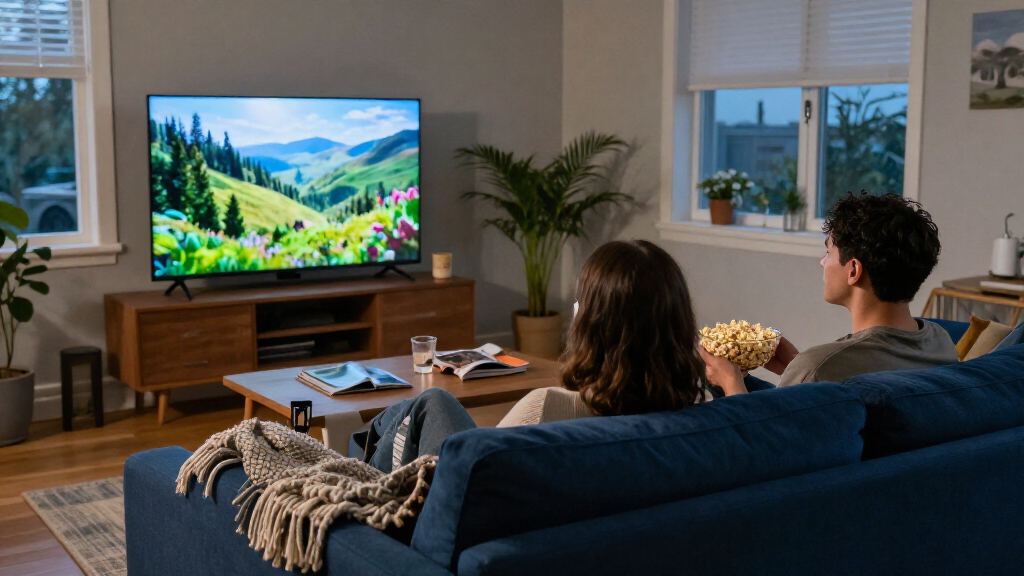
Buying a 98-inch TV sounds impressive, but it may not be practical for your specific room layout. The optimal viewing distance for a 4K TV is roughly 1 to 1.5 times the screen size. For an 85-inch screen, this means sitting 7 to 10 feet away; for a 100-inch screen, you need 8 to 12 feet. Sitting too close to a large 4K screen can reveal individual pixels, breaking the immersion. Conversely, sitting too far away wastes the resolution advantage. Measure your sofa-to-TV distance before ordering. If you cannot achieve the necessary distance, a high-quality 75-inch or 65-inch OLED will often look better than a stretched, underpowered 98-inch LED. Do not let the ‘biggest is best’ marketing trap you into a setup that causes eye strain.
Brightness and Ambient Light Performance
Large screens act as giant mirrors, reflecting everything in the room, including windows and lamps. Peak brightness, measured in nits, is a critical spec for living rooms with natural light. Premium models like the Samsung Neo QLED and LG QNED series often exceed 1,500 to 2,000 nits, allowing them to cut through glare and maintain HDR pop. Budget models may hover around 300-500 nits, which is sufficient for dark rooms but will look washed out during the day. Check for ‘ambient light rejection’ features or matte screen finishes if your TV wall faces a window. A TV that looks stunning in a store demo (which is brightly lit) but lacks brightness will disappoint in a sunlit home. If you cannot control the light, prioritize brightness over contrast ratio.
Gaming Features and HDMI 2.1 Support
If you own a PlayStation 5, Xbox Series X, or a high-end PC, HDMI 2.1 support is non-negotiable. This standard enables 4K resolution at 120Hz (or 144Hz) and Variable Refresh Rate (VRR), which eliminates screen tearing and stuttering. Not all large-screen TVs include this; many budget 75-inch models only support 60Hz at 4K. Look for terms like ‘ALLM’ (Auto Low Latency Mode) and ‘VRR’ in the specs. Furthermore, check the number of HDMI 2.1 ports; some TVs have only one, forcing you to choose between your console and a soundbar or other devices. For gamers, the TCL QM6K and Samsung QN70F offer robust gaming suites, whereas older LED models may lack these inputs entirely, resulting in a less responsive experience.
Smart TV OS and Long-Term Support
The operating system determines your daily user experience. Google TV (found on TCL and Sony) offers the most comprehensive app library and personalized recommendations. Fire TV (Hisense, Insignia) is deeply integrated with Alexa and Amazon ecosystem services, making it ideal for Prime subscribers. Tizen (Samsung) and webOS (LG) are fast and intuitive but have more limited third-party app support compared to Android-based systems. Consider how long the manufacturer supports software updates; Samsung and LG typically offer five years of updates, while budget brands may abandon support sooner. A slow, cluttered interface can ruin the experience of a high-quality panel. If you rely on niche streaming apps, verify they are available on your preferred OS before buying.
Frequently Asked Questions
Is a 98-inch TV too big for a standard living room?
It depends entirely on your viewing distance. If your sofa is less than 8 feet from the TV wall, a 98-inch screen will likely feel overwhelming and may cause eye fatigue as your eyes constantly scan the wide field of view. The general rule of thumb for 4K content is that the screen height should be roughly 1/3 of the viewing distance. For most average-sized living rooms (12×15 feet), an 85-inch TV is often the sweet spot, providing a cinematic feel without dominating the entire wall. Only choose 98-100 inches if you have a dedicated home theater space or a very wide seating arrangement where viewers sit 10-12 feet away.Do I need an OLED TV for a dark room, or is Mini LED good enough?
For a dedicated dark room, OLED provides the definitive image quality due to its perfect black levels, which create unmatched depth and contrast in cinematic scenes. Mini LED has improved dramatically, with high-end models like the Hisense U6 Pro or TCL QM6K getting very close by using extensive local dimming zones. However, Mini LED can still exhibit ‘blooming’ (glowing halos around bright objects in dark scenes), which is invisible in bright rooms but noticeable in pitch-black environments. If you watch mostly movies in a controlled, dark environment and budget is not a primary constraint, OLED remains the superior choice. If you watch mixed content, including sports and daytime TV, a high-quality Mini LED offers better brightness and less risk of burn-in, making it a more versatile option even in darker rooms.How does screen burn-in risk affect large OLED TVs?
Modern OLED TVs include multiple protective layers, such as pixel shifting, logo dimming, and automatic brightness limiters, which make burn-in highly unlikely for normal usage. The risk primarily comes from static elements like news tickers, video game HUDs, or channel logos left on screen for hundreds of hours without variation. If you primarily watch movies, streaming series, or varied content, you should not worry about burn-in on current OLED models. However, if your viewing habits involve leaving the TV on for long periods with static content (e.g., as a background monitor), a Mini LED or QLED TV is a safer, worry-free alternative. Large OLEDs also require careful placement away from direct sunlight to prevent degradation, adding to the maintenance considerations.Are 8K TVs worth buying in large sizes like 85 inches?
Currently, no. There is virtually no native 8K content available, and upscaling 4K content to 8K on large screens rarely yields a visible improvement over high-quality 4K processing. The extra cost of 8K panels is better spent on superior panel technology (like OLED or high-end Mini LED), better sound systems, or a larger screen size (e.g., upgrading from 75 to 85 inches in 4K). 8K TVs also consume more power and generate more heat, requiring more robust cooling systems that can make the TV thicker and heavier. Until native 8K content becomes mainstream and affordable 8K panels reach parity with 4K, investing in 4K is the smarter financial and practical decision for large-screen setups.Can I mount a 100-inch TV on a standard drywall wall?
You should never mount a large TV directly to drywall anchors; it will pull out under the weight. You must locate the wooden studs behind the drywall and anchor the mount directly into them. A 100-inch TV can weigh 70-100 pounds, and leverage forces can increase significantly if the mount extends outward. Standard drywall anchors are rated for 10-20 pounds and will fail catastrophically. If you cannot find studs in the desired location, you must install a plywood backing board across multiple studs before mounting the TV bracket. Additionally, ensure your wall can support the weight; in some older homes with lath and plaster, professional consultation is recommended to prevent structural damage or safety hazards.Conclusion
Choosing the right large-screen TV comes down to matching technology to your environment and budget. For most households, the Samsung 85-Inch Neo QLED QN70F offers the best balance of brightness, gaming features, and smart TV usability, making it the Best Overall choice. If you are a cinephile who watches in a dark room and demands perfect contrast, the LG C6H Series 83-Inch OLED is the Best Premium pick, delivering an image quality that LED cannot match. On the other end of the spectrum, the TCL 85 Inch QM6K represents the Best Value, providing 90% of the performance of premium brands at a significantly lower cost, making it ideal for first-time upgraders or budget-conscious families.
For those seeking the absolute largest screen without breaking the bank, the TCL 98-Inch Q65 is the Best for Maximum Size, though it requires a spacious room. Finally, if you are just starting out and want a simple, affordable entry into big-screen viewing, the Insignia 85-Inch F50 serves as the Best for Beginners, offering solid picture quality and easy-to-use Fire TV integration. Assess your room’s lighting, measure your viewing distance, and prioritize the features that matter most to your daily viewing habits to make the final decision.