
Smart kitchen thermometers pair temperature probes with an app or display so you can monitor cooking without repeatedly opening the oven or grill. My best overall pick is the ThermoMaven P2, which combines WiFi, a smart base, and two probes for flexible everyday cooking; the CHEF iQ Sense Gen 3 stands out for app-guided cooking, while the ThermoMaven P4 suits cooks who need to track several items at once. The main tradeoffs are wireless range versus setup simplicity, and the convenience of an app versus the reassurance of a dedicated display. Probe count, heat tolerance, and how you cook matter as much as the connected features. Read on for the full breakdown and help matching a thermometer to your kitchen, grill, or smoker.

Get the latest gadgets delivered free with Prime
- Fast, free delivery on millions of items
- Prime Video, Amazon Music and more included
- Member-only deals all year
Complete the kit



Key Takeaways
- The ThermoMaven P2 is the strongest all-around fit in this lineup because its WiFi smart base and two probes balance remote monitoring with practical capacity.
- The ThermoMaven P4’s four probes set it apart for cooks tracking multiple cuts or doneness targets, though that extra capacity is unnecessary for many weeknight meals.
- CHEF iQ Sense Gen 3 emphasizes guided cooking, while simpler app-and-probe options may suit shoppers who mainly want temperature alerts.
- Connectivity choices shape where each thermometer works best: WiFi-oriented models are better suited to monitoring from farther away, while Bluetooth models favor nearby use.
- Display needs are a real dividing line. Models with a smart or digital base can provide at-a-glance feedback without a phone, while app-centered designs depend more on keeping a device close and connected.
| ThermoMaven WT02 Lite Smart WiFi Wireless Meat Thermometer with 2 Probes |  | Best for Phone-Free Monitoring | Probe count: 2 | Sensors per probe: 6 | Wireless range: Up to 1,000 ft | VIEW LATEST PRICE | See Our Full Breakdown |
| CHEF iQ Sense Smart Wireless Meat Thermometer (Gen 3) |  | Best for Multi-Item Cooks | Probes: 4 | Sensors: 5 per probe: 4 internal and 1 ambient | Connectivity: Wi-Fi and Bluetooth | VIEW LATEST PRICE | See Our Full Breakdown |
| MEATER SE Wireless Smart Meat Thermometer, Black |  | Best for Simple Bluetooth Cooking | Probe count: 1 | Sensors: Dual internal and ambient sensors | Connectivity: Bluetooth | VIEW LATEST PRICE | See Our Full Breakdown |
| ThermoMaven P2 WiFi Wireless Meat Thermometer with Smart Base and 2 Probes |  | Best for Precision and On-Base Control | Probes: 2 ultra-thin probes | Sensors: 6 per probe: 5 internal and 1 external | Accuracy and resolution: ±0.5°F; 0.01°F | VIEW LATEST PRICE | See Our Full Breakdown |
| CHEF iQ Sense Smart Wireless Meat Thermometer (Gen 3) |  | Best for Long Grilling Sessions | Probe count: 1 | Sensors: 5: 4 internal and 1 ambient | Connectivity: Wi-Fi and Bluetooth | VIEW LATEST PRICE | See Our Full Breakdown |
| ThermoMaven P4 WiFi Wireless Meat Thermometer with 4 Probes and Smart Base |  | Best for Multi-Item Cooking | Connectivity: 2.4GHz Wi-Fi and Bluetooth | Probes: 4 ultra-thin wireless probes | Sensors: 6 per system: 5 internal and 1 external | VIEW LATEST PRICE | See Our Full Breakdown |
| CHEF iQ Sense Smart Wireless Meat Thermometer with Two Probes |  | Best for Long, High-Heat Cooks | Model: iQ Sense CQ60-2C-Z1-E | Included components: 2 probes and hub | Temperature sensors: 5: 4 internal and 1 ambient | VIEW LATEST PRICE | See Our Full Breakdown |
| JoyBear Wireless Meat Thermometer with Smart Base and 2 Probes |  | Best for Phone-Free Monitoring | Model: FM200 | Connectivity: Bluetooth | Probe count: 2 | VIEW LATEST PRICE | See Our Full Breakdown |
| Govee Bluetooth Meat Thermometer with Smart App, 2 Probes, and Digital Display |  | Best for Simple Bluetooth Cooking | Model: H5055 | Connectivity: Bluetooth | Wireless range: Up to 230 ft / 70 m | VIEW LATEST PRICE | See Our Full Breakdown |
| GoveeLife Smart Wireless Meat Thermometer with App Alerts |  | Best for Wi-Fi Range on a Single Probe | Connectivity: 2.4GHz Wi-Fi and Bluetooth | Probe configuration: 1 probe with internal and ambient sensors | Accuracy: ±1.8°F | VIEW LATEST PRICE | See Our Full Breakdown |
| MEATER Plus Smart Meat Thermometer (Walnut) |  | Best for App-Guided Wireless Cooking | Connectivity: Bluetooth | Wireless range: Up to 165 ft via charger repeater | Sensors: Dual: internal and ambient | VIEW LATEST PRICE | See Our Full Breakdown |
| ThermoMaven 3000 ft Wireless Meat Thermometer with 2 Probes | 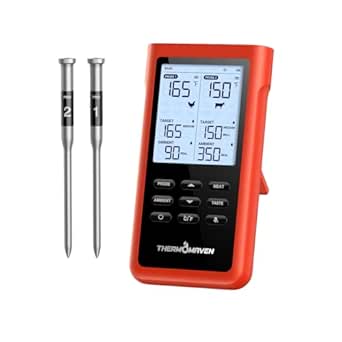 | Best Value for Two-Food Monitoring | Connectivity: Sub-1G wireless | Wireless range: Up to 3,000 ft | Probe count: 2 ultra-thin probes | VIEW LATEST PRICE | See Our Full Breakdown |
| GoveeLife Smart Wireless Meat Thermometer with Dual Probes |  | Best for App-Based Cooking Guidance | Probe count: 2 | Connectivity: Bluetooth and 2.4 GHz Wi-Fi | Bluetooth range: Up to 500 ft | VIEW LATEST PRICE | See Our Full Breakdown |
| ThermoMaven G2 Wireless Meat Thermometer with Two Probes |  | Best for Precise, App-Optional Two-Probe Cooking | Probe count: 2 | Wireless technology: Sub-1G and Wi-Fi | Wireless range: Up to 3,000 ft unobstructed; 700 ft obstructed | VIEW LATEST PRICE | See Our Full Breakdown |
| ThermoMaven G1 Wireless Meat Thermometer with Smart Display Base |  | Best Single-Probe Pick with Smart Base | Probe count: 1 wireless probe | Connectivity: Sub-1G, Bluetooth, and Wi-Fi | Wireless range: Up to 3,000 ft unobstructed; 700 ft obstructed | VIEW LATEST PRICE | See Our Full Breakdown |
| smart kitchen thermometer | Connectivity | Probe count | Wireless range | Sensors |
|---|---|---|---|---|
| ThermoMaven WT02 Lite Smart Wi | Wi-Fi, Bluetooth, and RF | 2 | Up to 1,000 ft | — |
| CHEF iQ Sense Smart Wireless M | Wi-Fi and Bluetooth | — | — | 5 per probe: 4 internal and 1 ambient |
| MEATER SE Wireless Smart Meat | Bluetooth | 1 | Up to 165 ft | Dual internal and ambient sensors |
| ThermoMaven P2 WiFi Wireless M | 2.4GHz Wi-Fi and Bluetooth | — | — | 6 per probe: 5 internal and 1 external |
| CHEF iQ Sense Smart Wireless M | Wi-Fi and Bluetooth | 1 | — | 5: 4 internal and 1 ambient |
| ThermoMaven P4 WiFi Wireless M | 2.4GHz Wi-Fi and Bluetooth | — | — | 6 per system: 5 internal and 1 external |
| CHEF iQ Sense Smart Wireless M | Wi-Fi and Bluetooth | — | — | — |
| JoyBear Wireless Meat Thermome | Bluetooth | 2 | — | — |
| Govee Bluetooth Meat Thermomet | Bluetooth | — | Up to 230 ft / 70 m | — |
| GoveeLife Smart Wireless Meat | 2.4GHz Wi-Fi and Bluetooth | — | Up to 500 ft, unobstructed | — |
| MEATER Plus Smart Meat Thermom | Bluetooth | — | Up to 165 ft via charger repeater | Dual: internal and ambient |
| ThermoMaven 3000 ft Wireless M | Sub-1G wireless | 2 ultra-thin probes | Up to 3,000 ft | 6 per probe |
| GoveeLife Smart Wireless Meat | Bluetooth and 2.4 GHz Wi-Fi | 2 | — | — |
| ThermoMaven G2 Wireless Meat T | — | 2 | Up to 3,000 ft unobstructed; 700 ft obstructed | 6 per probe |
| ThermoMaven G1 Wireless Meat T | Sub-1G, Bluetooth, and Wi-Fi | 1 wireless probe | Up to 3,000 ft unobstructed; 700 ft obstructed | — |
More Details on Our Top Picks
ThermoMaven WT02 Lite Smart WiFi Wireless Meat Thermometer with 2 Probes
The WT02 Lite is the pick for cooks who want smart alerts without keeping a phone beside the grill. Its standalone display base shows temperatures and alerts directly, while Wi-Fi, Bluetooth, and RF give it more connection options than the Bluetooth-only MEATER SE. Two waterproof probes, each with six sensors, let you track separate cuts and follow their core temperatures in real time. The app adds guided cooking and temperature graphs for cooks who want more detail remotely. The tradeoff is that remote monitoring depends on Wi-Fi, so the base must connect to a network for away-from-home access. Its listed 1,000-foot wireless range is useful nearby, but this model also requires three nonstandard batteries, which may be less convenient to replace than a standard battery setup.
Pros:- Standalone base displays temperatures and alerts without a nearby phone.
- Two waterproof probes have six sensors each for real-time core-temperature tracking.
- Wi-Fi, Bluetooth, and RF connectivity with a stated range up to 1,000 feet.
- App includes guided cooking, alerts, and temperature graphs.
Cons:- Remote monitoring requires the base to connect to Wi-Fi.
- Uses three nonstandard batteries, which can be harder to replace than common battery types.
Best for: Grill and oven cooks who want a display and alerts at the cooking station, plus two-probe monitoring and app guidance.
Not ideal for: Cooks who need four probes for several dishes at once or want remote access without configuring Wi-Fi.
- Probe count:2
- Sensors per probe:6
- Wireless range:Up to 1,000 ft
- Temperature accuracy:±0.5°F
- Upper temperature range:752°F
- Connectivity:Wi-Fi, Bluetooth, and RF
- Probe care:Machine washable
- Power:Rechargeable; requires three included nonstandard batteries
Our verdict“Choose the WT02 Lite if you want two-probe smart cooking with a readable base that works without keeping your phone at hand.”
CHEF iQ Sense Smart Wireless Meat Thermometer (Gen 3)
With four probes, this CHEF iQ Sense is the strongest fit here for cooks tracking several proteins or grill zones at once. Each probe uses five sensors, including an ambient sensor, so the app can report both food and surrounding cooking conditions. Wi-Fi monitoring with unlimited range also makes it more suitable for checking a long smoke away from the kitchen than the Bluetooth-based MEATER SE, whose direct range is listed at 165 feet. The 1,000°F heat rating and dishwasher-safe, waterproof probes suit demanding grill sessions and reduce cleanup work. The compromise is a phone-centered feature set: guided cooking and real-time updates run through the app. The hub and probes also need charging, though the hub charges the probes together, so this setup may feel like more equipment than a cook using just one probe needs.
Pros:- Four probes allow simultaneous tracking of multiple foods or cooking zones.
- Five sensors per probe include internal and ambient temperature monitoring.
- Wi-Fi supports unlimited-range remote monitoring through the app.
- Waterproof, dishwasher-safe probes withstand temperatures up to 1,000°F.
Cons:- Full guided cooking and monitoring features rely on the smartphone app.
- Hub and probes need charging, adding upkeep compared with a simple wired thermometer.
Best for: People who regularly cook several cuts or monitor multiple grill zones and want app-based, long-distance updates.
Not ideal for: Single-probe cooks or anyone who wants full controls and alerts without a smartphone app.
- Probes:4
- Sensors:5 per probe: 4 internal and 1 ambient
- Connectivity:Wi-Fi and Bluetooth
- Maximum temperature:1,000°F
- Battery life:Up to 50 hours
- Probe material:Stainless steel
- Probe care:Waterproof and dishwasher-safe
- Warranty:3 years
Our verdict“Pick this four-probe CHEF iQ if you often manage several foods at once and want to check them remotely through an app.”
MEATER SE Wireless Smart Meat Thermometer, Black
The MEATER SE keeps the setup simple: one dishwasher-safe probe, dual sensors, and an app with guided cooking, time estimates, and notifications. It suits cooks who want help timing a roast or air-fried meal but do not need a base or multiple probes. Compared with the two-probe ThermoMaven WT02 Lite, the SE gives up multi-cut monitoring and a standalone display; its direct Bluetooth range is also shorter than that model’s stated RF reach. In exchange, it covers a broad set of cooking methods and has a 0.1°F resolution with a listed three-second response time. For monitoring beyond its 165-foot Bluetooth range, MEATER Link Wi-Fi and Cloud connectivity are needed, so remote access is not as straightforward as a Wi-Fi-first system. The plastic charger is another less premium part of an otherwise compact setup.
Pros:- Dual sensors track internal food and ambient cooking temperatures.
- App provides guided cooking, time estimates, notifications, and recipes.
- Dishwasher-safe probe supports grilling, smoking, roasting, baking, air frying, and sous vide.
- Bluetooth range is listed up to 165 feet, with 0.1°F resolution and three-second response time.
Cons:- Only one probe is included, unlike the two-probe ThermoMaven WT02 Lite.
- Extended range requires MEATER Link Wi-Fi and Cloud connectivity.
- The included charger is plastic.
Best for: Home cooks who prepare one main dish at a time and want app-guided timing across grilling, roasting, baking, and air frying.
Not ideal for: People who need multiple simultaneous probes, an on-device display, or reliable long-range monitoring without extra connectivity steps.
- Probe count:1
- Sensors:Dual internal and ambient sensors
- Connectivity:Bluetooth
- Wireless range:Up to 165 ft
- Internal temperature range:32°F to 212°F
- Ambient temperature range:Up to 527°F
- Response time and resolution:3 seconds; 0.1°F
- Probe care:Dishwasher-safe
Our verdict“Choose the MEATER SE if you want one app-guided probe for varied everyday cooking and can work within Bluetooth range or set up extended connectivity.”
ThermoMaven P2 WiFi Wireless Meat Thermometer with Smart Base and 2 Probes
The ThermoMaven P2 pairs a dedicated display base with Wi-Fi monitoring, making it a better match than the app-dependent CHEF iQ Sense for cooks who want to read temperatures at the grill without reaching for a phone. Its two NIST-certified probes report internal and ambient readings, with stated ±0.5°F accuracy and 0.01°F resolution. The base also supports direct temperature setting, while Wi-Fi provides remote access beyond a Bluetooth-only thermometer’s local reach. The tradeoff is probe endurance: the listed battery life is about two hours per charge, a constraint for long smoking sessions unless you can recharge between cooks. It also requires a 2.4GHz Wi-Fi network, which can take extra router setup. Compared with the WT02 Lite, the P2 foregrounds certified precision and fine resolution rather than a stated 1,000-foot RF range.
Pros:- Dedicated base displays readings and allows temperature setting without an app.
- Two NIST-certified probes have stated ±0.5°F accuracy and 0.01°F resolution.
- Wi-Fi enables unlimited-range monitoring when connected.
- IPX8 waterproof probes are dishwasher-safe.
Cons:- Probe battery life is listed at only about two hours per charge.
- Requires a 2.4GHz Wi-Fi network, which may need router configuration.
Best for: Precision-minded cooks who want certified readings, on-base controls, and Wi-Fi access for shorter grilling or roasting sessions.
Not ideal for: People who run long overnight smokes or cannot use a 2.4GHz Wi-Fi network and do not want frequent probe charging.
- Probes:2 ultra-thin probes
- Sensors:6 per probe: 5 internal and 1 external
- Accuracy and resolution:±0.5°F; 0.01°F
- Connectivity:2.4GHz Wi-Fi and Bluetooth
- Maximum internal temperature:221°F
- Maximum ambient temperature:752°F
- Battery life:24+ hours for base; about 2 hours for probes
- Probe care:IPX8 waterproof and dishwasher-safe
Our verdict“Choose the P2 for fine-resolution, certified readings and direct base controls, but skip it for cooks who need probes to last through very long sessions.”
CHEF iQ Sense Smart Wireless Meat Thermometer (Gen 3)
This single-probe CHEF iQ Sense keeps the same five-sensor and Wi-Fi feature set as the four-probe version, but is a more focused option for cooks who mainly track one roast or brisket at a time. Its sensors monitor internal and ambient temperatures, while the app adds guided cooking and audio notifications through the rechargeable hub. With up to 50 hours of battery life and a 1,000°F heat rating, it is better suited to extended grilling and smoking than the MEATER SE, whose listed direct connection is Bluetooth with a 165-foot range. The tradeoff is less flexibility: there is one probe rather than four, and full access depends on the app and Wi-Fi connection. That makes this model a better fit for a long cook on one item than for a multi-protein dinner or anyone seeking phone-free controls.
Pros:- Five sensors track internal and ambient temperatures.
- Wi-Fi and Bluetooth connectivity support app-based monitoring.
- Battery life is listed up to 50 hours for extended cooks.
- Stainless-steel probe is dishwasher-safe and rated for temperatures up to 1,000°F.
Cons:- One probe cannot monitor multiple foods simultaneously.
- Full feature access depends on a smartphone app, and remote monitoring relies on Wi-Fi.
Best for: Brisket and roast cooks who want a single probe for extended sessions, with app guidance and remote Wi-Fi monitoring.
Not ideal for: Hosts tracking several proteins at once or cooks who want a standalone display and controls independent of a phone.
- Probe count:1
- Sensors:5: 4 internal and 1 ambient
- Connectivity:Wi-Fi and Bluetooth
- Temperature range:32°F to 1,000°F
- Response time:3 seconds
- Battery life:Up to 50 hours
- Probe material:Stainless steel
- Warranty:3 years
Our verdict“Pick this CHEF iQ model for long cooks centered on one cut of meat, and choose its four-probe counterpart if you need to track several foods.”
ThermoMaven P4 WiFi Wireless Meat Thermometer with 4 Probes and Smart Base
The P4 is the strongest fit here when you need to track several cuts or zones at once: its four wireless probes give it an advantage over the two-probe CHEF iQ Sense and JoyBear FM200. Wi-Fi supports remote monitoring through the app, while the standalone display base keeps readings available without relying on a phone. Its NIST-certified ±0.5°F accuracy and six sensors suit cooks who want close temperature tracking across different foods. The probes can handle ambient temperatures up to 752°F, and their waterproof, dishwasher-safe design cuts cleanup effort. The tradeoff is charging: probe battery life is listed at about two hours, far shorter than the CHEF iQ Sense’s up-to-50-hour runtime. The internal reading also tops out at 221°F, and remote use depends on a 2.4GHz Wi-Fi network.
Pros:- Four probes support simultaneous monitoring of several foods or grill zones.
- Standalone display base provides readings without opening the app.
- NIST-certified ±0.5°F accuracy and six sensors support precise tracking.
- IPX8 probes are dishwasher-safe and rated for ambient temperatures up to 752°F.
Cons:- Probe battery life is listed at only about two hours per charge.
- Remote Wi-Fi monitoring requires a 2.4GHz network.
- Internal temperature readings are capped at 221°F.
Best for: Hosts and barbecue cooks who monitor four cuts or cooking zones at once and want both a local display and Wi-Fi app access.
Not ideal for: Long-smoke cooks who need probes to run for many hours between charges, or cooks without access to a 2.4GHz Wi-Fi network.
- Connectivity:2.4GHz Wi-Fi and Bluetooth
- Probes:4 ultra-thin wireless probes
- Sensors:6 per system: 5 internal and 1 external
- Accuracy:±0.5°F, NIST-certified
- Internal temperature range:32°F to 221°F
- Ambient temperature range:Up to 752°F
- Battery life:Base: 24+ hours; probes: about 2 hours
- Probe care:IPX8 waterproof and dishwasher-safe
Our verdict“Choose the P4 if four-probe capacity and a phone-free display matter more than long probe runtime.”
CHEF iQ Sense Smart Wireless Meat Thermometer with Two Probes
For cooks who want wireless probes that can stay in through a long session, the CHEF iQ Sense pairs up to 50 hours of battery life with a stated maximum temperature of 1,000°F. That makes it a better match for extended smoking or high-heat grilling than the ThermoMaven P4, whose probe runtime is listed at about two hours, although the P4 gives you four probes instead of two. The Sense’s ultra-thin stainless-steel probes help limit disruption when inserted into food, and two probes let you track separate cuts or doneness targets. Wi-Fi and Bluetooth provide remote updates through the CHEF iQ app. The main compromise is app dependence for smart cooking features; unlike the P4 or JoyBear’s standalone-base approach, this setup centers the experience on the app and hub. Its included hub is also the charging point for both probes.
Pros:- Up to 50 hours of probe battery life suits extended cooking sessions.
- Rated for temperatures up to 1,000°F for high-heat cooking environments.
- Two probes allow monitoring separate foods or doneness targets.
- Waterproof, dishwasher-safe stainless-steel probes simplify cleanup.
Cons:- Smart cooking features require the CHEF iQ app.
- The included hub is needed to charge both probes.
- Two-probe capacity is lower than the ThermoMaven P4’s four-probe setup.
Best for: Smokers and grill owners who need long probe runtime, high ambient-temperature tolerance, and simultaneous tracking of two foods.
Not ideal for: Cooks who want a standalone display to manage readings without an app, or who need more than two probes at once.
- Model:iQ Sense CQ60-2C-Z1-E
- Included components:2 probes and hub
- Temperature sensors:5: 4 internal and 1 ambient
- Maximum temperature:1,000°F
- Battery life:Up to 50 hours
- Connectivity:Wi-Fi and Bluetooth
- Immersion depth:4.75 inches
- Probe care:Waterproof and dishwasher-safe
- Warranty:3 years
Our verdict“Pick the CHEF iQ Sense for long, hot cooks where probe endurance matters more than a standalone display or extra probe capacity.”
JoyBear Wireless Meat Thermometer with Smart Base and 2 Probes
The JoyBear FM200 suits cooks who want a clear reading at the grill without keeping a phone nearby. Its standalone smart base handles live monitoring and alerts, while Bluetooth adds app customization when a phone is within range. That local-display approach is a practical contrast with the CHEF iQ Sense, which relies on its app for smart cooking features, and the Wi-Fi-enabled ThermoMaven P4, which is better suited to remote access away from the cooking area. JoyBear includes two probes with NIST-certified ±0.5°F accuracy, six sensors, and a fast listed response time of 0.5 seconds. The probes are IP67-rated and dishwasher-safe, but that protection does not extend to the base. Bluetooth also limits remote reach compared with Wi-Fi, so this is best for nearby cooking rather than monitoring from elsewhere.
Pros:- Standalone base displays readings and manages alerts without a phone.
- Two probes support monitoring separate foods at the same time.
- NIST-certified ±0.5°F accuracy and a 0.5-second response time.
- IP67-rated, dishwasher-safe probes make cleanup straightforward.
Cons:- Bluetooth offers less remote reach than Wi-Fi models such as the ThermoMaven P4.
- The base is not covered by the probes’ waterproof rating.
- The listed 30-hour battery life is shorter than the CHEF iQ Sense’s up-to-50-hour runtime.
Best for: Grillers and home cooks who want accurate dual-probe readings and alerts on a dedicated display instead of relying on a phone screen.
Not ideal for: Cooks who need Wi-Fi monitoring from outside Bluetooth range or want a waterproof base for outdoor use.
- Model:FM200
- Connectivity:Bluetooth
- Probe count:2
- Sensor count:6
- Accuracy:±0.5°F, NIST-certified
- Response time:0.5 seconds
- Battery life:30 hours
- Power source:1 AAA battery
Our verdict“Choose the JoyBear if you value a dedicated, phone-free display for nearby cooking more than Wi-Fi reach.”
Govee Bluetooth Meat Thermometer with Smart App, 2 Probes, and Digital Display
The Govee H5055 is a straightforward option for cooks who want two wired probes, a readable local screen, and app alerts without moving to a Wi-Fi system. Its backlit LCD makes temperatures easier to check in dim grilling conditions, while audio and phone notifications can help catch a temperature target when you step away. The listed Bluetooth range is up to 230 feet in suitable conditions, but this remains a nearby-monitoring tool, unlike the Wi-Fi-enabled CHEF iQ Sense or ThermoMaven P4. Its probes are accurate to ±1.8°F and respond in two seconds, which is less precise and slower than the JoyBear FM200’s listed ±0.5°F and 0.5-second figures. A 40-inch cable per probe trades true wireless placement for a familiar wired setup. The 200-hour battery life is a plus, though full app functionality depends on Govee Home.
Pros:- Backlit LCD provides a local reading in low-light conditions.
- Audio and phone alerts help track preset temperature targets.
- Two 40-inch probe cables support monitoring separate foods.
- Listed battery life is up to 200 hours on two AA batteries.
Cons:- Wired probes offer less placement freedom than the wireless ThermoMaven P4 or CHEF iQ Sense.
- Bluetooth range is limited compared with Wi-Fi-enabled alternatives.
- Full app functionality and temperature presets require the Govee Home app.
Best for: Home cooks who prefer a conventional wired-probe setup with an easy-to-read display and Bluetooth alerts for nearby grilling or roasting.
Not ideal for: Cooks seeking fully wireless probes, Wi-Fi monitoring from farther away, or the tighter stated accuracy of the JoyBear FM200.
- Model:H5055
- Connectivity:Bluetooth
- Wireless range:Up to 230 ft / 70 m
- Probe count and cable length:2 probes; 40 inches / 1 m per cable
- Probe accuracy:±1.8°F / 1°C
- Temperature range:32°F to 572°F
- Response time:2 seconds
- Display:Backlit digital LCD
- Power and battery life:2 AA batteries; up to 200 hours
Our verdict“Pick the Govee H5055 if you want a simple display-and-cable setup with nearby app alerts rather than fully wireless, Wi-Fi-connected probes.”
GoveeLife Smart Wireless Meat Thermometer with App Alerts
The GoveeLife makes sense for cooks who want to step away from the grill and check a cooking session over Wi-Fi, but only need to track one probe. Its 2.4GHz Wi-Fi and Bluetooth support app alerts, while the magnetic display base gives you a handy local readout. The stated range reaches 500 feet only in unobstructed conditions, so I would treat that as a best-case figure rather than a guarantee through walls. Unlike the dual-probe CHEF iQ Sense or Govee H5055, this model has a single probe with dual internal and ambient sensors; it can track food and its cooking environment, but not two separate cuts. Up to 48 hours of battery life and a 25-minute probe charge are useful for longer sessions. Its internal range stops at 212°F, and its ±1.8°F accuracy is less precise than JoyBear’s specification.
Pros:- Wi-Fi and Bluetooth support app alerts and remote monitoring.
- Dual sensors report both internal food and ambient temperatures.
- Magnetic display base allows hands-free placement nearby.
- Up to 48 hours of use and a 25-minute probe charge support repeat cooking sessions.
Cons:- A single probe cannot monitor multiple foods like the CHEF iQ Sense or Govee H5055.
- Internal temperature readings are capped at 212°F.
- The stated 500-foot range applies to unobstructed conditions.
Best for: Cooks who monitor one roast or grill item and want Wi-Fi app alerts, a magnetic local display, and a rechargeable probe.
Not ideal for: People who routinely cook multiple cuts at once, need internal readings above 212°F, or require the tighter stated accuracy of the JoyBear FM200.
- Connectivity:2.4GHz Wi-Fi and Bluetooth
- Probe configuration:1 probe with internal and ambient sensors
- Accuracy:±1.8°F
- Response time:2 seconds
- Probe temperature range:14°F to 212°F
- Ambient temperature range:Up to 572°F
- Wireless range:Up to 500 ft, unobstructed
- Battery life:Up to 48 hours
- Probe charge time:25 minutes
Our verdict“Choose the GoveeLife if Wi-Fi access and a local magnetic display matter more than tracking multiple foods or reading internal temperatures above 212°F.”
MEATER Plus Smart Meat Thermometer (Walnut)
The MEATER Plus suits cooks who want a truly cord-free probe and guidance on a phone rather than controls on a separate base. Its dual sensors track the meat and the surrounding oven or grill, while the charger doubles as a Bluetooth repeater for a stated range of up to 165 feet. That makes it a more mobile, app-centered choice than the ThermoMaven G2, whose display base can show readings and set temperatures without an app. The tradeoff is that full guided cooking and alerts depend on a smartphone, and the probe’s internal sensor tops out at 212°F. It is oven-safe and dishwasher-safe, but cooks need to keep its rechargeable probe ready: a five-minute charge provides up to two hours of use.
Pros:- Fully wireless probe avoids cords around the oven or grill.
- Dual sensors track internal food and ambient cooking temperatures.
- Charger repeater provides a stated Bluetooth range of up to 165 feet.
- Probe is oven-safe and dishwasher-safe.
Cons:- Guided cooking and real-time alerts require a smartphone and the MEATER app.
- Internal temperature range ends at 212°F.
- Probe and repeater rely on regular charging and battery upkeep.
Best for: Phone-first home cooks who want guided cooking and a cordless probe for oven or grill meals.
Not ideal for: Cooks who want a standalone display, avoid app dependence, or need an internal sensor range above 212°F.
- Connectivity:Bluetooth
- Wireless range:Up to 165 ft via charger repeater
- Sensors:Dual: internal and ambient
- Internal temperature range:32°F to 212°F
- Ambient temperature limit:Up to 527°F
- Charge time and use:5-minute charge for up to 2 hours
- Care:Dishwasher-safe and oven-safe
- Probe length:6.18 inches
Our verdict“Choose the MEATER Plus if app-guided, cord-free cooking matters more to you than standalone controls or a higher internal temperature ceiling.”
ThermoMaven 3000 ft Wireless Meat Thermometer with 2 Probes
For cooks who want to track two foods without adding an app to the routine, the ThermoMaven 3000 ft pairs two thin probes with a standalone LCD base. Its stated ±0.5°F accuracy is NIST-certified, and the 0.5-second response time is a useful fit for checking changing temperatures quickly. Compared with the GoveeLife Smart Wireless Meat Thermometer, it skips Wi-Fi and app-based recommendations in favor of direct readings on the base. That simplicity is also a limitation: there are no app alerts or remote Wi-Fi features listed, and the advertised 3,000-foot range can vary with the cooking environment. The probes are waterproof and dishwasher-safe, which helps when monitoring separate dishes, but the base needs an AAA battery.
Pros:- Two probes allow simultaneous monitoring of separate foods.
- Standalone LCD base works without an app or account.
- NIST-certified ±0.5°F accuracy and 0.5-second response time.
- Waterproof probes are dishwasher-safe.
Cons:- No app or Wi-Fi monitoring is listed for remote alerts or cooking guidance.
- The stated 3,000-foot range may vary with the environment.
- The base requires an AAA battery.
Best for: Grill and smoker cooks who regularly monitor two foods and prefer reading temperatures on a dedicated display instead of a phone.
Not ideal for: Buyers who want Wi-Fi alerts, app-based cooking guidance, or a range specification they can expect regardless of obstacles.
- Connectivity:Sub-1G wireless
- Wireless range:Up to 3,000 ft
- Probe count:2 ultra-thin probes
- Sensors:6 per probe
- Accuracy:±0.5°F, NIST-certified
- Probe temperature range:14°F to 752°F
- Response time:0.5 seconds
- Display and power:Standalone LCD base; 1 AAA battery included
Our verdict“Pick this model for straightforward two-food monitoring and precise readings from a dedicated base, not for app-connected cooking features.”
GoveeLife Smart Wireless Meat Thermometer with Dual Probes
The GoveeLife Smart Wireless Meat Thermometer gives app-first cooks a balance of on-device readings and connected guidance: its 10-function LCD works alongside Bluetooth and 2.4 GHz Wi-Fi, while the app offers 28 USDA-based temperature recommendations and alerts. Two probes let you follow separate foods, and the magnetic base can attach to a grill for hands-free access. Its stated Bluetooth range of 500 feet is longer than the MEATER Plus‘s 165-foot range, though the MEATER Plus uses a single fully wireless probe and centers more directly on guided cooking. GoveeLife’s ±1.8°F accuracy is less precise on paper than the ThermoMaven models’ ±0.5°F, and the probe’s 5-inch immersion limit may not suit every cut. A 25-minute charge supports up to 48 hours of use.
Pros:- Two probes monitor separate foods or temperature points.
- App offers 28 USDA-based cooking recommendations and alerts.
- Wi-Fi and Bluetooth connectivity pair with a 10-function LCD.
- IP68-rated probe supports up to 48 hours of use after a 25-minute charge.
Cons:- The stated ±1.8°F accuracy is less precise than the ThermoMaven G1 and G2 specifications.
- Probe immersion depth is limited to 5 inches.
- Guided cooking and remote monitoring rely on the smartphone app.
Best for: Home cooks who want two probes, on-device readings, and app recommendations and alerts across Wi-Fi or Bluetooth.
Not ideal for: Cooks who prioritize the tightest stated accuracy, need deeper probe immersion, or want to cook without a phone app.
- Probe count:2
- Connectivity:Bluetooth and 2.4 GHz Wi-Fi
- Bluetooth range:Up to 500 ft
- Temperature range:14°F to 572°F
- Accuracy:±1.8°F
- Response time:3 seconds
- Probe use and immersion:Up to 48 hours after a 25-minute charge; 5-inch immersion depth
- Water resistance and display:IP68 probe; 10-function LCD
Our verdict“Choose GoveeLife if you want app guidance and dual-probe flexibility, and can accept a less precise stated accuracy than the ThermoMaven alternatives.”
ThermoMaven G2 Wireless Meat Thermometer with Two Probes
The ThermoMaven G2 stands out for pairing two probes with unusually direct controls: its display base shows readings and lets you set temperatures without opening an app. The probes have NIST-certified ±0.5°F accuracy, six sensors each, and a 0.5-second response time, making this a more precision-focused choice than the GoveeLife Smart Wireless Meat Thermometer, whose stated accuracy is ±1.8°F and whose app supplies USDA-based recommendations. The G2’s Sub-1G connection claims up to 3,000 feet unobstructed, but the listed obstructed range is 700 feet, a more grounded guide for typical home use. Its probes are dishwasher-safe and rated for high ambient temperatures. One limit: the 752°F ambient ceiling should not be confused with its 221°F internal temperature maximum.
Pros:- Two probes support simultaneous monitoring of separate dishes.
- Display base provides readings and temperature controls without an app.
- NIST-certified ±0.5°F accuracy, six sensors per probe, and 0.5-second response time.
- Dishwasher-safe probes and high ambient temperature tolerance suit grilling and oven cooking.
Cons:- The 3,000-foot range applies to unobstructed conditions; obstructed range is listed as 700 feet.
- Internal temperature limit is 221°F, far below the 752°F ambient limit.
- The plastic outer material may feel less substantial than a metal-bodied base.
Best for: Detail-oriented cooks who monitor two dishes, want a display with direct temperature controls, and value tightly specified probe accuracy.
Not ideal for: Cooks who need internal readings above 221°F or expect the full 3,000-foot wireless range through walls and other obstacles.
- Probe count:2
- Wireless technology:Sub-1G and Wi-Fi
- Wireless range:Up to 3,000 ft unobstructed; 700 ft obstructed
- Sensors:6 per probe
- Accuracy and resolution:±0.5°F; 0.01°F resolution
- Temperature limits:32°F to 752°F ambient; up to 221°F internal
- Response time:0.5 seconds
- Probe care:Dishwasher-safe
Our verdict“Choose the G2 for precise two-probe monitoring and app-optional controls, provided its internal temperature limit fits your cooking.”
ThermoMaven G1 Wireless Meat Thermometer with Smart Display Base
The ThermoMaven G1 is the more focused choice for cooks who want to watch one roast or grill item from a display base rather than manage multiple probes. The base lets you check readings and set temperatures without an app, while Sub-1G, Bluetooth, and Wi-Fi provide several ways to connect, including app monitoring when wanted. Its stated ±0.5°F accuracy and IPX8, dishwasher-safe probe make it a capable single-probe alternative to the two-probe ThermoMaven G2. The G2 is the better fit for tracking two dishes at once and lists NIST certification; the G1’s appeal is a simpler one-probe setup. The G1 also has a data discrepancy: its resolution is listed as both 0.01°F and 0.5°F. Its base is only splash-resistant, so it needs wiping rather than washing.
Pros:- Smart display base shows readings and supports temperature settings without an app.
- Sub-1G, Bluetooth, and Wi-Fi offer multiple monitoring connections.
- IPX8, dishwasher-safe probe is suited to wet cleanup and cooking use.
- Probe is rated for ambient temperatures up to 752°F.
Cons:- One probe cannot monitor two separate dishes at the same time, unlike the ThermoMaven G2.
- Base is splash-resistant only and must be wiped clean.
- Listed resolution conflicts between 0.01°F and 0.5°F.
Best for: Cooks who monitor one large roast or grill item and want a display base with optional app and Wi-Fi monitoring.
Not ideal for: People who regularly track two dishes at once, need a washable base, or require an unambiguous resolution specification.
- Probe count:1 wireless probe
- Connectivity:Sub-1G, Bluetooth, and Wi-Fi
- Wireless range:Up to 3,000 ft unobstructed; 700 ft obstructed
- Accuracy and resolution:±0.5°F accuracy; resolution listed as 0.01°F and 0.5°F
- Temperature limits:32°F minimum; up to 221°F internal and 752°F ambient
- Sensors and response time:6 sensors; 0.5-second response
- Probe care and water resistance:IPX8 probe; dishwasher-safe
- App compatibility:iOS and Android
Our verdict“Pick the G1 if a single probe and app-optional display base fit your routine better than the G2’s two-probe capacity.”
How We Picked
I compared the 15 listed models by the factors that most affect daily cooking: connection method and monitoring range, probe count, whether a base or display is included, app guidance and alerts, and the likely ease of setup. I also weighed practical versatility: a single-probe setup can be enough for a roast, while multiple probes help with different cuts, several doneness targets, or a smoker session. Build and care matter too, since probes have to withstand cooking conditions and be cleaned after use.
The order favors products with a useful mix of dependable monitoring, low-friction operation, and flexibility, rather than the longest feature list. That puts the ThermoMaven P2 first as a balanced option, with the P4 higher for multi-item cooking and CHEF iQ Sense Gen 3 appealing to buyers who value guided app features. More specialized picks rank well for their intended job, but not as broadly; similar models and duplicate listings are judged by their stated configuration, not treated as distinct advantages without a clear difference.
Factors to Consider When Choosing Smart Kitchen Thermometers
Before choosing a smart thermometer, think about where the cook happens and how you want to check progress. The right connection, probe setup, and display can matter more than adding extra app features. These buying factors help separate meaningful convenience from features that may go unused.
Choose Connectivity for Your Cooking Location
Bluetooth can be a straightforward choice when you stay near the oven, grill, or stovetop, but walls and distance can limit how reliably a phone receives updates. WiFi models are more suited to cooks who want to check on food from another room or farther from the cooking area, though they may require more setup and a stable home network. A long advertised range is not the same as guaranteed performance through walls, appliances, or outdoor spaces. Think about the route between the probe base and your phone, not just the size of your home or yard. If you usually cook close by, a simpler connection may be more useful than remote monitoring. If you smoke food for hours or step away, prioritize the connection design and alerts that match that routine.
Buy the Probe Count You Will Actually Use
Two probes let you monitor separate items or compare the center and another area of a larger cook, while four probes can help when several cuts need different doneness targets. More probes also mean more placement decisions, more cables or charging to manage, and potentially more cleanup. A common mistake is buying for an occasional holiday meal when most cooks involve one roast or a single piece of meat. Consider whether you regularly cook for a group, use a smoker, or prepare different proteins at once. Probe count does not replace correct placement: a probe near bone or in a thin section can give a misleading reading. Choose capacity for your typical cooking pattern, with occasional larger meals as a secondary factor.
Decide Whether You Need a Base Display
A dedicated display or smart base can make temperature checks quick for anyone in the kitchen, including a cook who does not want to open an app. App-first models may offer more detailed guidance and notifications, but they make a charged, nearby phone part of the cooking setup. Before choosing, ask whether you want a thermometer that works comfortably when your phone is busy, out of reach, or shared with someone else. A display also helps when several people are monitoring a meal, while app features can be more helpful for custom targets and remote alerts. Avoid assuming that every smart base functions as a full standalone controller; check which readings and settings are available directly on it. The best choice depends on whether glanceable feedback or phone-based control matters more to you.
Look Beyond Smart Features to Probe Suitability
Wireless convenience does not make every probe appropriate for every cooking method. Check the stated temperature limits and whether the probe is designed to stay in food during the entire cook, particularly for high-heat grilling, searing, or long smoking sessions. Probe thickness, insertion depth, and the placement of the sensor affect the readings you get. Some methods, such as thin cuts or very high-heat cooking, may call for a different thermometer style or a quick-read check alongside a wireless probe. Follow the product’s instructions for positioning and heat exposure rather than relying on a general claim of heat resistance. Matching the probe to your cooking method can prevent a connected feature set from becoming a poor fit.
Compare Alerts and App Guidance With Your Habits
App alerts are most useful when they tell you what action to take and arrive reliably, not simply when they add more notifications. Guided cooking can help newer cooks choose targets and follow a process, while experienced cooks may prefer custom temperatures and fewer prompts. Check whether the app offers the controls you expect, such as target setting, cooking progress, and alerts, and whether those functions depend on an account or an internet connection. If you silence phone notifications or keep your phone away from the kitchen, a sophisticated app may not change your routine. Pick the level of guidance that fits your confidence and cooking style. A simpler alert system can be a better match than a feature-rich app you rarely open.
Factor in Cleaning, Charging, and Storage
A thermometer becomes less convenient if its probes are awkward to clean, its base is difficult to store, or charging is easy to forget. Check the maker’s care instructions before washing a probe or exposing its connection points to water; wireless does not automatically mean every component is washable. Think about where the probes and base will live between cooks, and whether the charging method fits that storage spot. If you often cook outdoors, a compact setup may be easier to pack and protect than a larger multi-probe system. Build quality also includes the parts you handle repeatedly, not just the probe’s headline specifications. Choosing a design that fits your cleanup and storage habits can matter more over time than an extra app function.
Frequently Asked Questions
Should I choose WiFi or Bluetooth for a smart kitchen thermometer?
Choose based on how far you expect to move from the cooking area. Bluetooth can work well when your phone stays nearby, while WiFi is a better match for checking a cook from another room or while away from the grill. Actual range depends on walls, interference, and the connection between the probe base and your network, so advertised distance alone is not a guarantee. If you mostly cook in the kitchen, ease of pairing and clear alerts may matter more than remote access. For long smoking sessions, prioritize the setup that can keep sending updates reliably in your home.
Are two probes enough, or should I buy a four-probe thermometer?
Two probes are enough for many households: they can monitor two foods or help compare separate cooking zones. Four probes make more sense if you regularly cook several cuts at once, serve different doneness preferences, or manage a smoker with multiple items. Extra probes add flexibility, but they also create more setup, cleaning, and storage work. Think about how often you would use all of them rather than choosing the largest configuration by default. If multi-item cooks are rare, a two-probe model is usually the simpler fit.
Do I need a thermometer with a display if it has a smartphone app?
A display is helpful if you want to check temperatures without unlocking a phone or relying on notifications. It can also make a setup easier for people who share cooking duties or do not want a phone next to food prep. An app may offer more detailed targets, cooking guidance, or remote access, but those benefits depend on your phone and connection being available. Some bases show readings but do not provide every app control, so verify what the display can do by itself. Choose a display for at-a-glance convenience and an app for connected controls and alerts.
Can I use a wireless meat thermometer for grilling and smoking?
Many wireless probes are designed for ongoing monitoring, but suitability depends on the specific model’s temperature limits and instructions. Smoking typically benefits from continuous alerts over a long cook, while grilling can expose a probe to hotter conditions and direct flame. Check whether the probe is meant to remain inserted during the cooking method you use, and keep it away from flames or surfaces beyond its rated limits. A wireless thermometer may not replace a quick-read thermometer for thin foods or fast, high-heat cooking. Follow the manufacturer’s care and placement directions for each use.
Is guided cooking useful if I already know my preferred doneness?
Guided cooking can still help by organizing target settings and reminders, but it may add little if you already know your temperatures and prefer manual control. For an experienced cook, flexible targets and reliable alerts may matter more than preset recipes or step-by-step prompts. Newer cooks may appreciate guidance that explains when to check food and when to let it rest. App features can also differ by model, so look for controls you would use rather than choosing by the word “smart” alone. If you want a simpler routine, a clear display and dependable temperature monitoring may be enough.
Conclusion
For most cooks, I would start with the ThermoMaven P2 as the best overall because it balances two-probe capacity with a WiFi smart base. The ThermoMaven WT02 Lite is my value-minded pick for buyers who want two probes and wireless monitoring without stepping up to a larger multi-probe setup. For a premium, feature-led experience, consider the CHEF iQ Sense Gen 3; it is also my choice for beginners who want app guidance, though cooks who prefer a physical readout may lean toward a display-base model instead. The ThermoMaven P4 is the better fit for frequent multi-item cooks, while the MEATER SE suits shoppers who favor a compact, app-centered single-probe approach. Match the thermometer to your cooking distance, probe needs, and preferred way to check readings, and the best pick becomes much clearer.