
TL;DR
IdeaClyst is a digital war room for founders that combines AI-driven advice, discovery, and a local-first workspace. It helps turn raw ideas into validated, ready-to-build plans faster and more confidently—without losing control of your data.
Imagine having a dedicated space where your ideas are not just scribbled on sticky notes or buried in endless email threads. Instead, they’re front and center — visible, debated, refined. That’s what a war room embodies, and now, with tools like IdeaClyst, you can create this space digitally, on your own terms.
In this article, you’ll see how IdeaClyst acts as a hub for your idea development, blending AI, structured debate, and your own data to make smarter decisions faster. It’s a game-changer for founders tired of the endless guesswork and gut feeling. Ready to see how it works? Let’s dive into this innovative approach to building your next big thing.
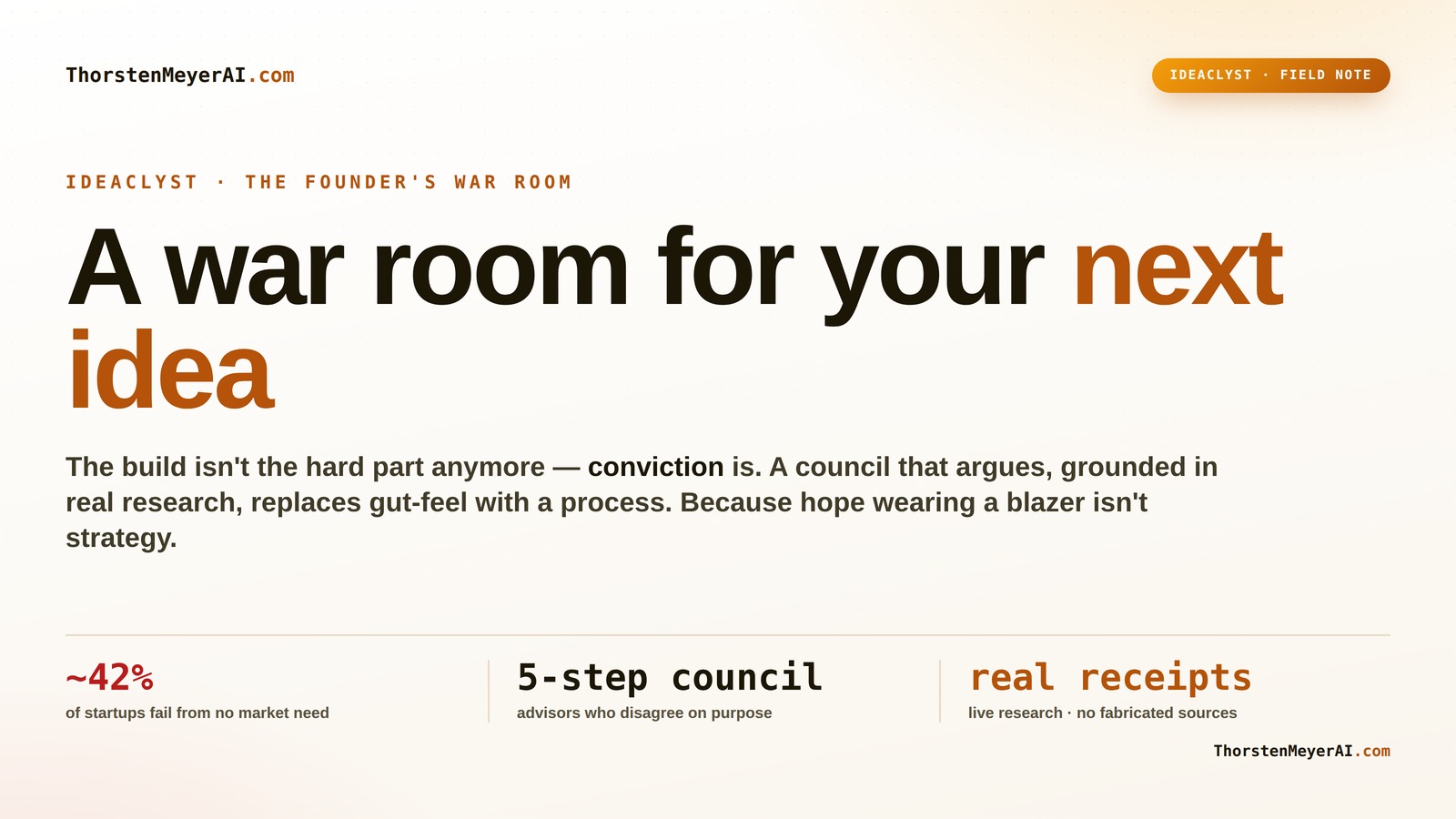
A war room for your next idea
The build isn’t the hard part anymore — conviction is. Knowing which idea deserves the next six months, and being able to defend it. Most founders answer with gut feel and optimistic math. That’s hope wearing a blazer. IdeaClyst replaces it with a process.
The most expensive decision is what to build
The single most valuable thing a tool can do is talk you out of the wrong six months. The numbers make the case better than any pitch.
![DeskFX Free Audio Effects & Audio Enhancer Software [PC Download]](https://m.media-amazon.com/images/I/41fXbDohyuS._SL500_.jpg)
DeskFX Free Audio Effects & Audio Enhancer Software [PC Download]
Transform audio playing via your speakers and headphones
As an affiliate, we earn on qualifying purchases.
As an affiliate, we earn on qualifying purchases.
Three tools in one — on your own machine
Strip away the framing and IdeaClyst is three things at once, all running locally with nothing leaving your laptop.
An AI council
Pressure-tests an idea you bring it — advisors who argue on purpose.
A discovery engine
Finds ideas you didn’t know to look for by hunting real demand signals.
A founder’s workspace
Carries winners from “interesting” all the way to “ready to build.”
collaborative startup war room tools
As an affiliate, we earn on qualifying purchases.
As an affiliate, we earn on qualifying purchases.
Advisors who disagree on purpose
Not one confident, agreeable answer — a structured five-step deliberation where models play different roles and turn on their own work. The disagreement is the feature.
The five-step deliberation
A council that leads with the bad news surfaces the objections you’d otherwise find the expensive way, on month five.
Product strategy
Who’s it for, what’s the wedge, why now, what’s the business model.
Technical architecture
What would it actually take to build — and where’s the risk.
Critique pass
The council turns on its own work. Where’s the hand-waving? What kills this?
Second, independent critique
A different voice, a different angle — so blind spots don’t survive.
Final synthesis
Everything into one coherent founder packet: strategy, architecture, validation, plan.

Winning With AI: How to Dominate Your Niche in 2026 (The Triage Doctor)
As an affiliate, we earn on qualifying purchases.
As an affiliate, we earn on qualifying purchases.
When IdeaClyst cites a source, it actually fetched it
The hard departure from “ask an AI what it thinks of my startup.” It runs in a strict, real-data-only mode — if it can’t gather genuine evidence, it says so plainly rather than inventing a plausible paragraph.
Confidence with receipts
No fabricated statistics, no imaginary competitors, no made-up citations. The packet survives a skeptical co-founder or a sharp investor because the reasoning has receipts.
Market research first
Scouts the landscape before the council reasons about anything.
Competitor read
Real positioning, pricing signals, feature claims — differentiation vs. reality.
Validation with links
Not “talk to customers” — concrete signals & sources you can click.
![Express Schedule Free Employee Scheduling Software [PC/Mac Download]](https://m.media-amazon.com/images/I/41yvuCFIVfS._SL500_.jpg)
Express Schedule Free Employee Scheduling Software [PC/Mac Download]
Simple shift planning via an easy drag & drop interface
As an affiliate, we earn on qualifying purchases.
As an affiliate, we earn on qualifying purchases.
From the blank page to build-ready
Evaluation is half the problem; the blank page is the other half. And a plan is worthless if it dies in a tab you never reopen.
Bring a space, not an idea
“AI for accountants,” “tools for indie game studios” — plus your goal and real capacity. It hunts demand signals across HN, Reddit, Product Hunt, GitHub, pricing pages.
- An honest market read — leads with the bad news when a space is hard
- An opportunity map — high pain, thin competition
- Ranked candidates — wedge, who pays, effort, risk, confidence
- each with KILL CRITERIA — when to walk away
A home and a forward path
Every promising idea gets carried forward, with every artifact in plain files on your disk.
- Validation tooling — sprint board, interview list, evidence browser
- Founder profile — a personal-fit lens; same discovery, different advice
- Build workspaces — funnel, personas, landing draft, version history
- “Build this idea” → a PRD + task queue, ready for a coding agent
Key Takeaways
- A war room acts as the central nervous system for your idea development, making progress visible and collaborative.
- IdeaClyst combines AI, live research, and local storage to create a private, smart, digital war room tailored for founders.
- Structured debates in IdeaClyst’s AI council surface blind spots early, saving time and money.
- You can set up a war room with simple tools, whether physical or digital, tailored to your team size and workflow.
- Regular maintenance and clear organization keep your war room vibrant, useful, and clutter-free.
Why a War Room Is the Heartbeat of Your Startup Journey
A war room isn’t just a fancy term — it’s your central command for ideas, feedback, and decisions. Think of it as a home base where everything about your idea is gathered, visible, and constantly evolving. It keeps your team aligned and makes progress impossible to ignore. For more on effective strategies, see inside IdeaClyst.
For example, a small startup might use a physical whiteboard in their office to track customer feedback, feature ideas, and KPIs. But in today’s remote world, that’s not enough. Digital war rooms, like IdeaClyst, turn that physical space into a flexible, accessible hub that lives on your laptop.
According to the design checklist, a war room should be the ‘heart’ of your project, making progress visible and collaborative. It’s where ideas grow into plans, and plans turn into action.
How IdeaClyst Turns Your Idea War Room Into a Smarter Space
So, what makes IdeaClyst stand out as a digital war room? It’s the unique mix of AI council, discovery engine, and local workspace — all built for founders who want control and clarity. Learn more about how digital war rooms are transforming startups at this detailed article.
When you bring an idea — say, a new subscription model — IdeaClyst kicks into gear. It convenes a virtual council of models that debate strategy, tech risks, and market fit. Instead of just brainstorming alone or relying on gut instincts, you get multiple perspectives that help surface hidden assumptions and potential pitfalls early. This layered, multi-voice approach encourages critical thinking and reduces the risk of overlooking key issues.
And here’s the kicker: it’s run entirely on your machine. No cloud, no data leaks, just plain files stored securely on your disk. This setup means you retain full control over your data, which is vital for sensitive ideas or proprietary concepts. For more insights into secure data management, visit nanomachines.net.
The Five-Step AI Council: Making Better Decisions Faster
IdeaClyst’s AI council isn’t just a chatbot — it’s a structured, multi-phase debate that leverages different AI models, each with a specific role. This layered approach allows for comprehensive analysis, akin to consulting a diverse team of experts. For more on AI-driven decision-making, see YouGonews.
- Product Strategy: This phase helps clarify who your target customer is, why your timing matters, and how your business will generate revenue. It prompts founders to consider the core assumptions behind their idea, forcing a deeper analysis than surface-level thinking.
- Technical Architecture: Here, the focus shifts to feasibility — what technologies are needed, what risks exist, and where potential bottlenecks could occur. This step encourages founders to think critically about implementation challenges early on, avoiding costly surprises later.
- Critique Pass: The council actively searches for weak points — untested assumptions, overlooked risks, or gaps in logic. This stage is crucial because it fosters a culture of skepticism, preventing overconfidence and encouraging rigorous validation.
- Second Critique: A fresh set of AI models or perspectives re-examines the proposal, catching issues the first pass might have missed. This layered critique enhances robustness and reduces blind spots.
- Final Synthesis: All critiques and insights are integrated into a cohesive, actionable plan. This synthesis ensures that your idea is not only well-vetted but also clear and ready for execution. The process accelerates decision-making and improves confidence, saving time and resources.
By automating this multi-angle debate, founders can identify potential flaws early, make evidence-based adjustments, and significantly cut down on trial-and-error cycles. It’s like having a boardroom of experts on demand, working tirelessly to refine your idea with precision.
Grounded in Reality: Why Evidence-Backed Ideas Matter
One of the biggest pitfalls for founders is overconfidence based solely on intuition or vague market vibes. Without concrete data, decisions are more prone to bias, misjudgment, and costly errors. IdeaClyst counters this by anchoring its council in real-time web research, pulling in current market data, customer reviews, and competitor insights. This approach ensures validation is based on facts, not just assumptions.
For example, instead of guessing whether a new feature will resonate with users, you can ask IdeaClyst to gather recent customer feedback or analyze market reports—providing a factual basis for your decisions. This reduces the risk of building something nobody needs or market rejection. The implications are significant: faster validation, fewer wasted resources, and a higher likelihood of market fit.
Research indicates that approximately 42% of startup failures are due to building products or features that don’t meet real market needs. By integrating live research into your idea process, IdeaClyst helps you avoid this common pitfall. For more about market validation, visit kwatsjpedia.org.
Build Your Own Idea War Room — Practical Tips for Founders
You don’t need a sprawling office or a large team to assemble a war room. The key is creating a space — physical or digital — that emphasizes visibility, organization, and regular engagement. Effective war rooms foster a culture of continuous iteration and critical review, which accelerates learning and reduces errors. Here are some practical tips:
- Use a dedicated digital folder, app, or platform like IdeaClyst to centralize all your ideas, research, and feedback. Consistency in organization helps you quickly locate and update key information, preventing important insights from slipping through the cracks.
- Label sections clearly — such as Strategy, Critiques, Validation, Roadmap — to streamline navigation and ensure everyone understands where to contribute or find specific details. Clear labeling fosters accountability and clarity, especially as your project grows.
- Schedule regular review sessions — weekly standups or bi-weekly deep dives — to keep momentum alive. Consistent check-ins help identify stagnation early and promote iterative refinement.
- Encourage team members to add comments, updates, or critiques directly within the space. This collaborative input creates a living document that evolves with your project, making it more dynamic and responsive.
- Keep it simple and functional. Use basic tools like Markdown files, sticky notes, or simple diagrams. Overcomplicating the setup can hinder engagement, whereas simplicity encourages frequent use and updates.
For solo founders or small teams, a well-organized local folder or a simple digital workspace can serve as your war room. The critical factor is maintaining discipline in updates and organization, ensuring your ideas stay visible and actionable as your project progresses.
Digital, Hybrid, or Portable? Choosing the Right War Room Format
The optimal war room format depends on your team’s size, workflow, and environment. Digital war rooms like IdeaClyst excel for remote teams because they provide instant access, version control, and privacy controls that physical spaces can’t match. They facilitate asynchronous collaboration, which is crucial for distributed teams working across time zones.
Physical spaces, such as whiteboards or dedicated rooms, foster spontaneous idea flow and face-to-face collaboration, which can be more engaging and immediate. Hybrid models combine these approaches, leveraging digital tools to support physical brainstorming sessions or whiteboards, offering flexibility and continuity.
Portability can be a game-changer for founders who need to move ideas around—using tablets, whiteboards on wheels, or portable devices—allowing them to brainstorm, review, and revise on the go. This flexibility can accelerate iteration cycles and keep ideas fresh and adaptable.
For example, a remote SaaS startup might rely solely on IdeaClyst for seamless collaboration across continents, while a local design studio might use physical whiteboards during meetings and digitize key points afterward. The right choice hinges on your team’s specific needs and workflow preferences.
Keeping Your War Room Alive: Tips to Prevent Clutter and Stagnation
A war room is only as effective as its ongoing maintenance. Without regular updates and organization, it risks becoming cluttered, stale, or ineffective. To keep your space vibrant and useful, consider these strategies:
- Schedule periodic pruning sessions—monthly or quarterly—to remove outdated ideas, duplicate notes, and low-priority items. This keeps your focus sharp and reduces cognitive overload.
- Celebrate small wins openly within the space. Recognizing progress fosters motivation and helps maintain momentum, especially during challenging phases.
- Assign a ‘keeper’ role—someone responsible for maintaining organization, updating content, and ensuring the space remains relevant. This person acts as a steward, preventing clutter and ensuring continuous usefulness.
- Use visual cues like color-coding, tags, or icons to categorize ideas and notes. This visual organization makes it easier to scan and identify important areas quickly, saving time and mental energy.
- Encourage team members to contribute new insights, questions, or critiques regularly. A dynamic, evolving space promotes ongoing learning and prevents stagnation, ensuring your war room remains a vital decision-making hub.
For example, a founder might set a recurring monthly review to clean up clutter, highlight key insights, and realign on priorities. This discipline helps keep the war room a living, breathing tool that actively supports your startup’s growth.
Small Teams and Solo Founders — How to Build Your Personal War Room
You don’t need a large team or a fancy office to run an effective war room. Solo founders can create a powerful, personalized space with simple tools that suit their workflow. Think of a dedicated folder on your laptop, a whiteboard app, or even a physical notebook where ideas, research, and critiques are stored and reviewed regularly.
By leveraging IdeaClyst’s local-first approach, you can keep your ideas private and secure while still benefiting from structured debate, live research, and iterative refinement. This setup allows you to simulate a team environment for decision-making without external dependencies. Regularly reviewing your notes, running self-critiques, and updating your research makes this space a strategic command center that grows with your project.
For instance, a solo SaaS founder might maintain a Markdown folder on their device, run live web searches to validate assumptions, and periodically critique their own ideas. This lean, disciplined approach creates a focused war room that enhances clarity and decision confidence without needing a big team or complex setup.
Best Tools for Digital War Rooms in 2026 — What Works and Why
Many digital tools claim to be the perfect war room, but the best options are those that combine simplicity, integration, and privacy. IdeaClyst stands out because it unites AI-driven debate, live research, and local storage, offering a comprehensive environment tailored for founders who want control and security.
Other popular tools include:
Tool Strengths Limitations Trello/Notion Great for visual project tracking and collaboration Primarily cloud-based, raising privacy concerns for sensitive data Miro Flexible visual boards, ideal for brainstorming and mapping ideas Lacks structured debate features, making deep validation harder IdeaClyst AI council, live research, local-first, open source — all in one Requires some setup and technical familiarity, which might be a barrier for some users Choosing the right tool depends on your priorities: ease of use, security, collaboration needs, and whether you prefer a simple or integrated environment. The key is selecting a platform that keeps ideas visible, editable, and protected—especially for remote or sensitive projects.
Your Next Step: Turn Your Ideas Into Action With a War Room
Now that you understand how a war room accelerates your idea development, it’s time to start building one. Begin small: choose your tools, organize your core ideas, and set a regular schedule for reviews. Use IdeaClyst to facilitate structured debates, research, and iterative refinement, transforming raw concepts into actionable plans.
Think of your war room as your personal command center — a dedicated environment where ideas are visible, challenged, and shaped into ready-to-launch solutions. The process of creating this space encourages discipline, clarity, and strategic thinking, all essential for turning visions into reality.
Don’t wait for the perfect setup; start with what you have and refine over time. The goal is consistency and engagement. A well-maintained war room becomes an invaluable asset, helping you stay focused, informed, and confident as you navigate your startup journey.
Frequently Asked Questions
What exactly is a war room, and why do I need one?
A war room is a dedicated space — physical or digital — where your team gathers to develop, track, and refine ideas. It keeps everyone aligned, makes progress visible, and helps you make smarter decisions faster.Can I create a war room if I’m a solo founder?
Absolutely. Solo founders can set up a simple local folder, a whiteboard app, or use tools like IdeaClyst to simulate a war room. The key is keeping your ideas organized and visible for regular review.Is a digital war room as effective as a physical one?
Yes, especially for remote teams. Digital war rooms like IdeaClyst provide instant access, version control, and privacy, making them highly adaptable and scalable for any team size.What should I put in my war room?
Include your current ideas, research data, critiques, roadmaps, and action plans. Organize them clearly so you can see progress at a glance and easily update as things evolve.How often should I update or review my war room?
Set a regular schedule — weekly or bi-weekly — to review, prune, and update. This keeps your space fresh, relevant, and a true reflection of your current priorities.Conclusion
Building a war room isn’t about having the perfect space — it’s about creating a dedicated environment where your ideas grow, are challenged, and get ready for action. With tools like IdeaClyst, that environment can be digital, private, and incredibly powerful.
Start small, stay consistent, and let your war room become the strategic hub that turns your next big idea into reality. Because in the end, the best ideas are the ones you bring to life — with clarity and confidence.