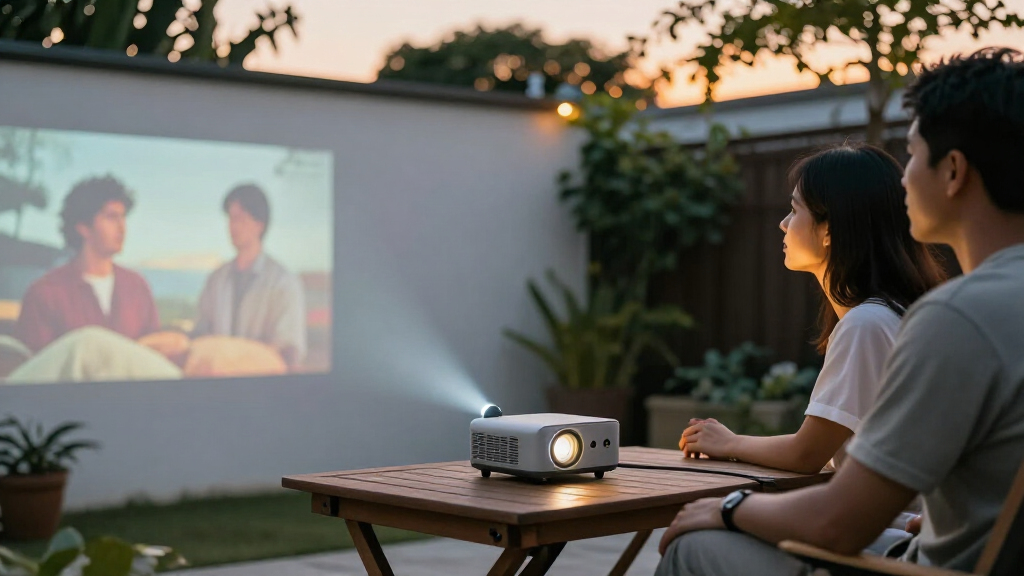
Portable mini projectors trade large-screen convenience for compromises in brightness, sound, and setup. My best overall pick is the Aurzen Roku TV D1R Air, a strong fit for viewers who want a familiar streaming interface in a portable design. The HAPPRUN H1 stands out for native 1080p, while the Kodak Ultra Mini DLP puts compact carry size ahead of home-theater features. Choosing between these options means weighing convenient built-in streaming against image detail, portability, and how much setup you are willing to do. Read on for the full breakdown, buying advice, and recommendations for different needs.

Get the latest gadgets delivered free with Prime
- Fast, free delivery on millions of items
- Prime Video, Amazon Music and more included
- Member-only deals all year
Complete the kit



Key Takeaways
- Built-in streaming separates the smart picks: The Aurzen Roku models and several Wi-Fi models with apps can simplify playback, but app availability and updates may vary; check support for the services you use.
- Native resolution matters more than compatibility claims: The HAPPRUN H1 specifies native 1080p, while “1080p support” on a projector does not necessarily mean it displays a full 1080p image.
- The HY300-style models prioritize flexible placement: Their rotating designs can help aim the picture at a wall or ceiling, but flexibility does not replace brightness or a suitable projection surface.
- Small size calls for realistic expectations: Kodak’s Ultra Mini DLP is the lineup’s portability-focused choice, while larger portable designs may offer more features but take up more bag space.
- Connectivity labels are not picture-quality guarantees: Wi-Fi 6 and newer Bluetooth versions may help with network or accessory connections, but they do not by themselves establish brightness, resolution, or sound quality.
| YGSKK Mini Projector with Wi-Fi 6, Bluetooth 5.3, and Built-In Streaming Apps |  | Best for Native 1080p Streaming | Resolution: Native 1080p; compatible with 4K input | Brightness: 300 ANSI lumens | Supported image size: 50–200 inches | VIEW LATEST PRICE | See Our Full Breakdown |
| HOMPOW Mini Portable Projector with Bluetooth 5.1 |  | Best for Lightweight, Simple Setups | Native resolution: 1280 × 720 | Input support: Supports 1080p input | Brightness: 200 lm | VIEW LATEST PRICE | See Our Full Breakdown |
| TMY V08 Portable Projector with Native 1080p Support and 80-Inch Screen |  | Best Bundle for Screen-Included Movie Nights | Native resolution: 1280 × 720 | Maximum display resolution: 1920 × 1080 | Display type: LCD | VIEW LATEST PRICE | See Our Full Breakdown |
| Portable Mini Projector with Wi-Fi, Bluetooth, and Built-In Apps |  | Best for Lightweight Bedroom Projection | Native resolution: 1280 × 720 | Maximum display resolution: 3840 × 2160 | Brightness: 500 lm | VIEW LATEST PRICE | See Our Full Breakdown |
| Aurzen Roku TV D1R Air Portable Smart Projector |  | Best for Roku Streaming and Easy Setup | Resolution: Native 1080p | Brightness: 300 ANSI lumens | Power input: 65 W or higher USB-C PD; 20 V/3.25 A | VIEW LATEST PRICE | See Our Full Breakdown |
| Aurzen Roku TV E1R Smart Portable Mini Projector |  | Best for Built-In Streaming | Native resolution: 1280 × 720 | Maximum image size: 120 inches | Brightness: 160 lm | VIEW LATEST PRICE | See Our Full Breakdown |
| Kodak Ultra Mini Portable DLP Projector |  | Best Pocket-Sized Pick | Native resolution: 640 × 360 | Maximum supported resolution: 1920 × 1080 | Brightness: 35 lumens | VIEW LATEST PRICE | See Our Full Breakdown |
| HAPPRUN H1 Native 1080p Portable Projector with Bluetooth 5.3 |  | Best for Native 1080p | Native resolution: 1920 × 1080 | Brightness: 300 ANSI lumens | Maximum image size: 200 inches | VIEW LATEST PRICE | See Our Full Breakdown |
| Portable Mini Projector with Wi-Fi and Bluetooth |  | Best for Flexible Device Connections | Resolution: 1080p Full HD input support | Projection size: 22–170 inches | Projection distance: 3.3–16 feet | VIEW LATEST PRICE | See Our Full Breakdown |
| Magcubic Portable Mini Projector with Wi-Fi 6 and Bluetooth 5.4 |  | Best for Flexible Angles and Built-In Apps | Native resolution: 1280 × 720 | Maximum supported resolution: 4096 × 2160 pixels | Brightness: 200 ANSI lumens | VIEW LATEST PRICE | See Our Full Breakdown |
| Magcubic HY300PRO Portable Mini Projector with Wi-Fi and Bluetooth |  | Best for Flexible Placement | Native resolution: 1280 × 720 | Maximum supported resolution: 3840 × 2160 | Brightness: 200 ANSI lumens | VIEW LATEST PRICE | See Our Full Breakdown |
| Thunrlge HY300 Pro Portable Smart Mini Projector with Android 11, Wi-Fi 6, Bluetooth, and 180° Rotation |  | Best for Built-In Streaming | Native resolution: 1280 × 720 | Display type: TFT LCD | Operating system: Android 11.0 | VIEW LATEST PRICE | See Our Full Breakdown |
| Philoent Mini Projector with Wi-Fi 6, Bluetooth 5.4, and Built-In Apps |  | Best Compact Pick | Native resolution: 1280 × 720 | Maximum display resolution: 1920 × 1080 | Brightness: 200 ANSI lumens | VIEW LATEST PRICE | See Our Full Breakdown |
| HY300Pro Portable Mini Projector with Wi-Fi 6, Bluetooth 5.4, and Android 14 |  | Best for Current Smart Features | Operating system: Android 14 | Native resolution: 1280 × 720 | Maximum supported resolution: 3840 × 2160 | VIEW LATEST PRICE | See Our Full Breakdown |
| AKIYO Mini Projector with WiFi and Bluetooth |  | Best for Travel and Flexible Angles | Native resolution: 1280 × 720 | Maximum supported resolution: 3840 × 2160 | Brightness: 200 ANSI lumens | VIEW LATEST PRICE | See Our Full Breakdown |
| portable mini projector | Brightness | Native resolution | Weight | Connectivity |
|---|---|---|---|---|
| YGSKK Mini Projector with Wi-F | 300 ANSI lumens | — | — | — |
| HOMPOW Mini Portable Projector | 200 lm | 1280 × 720 | 0.7 kg | — |
| TMY V08 Portable Projector wit | — | 1280 × 720 | — | 3.5 mm jack, Bluetooth, HDMI, USB |
| Portable Mini Projector with W | 500 lm | 1280 × 720 | 0.77 lb (0.35 kg) | — |
| Aurzen Roku TV D1R Air Portabl | 300 ANSI lumens | — | 1.18 kg (2.60 lb) | — |
| Aurzen Roku TV E1R Smart Porta | 160 lm | 1280 × 720 | Under 1 lb | Wi-Fi, Bluetooth 5.2, HDMI, USB |
| Kodak Ultra Mini Portable DLP | 35 lumens | 640 × 360 | 6.35 oz | HDMI, USB, MicroSD, 3.5 mm audio |
| HAPPRUN H1 Native 1080p Portab | 300 ANSI lumens | 1920 × 1080 | — | HDMI, USB, 3.5 mm audio, Bluetooth, IR |
| Portable Mini Projector with W | — | — | Under 1 lb | — |
| Magcubic Portable Mini Project | 200 ANSI lumens | 1280 × 720 | 0.88 lb | Wi-Fi 6, Bluetooth 5.4, HDMI, USB |
| Magcubic HY300PRO Portable Min | 200 ANSI lumens | 1280 × 720 | 0.67 kg | Wi-Fi, Bluetooth, HDMI, USB |
| Thunrlge HY300 Pro Portable Sm | — | 1280 × 720 | — | Wi-Fi 6, Bluetooth, HDMI, USB |
| Philoent Mini Projector with W | 200 ANSI lumens | 1280 × 720 | 387 g | Wi-Fi 6, Bluetooth 5.4, HDMI, USB |
| HY300Pro Portable Mini Project | 200 ANSI lumens | 1280 × 720 | 0.77 lb | — |
| AKIYO Mini Projector with WiFi | 200 ANSI lumens | 1280 × 720 | 360 g | 5G/2.4G Wi-Fi, Bluetooth 5.2, HDMI, USB, 3.5 mm audio output |
More Details on Our Top Picks
YGSKK Mini Projector with Wi-Fi 6, Bluetooth 5.3, and Built-In Streaming Apps
The YGSKK combines native 1080p with built-in Prime Video, YouTube, and Hulu, so it can handle streaming without a separate stick while delivering sharper detail than the HOMPOW and TMY, which are native 720p. Its electric focus and 210° rotating base make aiming and adjusting the picture easier when a flat, conventional setup is not available. Wi-Fi 6 and built-in speakers add convenience, but the 300 ANSI-lumen output favors a dark or dim room over daytime viewing. The rotation and apps make it more self-contained than the screen-included TMY, though Bluetooth cannot connect to smartphones, and Android mirroring requires an app. I’d pick it for a compact streaming setup, not for bright-room projection.
Pros:- Native 1080p resolution for sharper detail than the native 720p HOMPOW and TMY
- Built-in Prime Video, YouTube, Hulu, and app store reduce reliance on an external streaming device
- Electric focus and 210° rotation make positioning easier in flexible setups
- Wi-Fi 6, HDMI, USB, and a 3.5 mm audio connection offer several connection options
Cons:- 300 ANSI lumens are better suited to dim rooms than ambient-light viewing
- Bluetooth does not support smartphone connections
- Android screen mirroring requires an app
Best for: Viewers who want native 1080p and built-in streaming apps in a portable projector for bedrooms or other dim rooms.
Not ideal for: People who need bright-room viewing or want to pair a smartphone directly over Bluetooth; brightness is limited and that Bluetooth connection is unsupported.
- Resolution:Native 1080p; compatible with 4K input
- Brightness:300 ANSI lumens
- Supported image size:50–200 inches
- Wireless connectivity:Wi-Fi 6 (2.4 GHz and 5 GHz), Bluetooth 5.3
- Ports:HDMI, USB, 3.5 mm audio
- Adjustment:Electric focus; 210° rotation
- Built-in apps:Prime Video, YouTube, Hulu, and app store
- Warranty:3 years
Our verdict“Choose the YGSKK if native 1080p, built-in apps, and flexible aiming matter more than bright-room performance or direct phone-to-projector Bluetooth.”
HOMPOW Mini Portable Projector with Bluetooth 5.1
At 0.7 kg, the HOMPOW is a straightforward carry-around option for buyers who value portability and basic connections over sharpness or built-in streaming. Its native 720p image is a step below the YGSKK and Aurzen Roku TV D1R Air, both native 1080p models; accepting 1080p input does not change that native resolution. The two-way Bluetooth 5.1 and built-in 5 W speakers give it flexible audio options without making a separate speaker mandatory, while HDMI and USB cover common playback sources. Its 40–120-inch range is more restrained than the TMY’s stated 32–220-inch span. The tradeoff is modest 200 lm brightness, which narrows it to dim environments, and phones or TV sticks may need separate adapters or accessories.
Pros:- Light 0.7 kg design is easy to carry between rooms or on trips
- Two-way Bluetooth 5.1 supports flexible audio connections
- Built-in 5 W stereo speakers can handle casual viewing without separate audio gear
- HDMI 2.0, USB 2.0, and 3.5 mm audio cover common wired connections
Cons:- Native 1280 × 720 resolution is lower than the native 1080p YGSKK and Aurzen Roku TV D1R Air
- 200 lm brightness limits use in rooms with substantial ambient light
- Phone adapters and TV sticks are sold separately
Best for: Travelers and occasional movie viewers who want a light tabletop projector for a small, dim room and already have an HDMI source.
Not ideal for: Buyers prioritizing native 1080p, bright-room use, or a ready-to-stream setup without separate adapters or a streaming device.
- Native resolution:1280 × 720
- Input support:Supports 1080p input
- Brightness:200 lm
- Image size:40–120 inches
- Throw distance:3.49–7.26 ft
- Wireless connectivity:Two-way Bluetooth 5.1
- Ports:HDMI 2.0, USB 2.0, 3.5 mm jack
- Weight:0.7 kg
- Coverage:30-day replacement window; 2-year repair coverage
Our verdict“Pick the HOMPOW for a light, basic projector in a dim space if portability matters more than native resolution and built-in streaming.”
TMY V08 Portable Projector with Native 1080p Support and 80-Inch Screen
The TMY V08’s clearest advantage over the HOMPOW and YGSKK is what comes in the box: an 80-inch foldable screen that gives buyers a ready projection surface instead of requiring a blank wall or separate screen purchase. Its stated 32–220-inch projection range offers more sizing flexibility than the HOMPOW’s 40–120 inches, though a large maximum image does not make its native picture sharper. The TMY’s native resolution is 1280 × 720; 1920 × 1080 is its maximum supported display resolution, so it falls short of native 1080p options such as the Aurzen Roku TV D1R Air. Bluetooth audio, built-in speakers, HDMI, and USB suit simple setups. Phone adapters are not included, and some protected streaming apps need an external device rather than direct mirroring.
Pros:- Includes an 80-inch foldable screen, unlike the screen-free HOMPOW and YGSKK
- Stated 32–220-inch projection range offers flexible image sizing
- Two-way Bluetooth audio and built-in speaker support several listening setups
- HDMI and USB support common external playback devices
Cons:- Native 1280 × 720 resolution is lower than the native 1080p Aurzen Roku TV D1R Air
- Phone adapters are not included
- Some streaming apps require a connected streaming device or computer because of content protection
Best for: First-time projector buyers who want a foldable screen included and plan to connect a laptop, media player, or other HDMI source.
Not ideal for: Viewers who require native 1080p detail or expect all streaming apps to mirror directly from a phone.
- Native resolution:1280 × 720
- Maximum display resolution:1920 × 1080
- Display type:LCD
- Included screen:80-inch foldable screen
- Projection size:32–220 inches
- Projection distance:1.5–6 m
- Connectivity:3.5 mm jack, Bluetooth, HDMI, USB
- Aspect ratio:16:9
- Lamp life:10,000 hours
Our verdict“Choose the TMY V08 if an included screen and flexible setup are more useful than native 1080p or direct phone streaming.”
Portable Mini Projector with Wi-Fi, Bluetooth, and Built-In Apps
At just 0.77 lb, this model is the easiest pick in this group to move between a bedside table, floor, or travel bag. Its built-in apps and dual-band Wi-Fi make it more self-contained than the HOMPOW, which relies on external playback sources, while the 180° rotation and auto keystone allow more flexible placement than a fixed tabletop setup. The tradeoff is that its native resolution is 1280 × 720; 4K playback support does not deliver native 4K detail, and the YGSKK and Aurzen Roku TV D1R Air offer native 1080p instead. Its 500 lm specification and recommended 40–100-inch image range point toward modest, dim-room viewing rather than a large bright-room picture. Starry sky mode adds an ambience-focused use the other models do not emphasize.
Pros:- 0.77 lb weight makes it lighter than the HOMPOW and Aurzen Roku TV D1R Air
- Built-in apps and dual-band Wi-Fi support streaming without a separate TV stick
- Auto keystone and 180° rotation help with flexible placement
- Starry sky mode and sleep timer suit bedroom ambience
Cons:- Native 1280 × 720 resolution is below the native 1080p YGSKK and Aurzen Roku TV D1R Air
- 4K video playback support does not mean native 4K resolution
- TV sticks are not included for buyers who prefer an external streaming device
Best for: Travelers and bedroom viewers who want a very light projector with built-in apps, flexible mounting, and ambient starry-sky scenes.
Not ideal for: Buyers seeking native 1080p detail or a large, bright image for daytime or group viewing.
- Native resolution:1280 × 720
- Maximum display resolution:3840 × 2160
- Brightness:500 lm
- Recommended image size:40–100 inches
- Wireless connectivity:Dual-band Wi-Fi (2.4 GHz and 5 GHz), Bluetooth 5.2
- Rotation:180°
- Weight:0.77 lb (0.35 kg)
- Dimensions:3.73 × 3.73 × 6.17 inches
- Mounting options:Tabletop, floor, ceiling, or tripod
Our verdict“Choose this model for low-weight bedroom or travel use with built-in apps, but pick a native 1080p alternative if picture detail is the priority.”
Aurzen Roku TV D1R Air Portable Smart Projector
The Aurzen Roku TV D1R Air pairs native 1080p with Roku TV built in, making it a stronger choice for straightforward streaming than the TMY, which may need an external device for protected apps. Auto focus and auto keystone reduce manual picture adjustments, while dual 5 W speakers with Dolby Audio provide a more developed built-in sound setup than the HOMPOW’s single stated 5 W speaker output. Its USB-C PD power requirement is the main portability caveat: it needs a compatible 65 W or higher power source and a 5A E-Marker cable, so it is not as plug-and-go as a projector powered by a more common setup. At 300 ANSI lumens, it also suits dim rooms best. For viewers who value Roku convenience and native resolution, those limits may be acceptable.
Pros:- Native 1080p resolution exceeds the native 720p resolution of the TMY and HOMPOW
- Built-in Roku TV supports streaming without a separate stick
- TOF autofocus and auto keystone reduce setup adjustments
- Dual 5 W speakers, Dolby Audio, and several ports support varied setups
Cons:- 300 ANSI lumens are best suited to a dim or dark viewing room
- Requires a compatible 65 W or higher USB-C PD source and 5A E-Marker cable
- Reported fan noise is 29–35 dB at 1 meter, depending on mode
Best for: Roku users who want native 1080p, built-in streaming, and automatic picture setup for a portable projector used mainly in dim rooms.
Not ideal for: Buyers who need bright-room projection or do not want to source a compatible 65 W or higher USB-C PD power supply and 5A E-Marker cable.
- Resolution:Native 1080p
- Brightness:300 ANSI lumens
- Power input:65 W or higher USB-C PD; 20 V/3.25 A
- Speakers:Dual 5 W
- Audio:Dolby Audio
- Wireless connectivity:Dual-band Wi-Fi (2.4 GHz and 5 GHz), Bluetooth 5.2
- Ports:HDMI, USB, Audio Out, USB-C
- Setup features:TOF autofocus, auto keystone
- Weight:1.18 kg (2.60 lb)
Our verdict“Pick the Aurzen Roku TV D1R Air if native 1080p and simple Roku streaming outweigh the need for a readily available power source or bright-room performance.”
Aurzen Roku TV E1R Smart Portable Mini Projector
The built-in Roku TV gives this Aurzen an advantage for movie nights away from a television: streaming apps are available over Wi-Fi without packing a separate stick. Compared with the HAPPRUN H1, which needs an external streaming device for that convenience, the E1R is more self-contained. Its under-1-pound weight, carrying strap, and rotating stand also make moving it between rooms or setting it up at varied angles easier. The tradeoff is image detail: its 1280 × 720 resolution is below the HAPPRUN’s native 1080p, and 160 lumens calls for a dim viewing space. Roku activation also requires an account and internet connection. I’d choose it for simple app-based viewing, not for sharp, bright-room projection.
Pros:- Built-in Roku TV provides streaming apps without a separate streaming stick.
- Weighs under 1 lb and includes a carrying strap for easier transport.
- Rotating stand and automatic vertical keystone correction help with flexible placement.
- Bluetooth 5.2 and Apple AirPlay support audio connections and casting.
Cons:- Native 1280 × 720 resolution gives less image detail than the HAPPRUN H1’s native 1080p.
- 160-lumen brightness is better suited to dim spaces than rooms with substantial ambient light.
- Roku activation requires an account and an internet connection.
Best for: Travelers and casual viewers who want streaming apps built into a lightweight projector and can watch in a dim room.
Not ideal for: Viewers who prioritize native 1080p detail, need to use the projector without an internet connection for activation, or watch in bright rooms.
- Native resolution:1280 × 720
- Maximum image size:120 inches
- Brightness:160 lm
- Weight:Under 1 lb
- Connectivity:Wi-Fi, Bluetooth 5.2, HDMI, USB
- Stand rotation:180°
- Maximum throw distance:9.6 feet
- Activation requirement:Roku account and internet connection
Our verdict“Choose the E1R if built-in Roku streaming and easy portability matter more to you than native 1080p resolution or bright-room use.”
Kodak Ultra Mini Portable DLP Projector
The Kodak Ultra Mini makes the most sense when carrying space matters more than image size or sharpness. At 6.35 ounces and roughly 3.46 inches square, it is easier to tuck into a small bag than the larger HAPPRUN H1. Its built-in battery, media player, speaker, and MicroSD slot also let you play stored content without assembling a full streaming setup. But this compactness comes with steep limits: 640 × 360 native resolution softens detail, and 35 lumens means the room needs to be dark. The battery lasts up to 1.5 hours, so it may not cover longer viewing sessions. I’d treat its 100-inch maximum as a flexibility figure, not a promise of a bright, detailed image at that size.
Pros:- Very light at 6.35 oz and compact enough for small bags.
- Built-in battery, media player, and speaker support simple playback away from an outlet.
- HDMI, USB, MicroSD, and 3.5 mm audio provide several connection options.
- Supports input up to 1920 × 1080.
Cons:- Native 640 × 360 resolution is much less detailed than the HAPPRUN H1’s native 1080p.
- 35-lumen brightness limits viewing to dark or dim spaces.
- Battery playback is up to 1.5 hours, which can fall short for longer films.
Best for: Travelers who need a genuinely pocket-sized projector for short clips or stored media in dark rooms.
Not ideal for: People who want detailed movie playback, longer battery-powered sessions, or a picture that remains visible with room lights on.
- Native resolution:640 × 360
- Maximum supported resolution:1920 × 1080
- Brightness:35 lumens
- Maximum screen size:100 inches
- Battery playback:Up to 1.5 hours
- Weight:6.35 oz
- Connectivity:HDMI, USB, MicroSD, 3.5 mm audio
- Built-in speaker:1 W
Our verdict“Pick the Kodak if pocketable size and short, self-contained playback matter more than brightness, resolution, or battery runtime.”
HAPPRUN H1 Native 1080p Portable Projector with Bluetooth 5.3
For buyers who value image detail over all-in-one convenience, the HAPPRUN H1’s native 1920 × 1080 resolution sets it apart from the Aurzen Roku TV E1R and Magcubic, both of which are native 720p. That extra detail is useful for films and text, while the 40-to-200-inch image range gives it room to scale for different setups. It also offers desktop, tripod, or ceiling mounting, plus Bluetooth 5.3 audio for headphones or an external speaker. The compromise is that it is not a self-contained streaming projector: a TV stick or phone-to-HDMI adapter is sold separately, and Bluetooth handles audio rather than video casting. Its 300 ANSI lumens also favor dimmer viewing conditions. I’d choose it for a sharper picture, not for built-in apps or effortless setup.
Pros:- Native 1920 × 1080 resolution provides more detail than the native 720p Aurzen E1R and Magcubic.
- Projects from 40 to 200 inches for varied room setups.
- Desktop, tripod, and ceiling-mount options offer placement flexibility.
- Bluetooth 5.3 supports wireless audio connections, alongside built-in stereo speakers.
Cons:- A TV stick or phone-to-HDMI adapter is sold separately for streaming and phone connections.
- Bluetooth supports audio only, not video casting.
- 300 ANSI lumens are better suited to dim rooms than bright viewing spaces.
Best for: Movie viewers who want native 1080p detail and can supply a streaming device or connect another HDMI source.
Not ideal for: Buyers who want built-in streaming apps, wireless video casting, or a projector intended for bright-room viewing.
- Native resolution:1920 × 1080
- Brightness:300 ANSI lumens
- Maximum image size:200 inches
- Minimum image size:40 inches
- Bluetooth:Version 5.3; audio
- Connectivity:HDMI, USB, 3.5 mm audio, Bluetooth, IR
- Installation options:Desktop, tripod, or ceiling mount
- Maximum throw distance:7 meters
Our verdict“Choose the HAPPRUN H1 if native 1080p matters most and you are comfortable bringing a separate streaming source.”
Portable Mini Projector with Wi-Fi and Bluetooth
This compact projector suits buyers who want several ways to connect a phone, computer, or media device without carrying a larger unit. Its Wi-Fi screen mirroring and Type-C, USB, and HDMI ports offer more connection flexibility than the Kodak Ultra Mini, whose inputs are focused on HDMI, USB, and MicroSD. At under 1 pound, it remains easy to move, and the 22-to-170-inch projection range accommodates small rooms as well as larger setups. The tradeoff is that mirroring does not replace a streaming device: services such as Netflix require a TV stick or similar device. The product data also says it is not recommended for business presentations, so I would keep it aimed at personal entertainment. A tripod is sold separately, and its resolution details do not specify native resolution.
Pros:- Wi-Fi screen mirroring and Bluetooth 5.2 support wireless connections.
- Type-C, USB, HDMI, and audio ports offer varied device compatibility.
- Under-1-pound weight and compact dimensions suit portable use.
- Projection size ranges from 22 to 170 inches, with adjustable distance.
Cons:- Streaming services such as Netflix require a TV stick or similar device.
- Not recommended for business presentations.
- Tripod is sold separately, and the supplied resolution information does not specify native resolution.
Best for: Light-pack travelers and home viewers who want multiple wired inputs plus Wi-Fi screen mirroring for compatible devices.
Not ideal for: People seeking built-in streaming apps, business-presentation use, or a ready-to-mount setup with a tripod included.
- Resolution:1080p Full HD input support
- Projection size:22–170 inches
- Projection distance:3.3–16 feet
- Weight:Under 1 lb
- Dimensions:5.63 × 3.79 × 2.28 inches
- Wireless connectivity:Wi-Fi screen mirroring, Bluetooth 5.2
- Ports:Type-C, USB, HDMI, audio
- Fan noise:Under 30 dB
Our verdict“Choose this model for lightweight, flexible device connections, but look elsewhere if you need built-in streaming or presentation-focused use.”
Magcubic Portable Mini Projector with Wi-Fi 6 and Bluetooth 5.4
The Magcubic is a flexible pick for casual viewing when a fixed projector position is hard to arrange. Its 180-degree rotation, automatic vertical keystone correction, and multiple mounting options make it easier to aim at a wall or ceiling than the HAPPRUN H1, which offers several mounting styles but not the same rotating design. Built-in apps and an Air Mouse remote with voice control also reduce dependence on an external streaming device. Still, convenience does not mean a sharper picture: its native resolution is 1280 × 720, while the HAPPRUN is native 1080p. The 200 ANSI lumens rating also points to dim-room use, and its listed minimum image size is 80 inches, which limits small-space flexibility. I’d favor it for adaptable placement, not detailed or bright-room viewing.
Pros:- 180-degree rotation and automatic vertical keystone correction ease flexible placement.
- Built-in apps and the Air Mouse remote with voice commands reduce reliance on extra controls or devices.
- At 0.88 lb, it is easy to carry between rooms.
- Wi-Fi 6, Bluetooth 5.4, HDMI, and USB support varied connections.
Cons:- Native 1280 × 720 resolution is less detailed than the HAPPRUN H1’s native 1080p.
- 200 ANSI lumens make it better suited to dim rooms than bright environments.
- The listed minimum image size is 80 inches, limiting small-image setups.
Best for: Casual viewers who want built-in apps, voice-assisted control, and a projector that can aim at different surfaces.
Not ideal for: Buyers who need native 1080p detail, a small projected image, or clear viewing in a bright room.
- Native resolution:1280 × 720
- Maximum supported resolution:4096 × 2160 pixels
- Brightness:200 ANSI lumens
- Weight:0.88 lb
- Image size:80–130 inches
- Throw distance:0.6–2.6 meters
- Connectivity:Wi-Fi 6, Bluetooth 5.4, HDMI, USB
- Rotation:180 degrees
Our verdict“Choose the Magcubic if adjustable projection angles and built-in apps matter more than native 1080p detail or bright-room performance.”
Magcubic HY300PRO Portable Mini Projector with Wi-Fi and Bluetooth
The 180-degree rotating stand is the main reason I’d choose this HY300PRO: it makes aiming an image at a bedroom wall or ceiling easier than with the AKIYO’s rotating stand, which turns a full 360 degrees but still relies on its own placement. At 0.67 kg, this Magcubic is portable enough to move between rooms, and built-in apps, a speaker, Wi-Fi, Bluetooth, HDMI, and USB cover casual viewing without requiring a separate player. Its 200 ANSI lumens suit dim rooms better than daylight or lamps-on viewing. The tradeoff is the native 720p resolution; accepting 4K input does not make the projected image 4K. Compared with the Philoent, it offers a larger stated maximum image size, but that model is lighter and specifies autofocus.
Pros:- 180-degree rotation makes wall and ceiling placement more adaptable.
- Built-in apps and speaker support casual viewing without extra equipment.
- Wi-Fi, Bluetooth, HDMI, and USB cover wireless and wired sources.
- At 0.67 kg, it remains practical to carry between rooms.
Cons:- Native resolution is 1280 × 720, despite support for 4K input.
- 200 ANSI lumens is better suited to dim viewing spaces than bright rooms.
- The stated 130-inch maximum image size does not address brightness limits at larger projections.
Best for: Bedroom viewers who want to aim a compact projector at a wall or ceiling and use built-in apps or common wired connections.
Not ideal for: Buyers who watch with lights on, need native 1080p detail, or want autofocus rather than automatic vertical correction.
- Native resolution:1280 × 720
- Maximum supported resolution:3840 × 2160
- Brightness:200 ANSI lumens
- Connectivity:Wi-Fi, Bluetooth, HDMI, USB
- Rotation:180 degrees
- Maximum image size:130 inches
- Throw distance:0.6–2.6 meters
- Weight:0.67 kg
Our verdict“Choose this Magcubic if flexible aiming and built-in entertainment matter more than native 1080p resolution or bright-room use.”
Thunrlge HY300 Pro Portable Smart Mini Projector with Android 11, Wi-Fi 6, Bluetooth, and 180° Rotation
I’d shortlist the Thunrlge for someone who wants Android 11 and built-in Netflix rather than relying on phone mirroring or carrying a streaming stick. Its 180-degree rotation and automatic keystone correction also make it easier to point at different surfaces than the AKIYO, whose listing warns that copyrighted video may not play through mobile mirroring. Wi-Fi 6, Bluetooth, HDMI, and USB give it several ways to connect, while the stated 40–130-inch range provides flexibility in smaller rooms. This is still a 720p projector, not a native Full HD upgrade, and the listing conflicts on Bluetooth version: the title says 5.4 while the description says 5.0. Compared with the Android 14 HY300Pro, its listed software is older, so I’d favor it for the stated Netflix access rather than for the newest operating system.
Pros:- Android 11 with built-in Netflix reduces dependence on a separate streaming device.
- 180-degree rotation helps aim the projection toward different surfaces.
- Automatic keystone correction can simplify image alignment.
- Wi-Fi 6, Bluetooth, HDMI, and USB provide several connection options.
Cons:- Native resolution is 1280 × 720, limiting fine detail compared with native 1080p models.
- Bluetooth version is inconsistent between the title and product description.
- No brightness figure is supplied, making bright-room suitability difficult to judge.
Best for: Casual streamers who want a compact projector with stated built-in Netflix access and flexible angle adjustment.
Not ideal for: Buyers seeking native 1080p detail, a clearly specified Bluetooth version, or a projector intended for bright rooms.
- Native resolution:1280 × 720
- Display type:TFT LCD
- Operating system:Android 11.0
- Connectivity:Wi-Fi 6, Bluetooth, HDMI, USB
- Rotation:180 degrees
- Image size:40–130 inches
- Throw distance:0.5–3 meters
- Contrast ratio:1500:1
Our verdict“Pick the Thunrlge if built-in Netflix and flexible placement are priorities, but verify the Bluetooth specification and accept 720p projection.”
Philoent Mini Projector with Wi-Fi 6, Bluetooth 5.4, and Built-In Apps
At just 387 g, the Philoent is the easiest choice here to pack for a trip or move between rooms; even the AKIYO, another lightweight option, is listed at 360 g, so the difference is small, while the Philoent adds autofocus and a 0.8:1 throw ratio. That short-throw design can help produce a useful image without placing the projector far from the wall, and its 180-degree rotation broadens placement options. Built-in apps, Wi-Fi 6, Bluetooth 5.4, HDMI, and USB make it more self-contained than a projector that depends on phone mirroring. The main compromise is resolution: native 720p remains the limit despite support for 1080p display output and 4K content. Its 200 ANSI lumens also favor dim rooms, and the 86-inch image ceiling is smaller than the Magcubic HY300PRO’s stated 130 inches.
Pros:- Lightweight 387 g design is easy to carry and reposition.
- Autofocus and vertical keystone correction can reduce setup adjustments.
- 0.8:1 throw ratio suits rooms where the projector must sit relatively close to the wall.
- Built-in apps and Wi-Fi 6, Bluetooth 5.4, HDMI, and USB offer flexible viewing options.
Cons:- Native resolution is 1280 × 720; supported 1080p output and 4K content do not change that.
- 200 ANSI lumens limits usefulness in rooms with substantial ambient light.
- Maximum stated image size is 86 inches, smaller than the Magcubic HY300PRO’s 130-inch figure.
Best for: Travelers and small-room viewers who value low carry weight, autofocus, and streaming apps over a very large image.
Not ideal for: Buyers who want native 1080p, a projection larger than 86 inches, or a clear picture in a bright room.
- Native resolution:1280 × 720
- Maximum display resolution:1920 × 1080
- Brightness:200 ANSI lumens
- Throw ratio:0.8:1
- Maximum image size:86 inches
- Connectivity:Wi-Fi 6, Bluetooth 5.4, HDMI, USB
- Weight:387 g
- Warranty:2 years
Our verdict“Choose the Philoent for lightweight travel and easier focus in a small room, not for large-screen or bright-room viewing.”
HY300Pro Portable Mini Projector with Wi-Fi 6, Bluetooth 5.4, and Android 14
The clearest distinction here is Android 14: among these similar compact HY300-style projectors, it gives this model the most current stated operating system, while the Thunrlge lists Android 11. Wi-Fi 6, Bluetooth 5.4, HDMI, USB, and a built-in 5W speaker make it suited to casual streaming without much extra hardware. The 180-degree swivel and mounting options—tabletop, tripod, wall, or ceiling—give it more placement flexibility than the Philoent, although Philoent specifies autofocus while this HY300Pro uses manual focus. Its native resolution remains 720p, and 200 ANSI lumens points to dim-room use, not daytime viewing. The listed 4K support is input compatibility, not native 4K projection. I’d choose it for software and mounting flexibility, while buyers wanting simpler focus adjustment should compare the Philoent.
Pros:- Android 14 is the newest stated operating system among these HY300-style options.
- 180-degree swivel and several mounting choices accommodate varied room layouts.
- Wi-Fi 6, Bluetooth 5.4, HDMI, and USB support a range of sources.
- Built-in 5W speaker supports basic viewing without an external speaker.
Cons:- Native resolution is 1280 × 720; 4K is supported as input, not projected natively.
- Manual focus requires adjustment by the viewer, unlike the Philoent’s stated autofocus.
- 200 ANSI lumens makes bright-room viewing a poor fit.
Best for: Viewers who want a portable projector with Android 14, multiple mounting choices, and wireless or wired source options.
Not ideal for: People who need autofocus, native 1080p or 4K projection, or reliable viewing in a bright room.
- Operating system:Android 14
- Native resolution:1280 × 720
- Maximum supported resolution:3840 × 2160
- Brightness:200 ANSI lumens
- Wireless connectivity:Wi-Fi 6, Bluetooth 5.4
- Image size:35–135 inches
- Throw distance:0.75–2.65 meters
- Weight:0.77 lb
Our verdict“Choose this model for Android 14 and adaptable mounting, provided manual focus and dim-room limits suit your setup.”
AKIYO Mini Projector with WiFi and Bluetooth
The AKIYO’s strongest portable-projector case is its 360-degree rotating stand and compact 360 g body: it can be aimed more freely than the 180-degree Magcubic HY300PRO, and it is nearly as light as the Philoent. Automatic vertical correction, additional electronic correction, and 50% zoom give it several ways to fit an image to a temporary viewing space. It also has HDMI and USB, plus dual-band Wi-Fi and Bluetooth audio connections. The compromises matter for streaming: phone mirroring may block some copyrighted video, and Bluetooth does not connect to smartphones according to the listing. Like the other 720p choices here, it is best treated as a dim-room casual projector, not a native Full HD replacement. Its claimed 300-inch maximum should not be confused with a guaranteed bright, clear image at that size.
Pros:- 360-degree rotating stand gives it wider aiming flexibility than 180-degree designs.
- Compact 360 g weight and small listed dimensions make it easy to pack.
- Dual-band Wi-Fi, HDMI, and USB provide several source options.
- Automatic vertical correction, electronic keystone adjustment, and 50% zoom help adapt the image.
Cons:- 200 ANSI lumens is best suited to dark or dim viewing conditions.
- Some copyrighted streaming video may not play through phone mirroring.
- Bluetooth does not connect to smartphones, limiting its usefulness for that pairing.
Best for: Travelers who want a very light projector with broad angle adjustment and plan to use HDMI or USB for video sources.
Not ideal for: Phone-first streamers who rely on mirroring for protected video, smartphone Bluetooth pairing, or bright-room viewing.
- Native resolution:1280 × 720
- Maximum supported resolution:3840 × 2160
- Brightness:200 ANSI lumens
- Connectivity:5G/2.4G Wi-Fi, Bluetooth 5.2, HDMI, USB, 3.5 mm audio output
- Stand:360-degree rotating
- Maximum image size:300 inches
- Weight:360 g
- Dimensions:4.8 × 3.7 × 3.3 inches
Our verdict“Pick the AKIYO for lightweight travel and flexible aiming if you can connect streaming sources by HDMI or USB instead of relying on phone mirroring.”
How We Picked
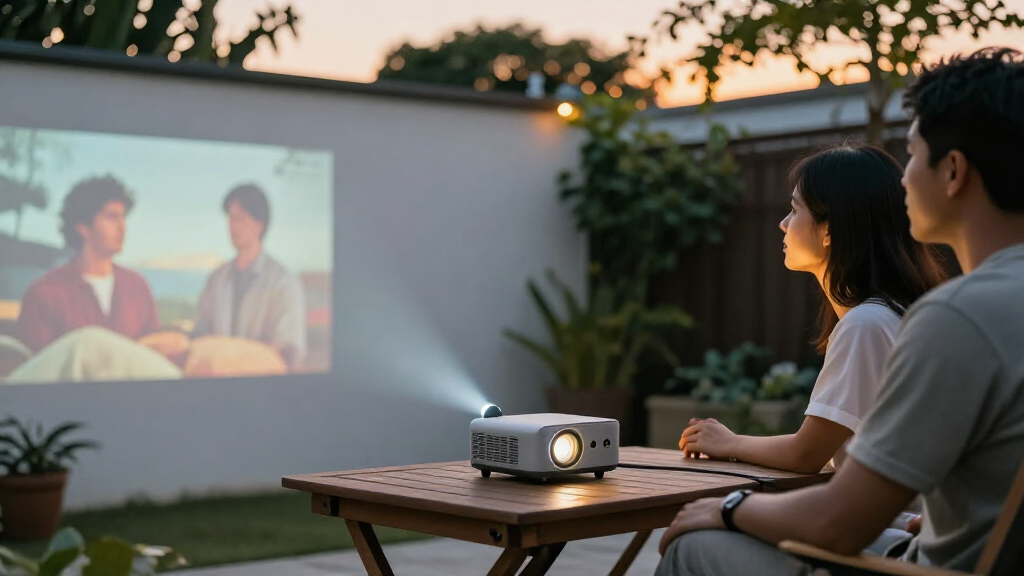
I compared the 15 listed models around the decisions that matter for a portable projector: how readily each can play content, what its stated resolution implies, how easily it can be moved and aimed, and what connections it offers for streaming devices, phones, and speakers. I gave weight to concrete distinctions in the product names, such as native 1080p, built-in apps, Roku TV, DLP projection, and 180-degree rotation, while avoiding assumptions about unprovided brightness, battery life, or image performance.
The ranking favors options with a clear advantage for a common buyer need, then separates models that appear to share broad feature sets by their more specific use case. Smart streaming and named resolution strengths earn attention, but neither substitutes for verified brightness or a genuinely portable power source. Since several listings provide limited specifications, I treat similar Wi-Fi-and-Bluetooth models as flexible alternatives rather than claiming meaningful performance differences the available details cannot support.
Factors to Consider When Choosing Portable Mini Projectors
Before choosing a portable mini projector, decide where it will be used and how content will reach it. A small chassis or a long list of wireless standards can sound compelling, but the viewing environment and your playback habits often matter more.
Match Brightness to the Room
Brightness determines whether a projected image remains visible with stray light in the room, so think about your likely viewing time and window coverings before focusing on portability. Mini projectors are generally better suited to dim rooms than sunny living spaces, and a large projected image can look less punchy than a smaller one. Treat brightness figures cautiously when brands use different measurement standards; look for clearly stated ANSI lumens and compare like with like. If you need daytime viewing, a brighter, larger unit may serve you better than the smallest model. For travel or occasional movie nights after dark, accepting a dim-room requirement can make a compact projector a sensible choice.
Check Native Resolution, Not Just Supported Formats
A projector that accepts a 1080p video signal may still display it at a lower native resolution. Native resolution describes the actual image-forming detail, which affects text clarity, fine edges, and how close you can sit to the screen. Look for the native specification in the listing or manual rather than relying on phrases such as “supports 1080p.” Resolution is only one part of perceived image quality: focus, lens alignment, screen size, and room lighting also matter. Pay extra for higher native resolution when sharp detail is a priority, but do not expect it to compensate for a washed-out picture.
Choose Streaming That Fits Your Devices
Built-in apps can reduce setup, but a product title alone cannot confirm that every service you want is supported or will stay current. Check the app list, operating system, and any restrictions on protected video before buying. A projector without suitable apps can still work well with a streaming stick, laptop, or phone, provided it has the right input and your device supports video output. Wireless screen mirroring is convenient for casual sharing, but it may introduce delays or service limitations that a wired source avoids. If you already own a streaming device, prioritize reliable inputs and simple controls over duplicated software.
Plan for Power, Sound, and Accessories
“Portable” describes size more often than it describes self-contained operation; confirm whether the projector has a built-in battery or needs wall power. If your plans include camping or outdoor use, check the exact power requirements and whether a compatible power bank can run it. Small built-in speakers can be handy for a quick setup, yet separate Bluetooth speakers or wired audio may suit movies better. Bluetooth pairing can also introduce audio delay, so confirm that audio synchronization can be adjusted if that matters to you. Add the cost and packing space of cables, a stand, a screen, and audio equipment to your portability calculation.
Measure Placement Before Picking a Screen Size
Projection size depends on throw distance, lens design, and the space available, so a claimed maximum screen size is not a promise of a bright, sharp picture at that size. Measure the distance from the planned projector position to the wall and compare it with the manufacturer’s throw information. Automatic keystone correction can speed setup, but digital correction may reduce usable image detail; careful physical alignment is usually preferable. Rotating models offer more aiming flexibility, especially when projecting upward, but check how securely they sit and whether the lens can be aimed without blocking airflow. A plain, light-colored wall can work for casual viewing, while a dedicated screen may improve consistency.
Treat Wireless Specs as Convenience Features
Wi-Fi 6 and newer Bluetooth versions describe connection standards, not projector brightness, sharpness, or overall reliability. Network performance also depends on the router, distance, and congestion, while streaming quality can be limited by the source service or device. For a fixed setup, a wired connection may be more dependable than casting over Wi-Fi. Bluetooth is useful for pairing headphones or speakers, but it does not replace checking for the video inputs your devices need. Choose newer wireless features when they solve a real connection problem rather than treating the numbers as a shortcut to better picture quality.
Frequently Asked Questions
Can a portable mini projector replace my television for everyday viewing?
It can replace a television for some viewing habits, but only if you can control room light and accept the setup involved. A television is usually easier to use in a bright room and does not need focusing or a clear projection surface. A projector makes more sense when a large image or easy storage matters more than instant, consistent viewing. Check whether your chosen model runs the streaming apps you rely on, or plan to connect an external device. For mixed daytime and evening use, compare the projector with a TV before making it your only screen.
Does a projector that supports 1080p show native 1080p detail?
Not necessarily: support for a 1080p input means the projector can accept that signal, not that its imaging hardware displays all of those pixels. Look for an explicit native-resolution specification and distinguish it from compatible input formats. The HAPPRUN H1 listing names native 1080p, making that claim more specific than a generic “1080p support” description. If a listing leaves native resolution unclear, check its manual or ask the seller rather than inferring it from the title. Native resolution helps with detail, but brightness, focus, and viewing distance still shape the result.
Are built-in streaming apps better than connecting a streaming stick?
Built-in apps can make a projector easier to carry and set up, especially when you do not want another device and cable. An external streaming stick may offer a familiar interface or app support that a projector’s software lacks. Before choosing, confirm that the built-in system supports your services and that the projector has the necessary inputs for your other devices. App catalogs and software support can change, so a separate streaming device may be easier to replace later. If you already use a stick, its presence can make built-in apps less important.
What should I check before using a mini projector outdoors?
First check power: portable size does not mean the projector includes a battery, and outdoor outlets may not be available. Plan to watch after dark, since ambient light can make a small projector’s image difficult to see. You will also need a stable, protected placement and a flat, light-colored surface or screen. Confirm how you will provide content, since Wi-Fi coverage may be weak away from home and wireless casting depends on both devices. Keep the projector dry and allow its vents to stay unobstructed during use.
Should I choose a rotating HY300-style projector or a compact DLP model?
Choose based on placement first: a rotating HY300-style design can simplify aiming at a wall or ceiling, while the Kodak Ultra Mini DLP is the lineup’s more explicitly compact choice. Rotation is useful when a normal tabletop position cannot point toward the screen, but it does not guarantee a brighter or sharper image. A pocketable projector is easier to carry, though a smaller body may mean fewer built-in conveniences or connections. Compare dimensions, power needs, inputs, and the image specifications in the full listing. If portability means easy aiming, favor the rotating format; if it means taking up less bag space, favor the smallest verified design.
Conclusion
For most buyers who want a ready-made streaming experience in a portable format, I would start with the Aurzen Roku TV D1R Air as the best overall; the Aurzen Roku TV E1R is another smart option if its feature set better suits your setup. For a resolution-focused choice, the HAPPRUN H1 is my pick for buyers who specifically want a stated native 1080p specification. The Kodak Ultra Mini DLP is the best fit for compact carry, while a Wi-Fi model with built-in apps can make a straightforward choice for beginners who want fewer connected devices. I would treat the Magcubic, Philoent, YGSKK, and other broadly similar wireless models as value-oriented candidates only after checking their exact native resolution, brightness, power needs, and app support; the available listing details do not establish a clear best-value winner. For ceiling or awkward-angle projection, compare the rotating HY300-style models, and choose based on verified specifications rather than wireless-version numbers alone.
Fall Picks
fall essentials
As an affiliate, we earn on qualifying purchases.