In today’s digital age, you perceive time as moving faster because instant updates, constant notifications, and immediate feedback shape your sense of speed. Social media and quick messaging make you expect rapid responses, while faster internet and information flow accelerate tasks and shift your patience. This digital environment rewires your perception, making delays feel longer and everything seem to rush by. To understand how this affects your daily experience, keep exploring what’s behind this swift-paced world.
Key Takeaways
- Digital acceleration and instant feedback create a perception that time moves faster than in the past.
- The need for immediate responses and rapid information flow compresses our sense of real time.
- Faster internet speeds and quick task completion reinforce the feeling that everything happens more quickly.
- Social immediacy and instant validation make delays feel longer, distorting time perception.
- The continuous speed of digital interactions rewires our patience, making real-world delays seem intolerable.
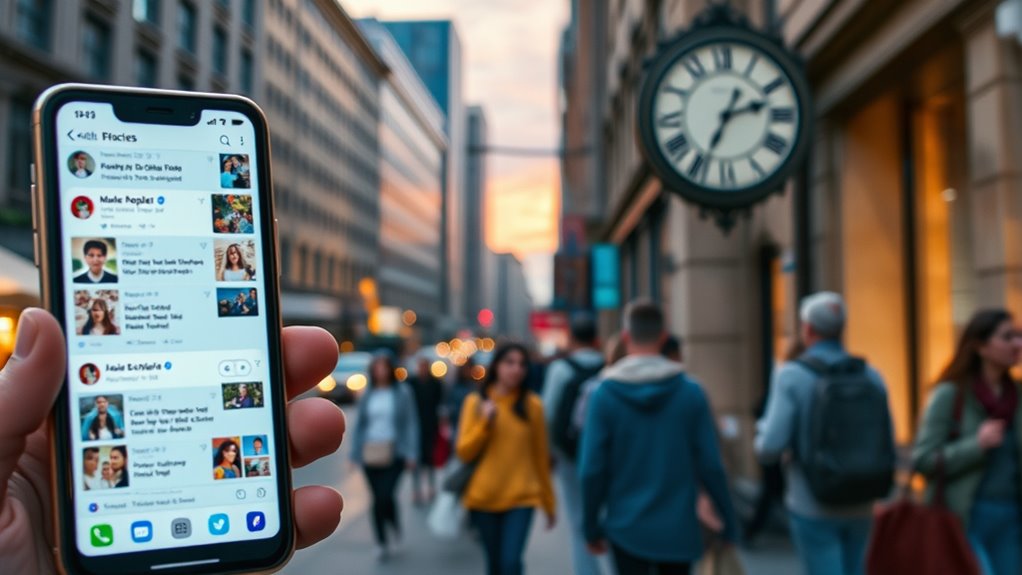
In today’s digital age, many of us live by internet time—where updates, messages, and notifications happen instantly—yet the clock still governs our daily schedules. This disconnect creates a sense that everything moves faster than it used to, and it’s no coincidence. The rapid pace of digital acceleration fuels this perception, making it seem like time itself is speeding up. Every second counts in this environment, and your sense of urgency is amplified by how quickly information travels. Social immediacy, a key facet of our online lives, feeds into this dynamic. When you post a message or share a story, you’re often expecting instant feedback—likes, comments, shares—which reinforces the idea that everyone’s always on, always waiting for the next update. This constant connectivity keeps your attention anchored to the digital domain, where time feels compressed because responses are expected in real time.
In digital age, instant updates and social feedback distort our perception of time and patience.
The impact of digital acceleration is profound. It’s not just about faster internet speeds; it’s about how information flow shapes your perception of time. Tasks that once took minutes now seem to be completed in seconds. You’re conditioned to expect quick replies, immediate results, and rapid shifts in news. This sense of immediacy pushes you to prioritize speed over patience, making the passage of real time seem sluggish by comparison. As a result, your internal clock adjusts, and waiting feels like wasted time. This phenomenon can heighten stress and create a constant feeling that you’re falling behind, even when you’re caught up. Additionally, technological advancements continue to push the boundaries of how quickly we can access and process information, further accelerating our perception of time passing.
Social immediacy intensifies this effect. When your social interactions are instantaneous, you become accustomed to quick exchanges, instant validation, and immediate gratification. This sense of immediacy makes it difficult to switch off or slow down, because you’re used to everything happening in real time. It’s almost as if the digital world has rewired your perception of how long things should take. If a message or notification doesn’t arrive instantly, it can feel like an eternity, even if only a few minutes pass. Over time, this shifts your baseline, making real-world delays seem intolerable or frustrating.
Ultimately, the blending of digital acceleration and social immediacy influences how you experience time daily. It’s a new rhythm—one that’s faster, more responsive, and more demanding. While it keeps you connected and informed, it also challenges your patience and your sense of natural time. Recognizing this shift is the first step toward managing it, so you can find a balance between the relentless pace of internet era and the steady beat of real-world clocks.
Frequently Asked Questions
How Does Internet Time Influence Our Daily Decision-Making?
You find yourself making decisions faster because internet time fuels digital impatience and the desire for instant gratification. When you expect quick responses, you tend to rush choices, often prioritizing immediate results over careful thought. This constant need for speed influences your daily decisions, encouraging you to skip thorough analysis and opt for quick fixes. As a result, you feel pressured to keep up, reinforcing the cycle of faster decision-making driven by online immediacy.
Can Real-Time Awareness Improve Mental Health?
Real-time awareness can boost your mental health by helping you stay present and reduce stress. You should consider a digital detox to minimize distractions and practice mindfulness regularly. These habits enable you to focus on your emotions and thoughts, fostering better mental clarity. By consciously engaging with the moment, you’ll find it easier to manage anxiety and improve overall well-being, making you more resilient in a fast-paced digital world.
What Role Does Technology Play in Altering Our Perception of Time?
Technology plays a big role in changing how you perceive time. Digital overload constantly bombards you with notifications, making it harder to focus and decreasing your attention span. This rapid flow of information creates a sense that everything moves faster, even when it doesn’t. You may feel like time speeds up because your brain is overwhelmed by the quick succession of digital stimuli, affecting your overall perception of time’s passage.
Is There a Biological Basis for Feeling That Time Speeds Up?
You might notice that time seems to speed up as you get older, which has a biological basis. Your biological clock influences your perception of time, and changes in neural processing can make moments feel shorter. When your brain processes information faster or becomes more efficient, you perceive time as passing quickly. This shift in neural activity helps explain why, biologically, you feel like everything’s moving faster.
How Can We Balance Internet and Real-Time Experiences Effectively?
Did you know people check their phones an average of 96 times a day? To balance internet and real-time experiences, prioritize digital detox periods and practice mindful time management. Set boundaries like screen-free zones and scheduled breaks, so you stay present in the moment. By consciously managing your digital habits, you’ll enjoy richer offline experiences and reduce the feeling that everything’s rushing past.
Conclusion
So, while it might feel like everything’s moving faster online, remember that slowing down occasionally can help you stay grounded. It’s easy to get caught up in the rapid pace, but taking a moment to disconnect allows you to reconnect with real life. Don’t let internet time dictate your entire experience—balance is key. Embrace the speed when needed, but cherish the moments that remind you to breathe and truly live beyond the screen.