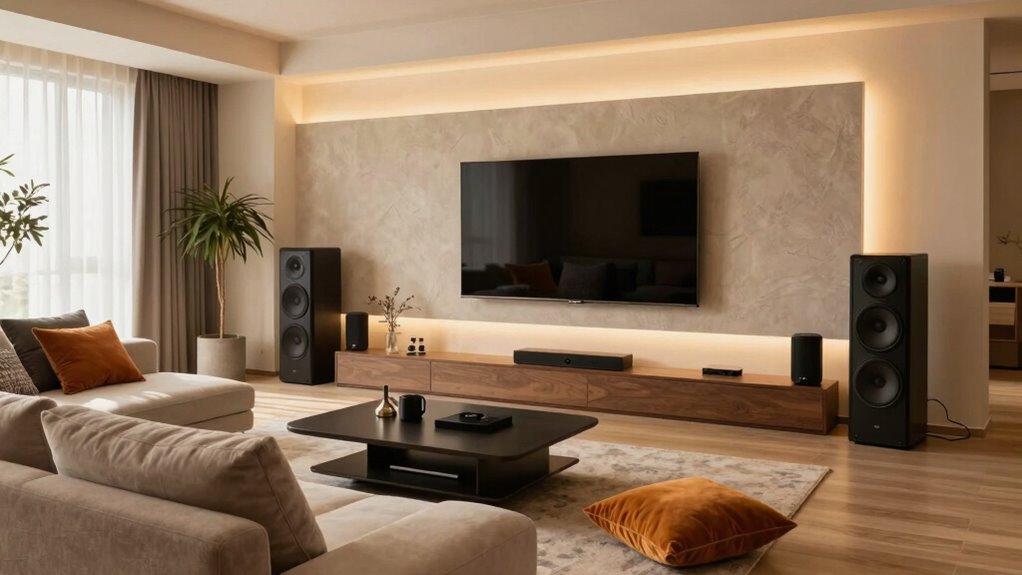

Your living room fights every speaker setup because its shape, surfaces, and furniture create unpredictable sound reflections and dead spots that distort audio. Hard surfaces reflect sound, causing echoes, while soft furnishings absorb it, leading to uneven sound distribution. Furniture placement also influences how sound waves move, often making it hard to get clear audio. By understanding these factors, you can improve your setup—if you keep exploring, you’ll discover how to create a balanced, acoustically friendly space.

Get the latest gadgets delivered free with Prime
- Fast, free delivery on millions of items
- Prime Video, Amazon Music and more included
- Member-only deals all year
Key Takeaways
- Room shape and size cause reflections and echoes that disrupt sound clarity and speaker performance.
- Hard surfaces reflect sound waves, creating reverberation and interfering with speaker imaging.
- Poor furniture placement can block or reflect sound, reducing audio quality and introducing dead spots.
- Lack of proper acoustic treatments leads to excessive reverberation and muddled sound.
- Improper balance between furnishings and acoustic adjustments prevents optimal sound distribution.

Many living rooms seem to resist achieving the perfect speaker setup, and it often feels like no matter how much you tweak the placement, the sound just doesn’t seem right. The room’s shape, size, and furnishings all play a role in how audio travels and how you perceive it. If your speakers produce uneven sound or muddled clarity, the problem might be the room’s acoustics. Acoustic treatments can make a significant difference, but they’re only effective when combined with a thoughtful furniture arrangement. Without paying attention to these details, you might be fighting a losing battle to get balanced, immersive sound.
Achieving perfect sound requires both acoustic treatment and careful furniture placement.
The challenge is that your living room isn’t a blank canvas. Walls, windows, and furniture reflect and absorb sound waves, creating echoes or dead spots. Acoustic treatments, such as foam panels, bass traps, or diffusers, help control these reflections. They’re designed to absorb excessive sound or scatter it evenly, leading to clearer audio. But simply installing acoustic treatments isn’t enough. If your furniture arrangement isn’t optimized, you’ll still struggle to achieve the desired sound quality. For example, placing your sofa directly against a wall can cause bass to boom or sound to become muffled. Moving furniture away from walls or repositioning your seating can improve sound distribution.
Your furniture acts as both a barrier and a reflector of sound waves. Large, plush sofas and thick curtains tend to absorb sound, reducing echo but potentially deadening the room if overused. Conversely, hard surfaces like glass tables, hardwood floors, or minimalistic furniture reflect sound, creating unwanted reverberations. Balancing these elements is key. You want enough soft furnishings to dampen harsh reflections but not so many that the room becomes acoustically dead. Rearranging furniture to create a more symmetrical or balanced layout can help direct sound more evenly toward your listening position, reducing hotspots and dead zones. Additionally, understanding room acoustics can help you identify problem areas and optimize your setup further. Incorporating proper furniture arrangement can also enhance the effectiveness of acoustic treatments by guiding sound waves in a more controlled manner. Sometimes, experimenting with different layouts and furniture placement can reveal surprising improvements.
Ultimately, achieving the perfect speaker setup involves understanding the room’s unique characteristics. Acoustic treatments help tame reflections, but furniture arrangement shapes how sound moves within that space. When you combine both strategies, you’ll notice a marked improvement in clarity, imaging, and overall listening experience. It’s about creating an environment where sound can breathe freely, not bounce chaotically around. By paying close attention to how your furniture interacts with acoustic treatments, you can turn a problematic living room into an acoustically tuned space where your speakers truly shine.
acoustic foam panels for living room
As an affiliate, we earn on qualifying purchases.
As an affiliate, we earn on qualifying purchases.
Frequently Asked Questions
How Do Room Dimensions Affect Speaker Placement?
Room dimensions considerably impact speaker placement because symmetrical rooms help distribute sound evenly, reducing dead spots and echoes. If your room isn’t symmetrical, you’ll likely face challenges with uneven sound. Wall reflections also play a role; placing speakers too close to walls causes sound bouncing, muddying clarity. To optimize your setup, position speakers away from walls and aim for balanced room dimensions to enhance sound quality.
What Are Common Acoustic Treatments to Improve Sound?
To improve sound in your living room, you should consider common acoustic treatments like soundproofing techniques and bass trap installations. Soundproofing helps reduce unwanted noise and echoes, creating a clearer listening environment. Bass traps target low-frequency issues, preventing bass from overwhelming the space. By combining these treatments, you’ll optimize sound quality, minimize room reflections, and enjoy a more balanced, immersive audio experience.
How Does Furniture Arrangement Impact Audio Quality?
Your furniture arrangement greatly impacts audio quality through decor placement and wall materials. Placing large furniture or decor near speakers can block sound waves, causing muddiness. Soft wall materials, like curtains or plush furniture, absorb sound, reducing clarity. Conversely, hard surfaces reflect sound, potentially creating echo. To optimize sound, arrange furniture to avoid blocking speakers and incorporate a mix of wall materials that balance absorption and reflection, enhancing overall audio clarity.
Are There Specific Speaker Types Better for Challenging Rooms?
You should consider using bookshelf or in-wall speakers, as they’re more adaptable to challenging rooms. These types often handle room acoustics better when you perform proper speaker calibration. Pair them with soundproofing techniques like adding acoustic panels or rugs to minimize reflections. This combo helps tame the room’s chaos, making your sound clearer and more balanced, even when space isn’t perfectly suited for traditional speakers.
How Can I Measure and Analyze Room Acoustics Effectively?
You can measure and analyze room acoustics by using tools like a sound level meter or room analysis software. Focus on identifying room resonance by noting any bass boom or uneven sound distribution, and evaluate sound absorption to see which surfaces absorb or reflect sound, affecting clarity. Moving speakers and adding soft furnishings can help optimize acoustics, reducing issues caused by room resonance and improving overall sound quality.
As an affiliate, we earn on qualifying purchases.
Conclusion
So, when your living room seems to fight every speaker setup, it’s like trying to fit a square peg in a round hole. Sometimes, you just need to tweak your space—adjust positioning, treat the acoustics, or experiment with different speakers—to turn the tide. Don’t throw in the towel; with patience and small changes, you’ll find harmony. After all, every room has its rhythm—you just need to find it.
As an affiliate, we earn on qualifying purchases.
living room furniture for optimal sound
As an affiliate, we earn on qualifying purchases.
As an affiliate, we earn on qualifying purchases.
Columbus Day / Indigenous Peoples' Day Picks
long weekend sales
As an affiliate, we earn on qualifying purchases.