
TL;DR

Get the latest gadgets delivered free with Prime
- Fast, free delivery on millions of items
- Prime Video, Amazon Music and more included
- Member-only deals all year
Mistral aims to carve out a niche with sovereign, open-weight models tailored for European enterprises and regulators. While its control-focused approach offers distinct advantages, doubts about its technical edge and scaling persist, raising the question: is it playing a different game or already falling behind?
Every conversation about Mistral spins around the same question: is it innovating on a different game or just falling behind the front-runners? At its recent AI Now Summit in Paris, Mistral repositioned itself as a full-stack provider, not just a model lab. That shift hints at a bold strategy rooted in sovereignty and control—an approach that could reshape how European companies adopt AI. But beneath the confident pitch, doubts flicker about whether Mistral’s technical offerings can truly compete with giants like OpenAI or Anthropic.
In this article, you’ll see what Mistral is really betting on—its full-stack approach, enterprise focus, and the trade-offs it makes. We’ll explore whether it’s winning by playing a different game or already lost in the race for reasoning prowess. By understanding both the promise and the pitfalls, you’ll get a clear picture of Mistral’s place in the AI landscape—and what it means for your own AI plans.
Different game, or already lost?
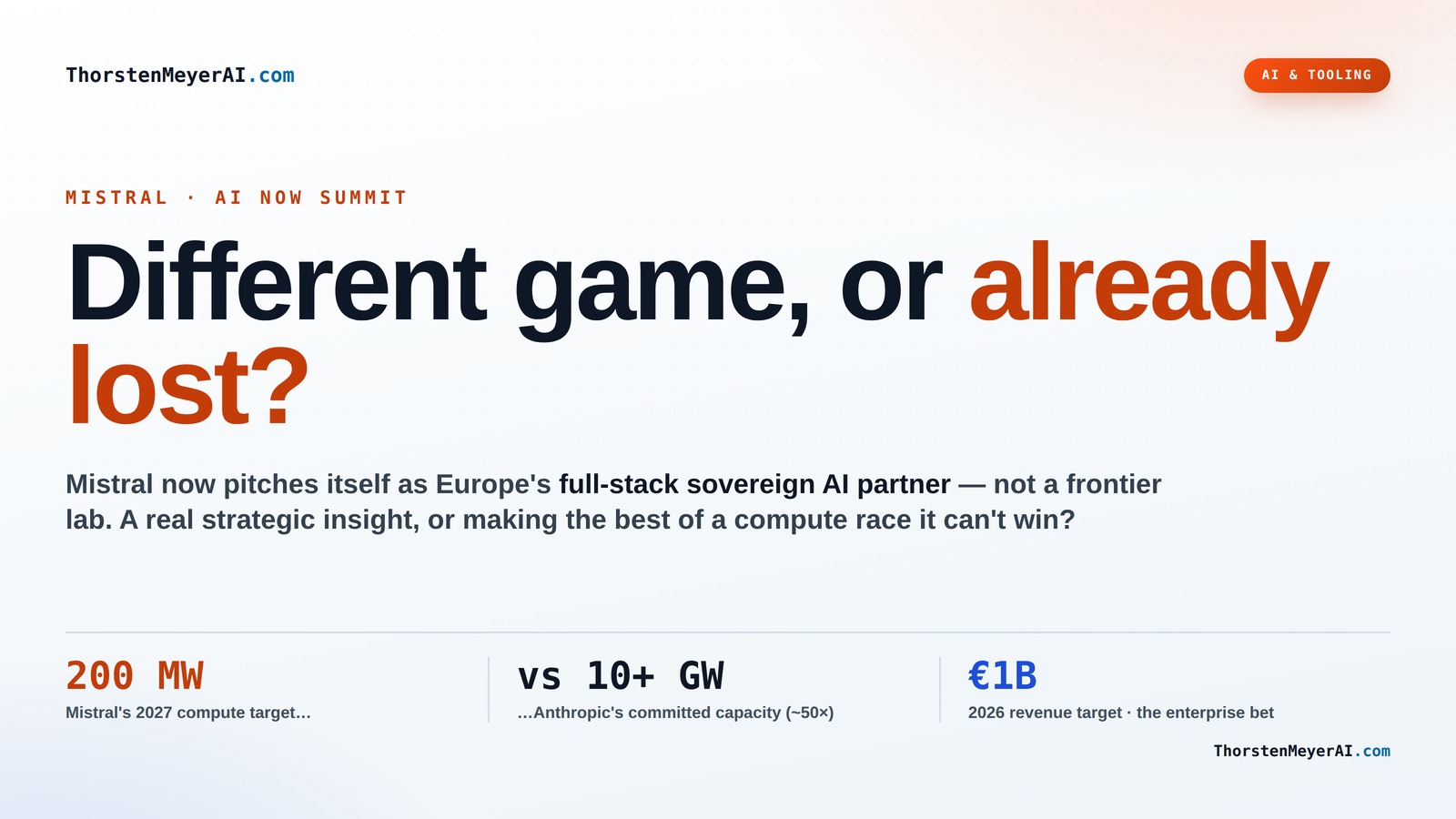
Mistral now pitches itself as Europe’s full-stack AI provider — compute, models, platform, consultancy — not a frontier-model lab. Is that a real strategic insight, or making the best of a race it can’t win? Both readings fit the same facts.
From model lab to full-stack provider
The clearest signal from the summit wasn’t a model — it was a posture. Heavy on enterprise logos and partnerships (ASML, BNP Paribas, Alexa+), light on new-model announcements. That absence is exactly what skeptics seized on.
Compute
40MW Paris DC + Sweden build · 200MW target by 2027
Models
Open & custom · efficient · you own and run them
Platform
Forge for custom models · Vibe for Work agent
Consultancy
Sales teams, integrators, EU provenance & support
Small & focused, or large & general?
Mistral bets on specialized small models. The claim isn’t that they win a reasoning leaderboard — they don’t. It’s that on the metrics that matter in production agent systems, a purpose-built small model wins. Flip the metric to see the case reverse.
Small specialized vs large general — by what you measure
In token-heavy agentic apps making hundreds of calls, speed/energy/cost compound. Toggle the metric.
Narrow models doing real work
Each is one model doing one thing efficiently — the tangible version of the strategy. Strong on their own terms; the open question is whether the bundle beats a free Chinese open-weight download.
On-prem KYC compliance
Mistral models run inside the bank’s walls for know-your-customer checks. Sensitive financial data never leaves. (BNP was Mistral’s first customer, 2023.)
Voxtral multilingual voice
A focused voice model powering Alexa+ across Europe — speed and efficiency over raw size.
Robostral industrial robotics
Plus a “physics AI” push (via the Emmi acquisition) into aerospace, automotive & semiconductor design and simulation.
Document AI / OCR at scale
Large-scale text extraction — the unglamorous, high-volume enterprise work small models excel at.
The strategy is downstream of the compute gap
Once you see the raw numbers, “why is Mistral behind?” answers itself — and the specialized-small-model strategy starts looking partly like a smart adaptation to a binding constraint, not a pure philosophical choice.
Compute & capital · Mistral vs a frontier leader, this same week
Not a knock — it’s the constraint that forces the efficiency-first, sovereignty-wedge strategy. Adapting intelligently to your position is what good strategy is.
“I want them to win, but I’m worried”
That ambivalence is the most accurate read of where Mistral sits. The enterprise pivot gets read two opposite ways — and both deserve airing.
On-prem, real sales teams, the Koyeb deployment acquisition, EU provenance — exactly what regulated enterprises want, and stickier than consumer mindshare. Targeting €1B revenue in 2026 with 1,000 staff, up from 15 people and one customer in 2023. US closed-API labs structurally can’t match the sovereignty axis.
“Software consultancy with a data center,” not a foundation-model moat. Enterprise B2B is where European startups go when they can’t win consumer or world-scale SaaS. Why pay Mistral on-prem when you could run Qwen free? One paying Le Chat Pro user said the quality gap with frontier labs is now hard to ignore.
Key Takeaways
- Mistral’s sovereignty focus appeals to regulated European markets, emphasizing control, compliance, and regional independence.
- Open weights give enterprises transparency and customization, but may come at a cost of slightly lower reasoning performance.
- Small, specialized models excel in deployment speed and efficiency, making them ideal for enterprise use cases demanding fast results.
- The core debate isn’t just technical—regional regulation, geopolitics, and procurement politics shape Mistral’s strategy.
- Whether Mistral is winning or losing depends on what you prioritize: control and sovereignty or raw AI reasoning power.
As an affiliate, we earn on qualifying purchases.
What Mistral’s Sovereign AI Really Means in Practice
Mistral’s ‘sovereign AI’ isn’t just a buzzword; it’s a concrete strategy. It means offering models that organizations can download, fine-tune, and run entirely within their own infrastructure. Think of a European bank, like BNP Paribas, keeping sensitive financial data inside their own walls while still leveraging AI. For them, sovereignty isn’t just about control—it’s about compliance, security, and trust. You can learn more about smart home technology and how regional control is shaping digital strategies.
Take the example of BNP Paribas, which runs Mistral models on-prem for anti-money laundering checks. No data leaves the bank’s servers. This setup appeals to regulated industries that dread the idea of their data floating in cloud services governed by foreign laws. It’s a clear move away from the US-centric API model—where you rely on a third-party provider—and toward full control.
This approach is especially relevant in Europe, where data privacy laws like GDPR are strict. It’s not just a technical choice but a political one, aligning with regional values around privacy and independence.

As an affiliate, we earn on qualifying purchases.
Open Weights and Why They Matter More Than Ever
Open weights are a game-changer—allowing enterprises to download, inspect, and modify models themselves. Mistral’s open-weight approach is a direct challenge to closed API giants like OpenAI. Instead of relying on a black box, companies get transparency and flexibility. For insights into AI tools and transparency, visit voice-over techniques and AI voice tools.
For example, a European government agency can download a Mistral model to customize for national security tasks. They can audit it, fine-tune it, and run it behind their firewall. That’s a level of control impossible with proprietary models.
But the real question is: are Mistral’s models good enough? Critics argue that open weights often lag in reasoning and understanding—especially compared to giants like GPT-4 or Claude. Still, the ability to self-host and customize is a major selling point for regions with strict data laws.
Overall, open weights tilt the balance of power, making AI adoption more about control than just raw performance.

As an affiliate, we earn on qualifying purchases.
Why Europe’s Strict Regulations Make Mistral’s Strategy a Winner—or Not
European regulations like GDPR and national security laws make sovereignty a must-have for many organizations. Mistral’s focus on on-prem deployment and open weights aligns perfectly with these needs. It’s a tailored fit for regulated industries—financials, defense, government. To explore more about regional tech regulations, check out the importance of sovereignty in AI.
Imagine a European defense contractor that wants to deploy AI without risking foreign data breaches. Mistral’s models, run locally, provide peace of mind. This isn’t just about legal compliance—it’s about geopolitical independence.
But here’s the catch: if Mistral’s models don’t keep pace in reasoning and scale, these organizations might eventually switch back to more capable, albeit less sovereign, options. The question is whether Mistral’s focus on control can compensate for potential technical gaps.
This regulatory environment turns Mistral’s strategy into a regional moat—at least for now.

As an affiliate, we earn on qualifying purchases.
Is Mistral Winning by Playing a Different Game, or Just Falling Behind?
The big debate centers on whether Mistral’s small, specialized models are a strategic advantage or a sign of lagging behind. On one side, smaller models excel in speed, energy efficiency, and cost—perfect for enterprise use cases like document processing or voice assistants. Mistral’s examples include OCR for patent texts and multilingual voice in Amazon Alexa+, both demanding fast, targeted AI. For more on AI innovation and industry trends, visit technology and digital innovation.
On the flip side, critics point out that in reasoning and understanding, Mistral’s models seem to trail larger, more advanced models. Some community chatter suggests that since mid-2025, Mistral’s models haven’t kept up with the reasoning benchmarks set by OpenAI or Anthropic.
This trade-off boils down to focus: is Mistral’s game about control and deployment or about cutting-edge intelligence? Both paths have winners, but the balance is delicate.
In essence, Mistral might be winning on a different axis—control, sovereignty, cost—but could be losing in the race for raw reasoning power.

The Big Question: Is Mistral Playing a Different Game, or Has It Already Lost?
This is the core question. Mistral’s strategy is to emphasize sovereignty, control, and regional independence. That’s a different game—one focused on enterprise control, compliance, and open collaboration. But the market keeps pushing forward in reasoning, scale, and general intelligence.
Recent signals show that European buyers increasingly prioritize sovereignty, giving Mistral an edge in regional markets. But some industry insiders worry the technical gap is widening. If Mistral’s models can’t match the reasoning and efficiency of the frontier labs, it risks becoming a niche player.
So, is Mistral ahead or behind? It depends what you value most: control and regional independence or cutting-edge AI performance. It’s a strategic choice, and the landscape is shifting fast.
The real challenge: whether Mistral can innovate fast enough or if it’s already resigned to a smaller slice of the AI pie.
Conclusion
In the end, Mistral’s move into full-stack sovereignty isn’t just about technical innovation—it’s a political and strategic stance. It’s betting that regional control, transparency, and compliance will outweigh the benefits of raw reasoning power. But as the AI race accelerates, that bet could be tested by faster, bigger models from the US and China.
If you’re considering your own AI future, remember: controlling your AI stack isn’t just a technical choice. It’s a statement about how you see the future of trust, security, and independence in AI. Watch how Mistral balances its regional vision with the relentless push for smarter, more capable models. That’s the real game.

Columbus Day / Indigenous Peoples' Day Picks
long weekend sales
As an affiliate, we earn on qualifying purchases.