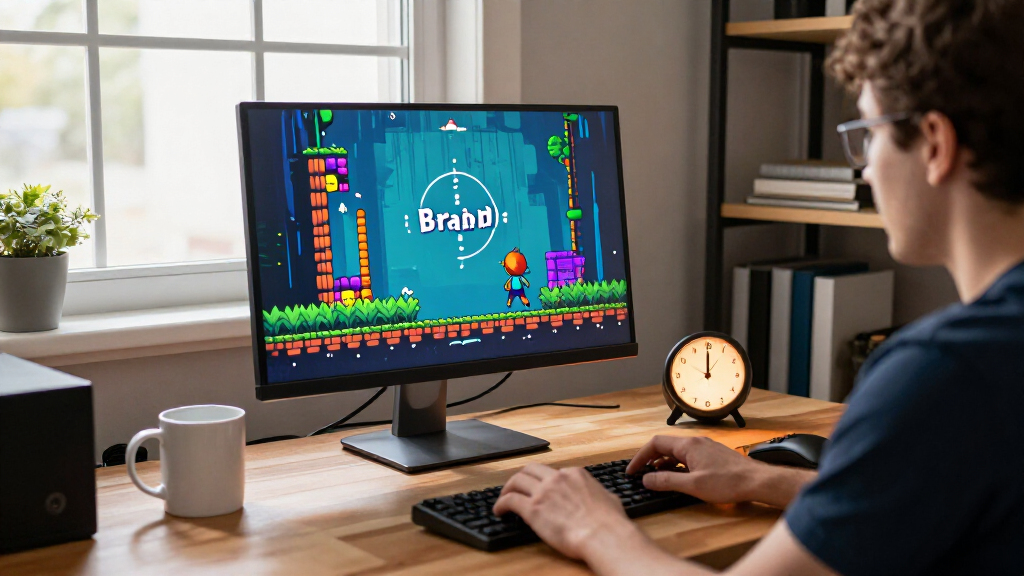

TL;DR

Get the latest gadgets delivered free with Prime
- Fast, free delivery on millions of items
- Prime Video, Amazon Music and more included
- Member-only deals all year
A 2015 report on Braid focuses on the time-manipulation mechanics introduced across its six worlds, rather than trying to settle the game’s ambiguous story. Its central observation is that the mechanics operate consistently, letting players test puzzle solutions within rules enforced by the game itself.
A 2015 report on Braid examines how the puzzle-platform game uses time-manipulation mechanics across its six worlds. The author argues that the rules remain consistent and focuses on what the game’s systems allow players to do, rather than interpreting its deliberately ambiguous story.
The report’s author says Braid introduces one new time-manipulation mechanic in each of six worlds. Some mechanics qualify as time travel more clearly than others, and the author distinguishes their potential for storytelling from their role in the puzzles. The essay does not offer a full account of the game’s plot; its stated focus is the possibilities created by the mechanics.
The author describes the game as a platformer built around temporal rules and argues that those rules are implemented consistently. In this reading, the game’s programmed environment constrains what can happen: players can explore and exploit the rules the game provides, but the system prevents the sort of unexplained exception that can appear in a written or filmed story. The report frames that constraint as a strength for time-travel fiction.
The source is a first-person report, not a formal technical study or a new announcement about the game. The author also recounts a control problem: a keyboard-driver issue prevented the game from registering the up or down arrows while Shift was held, obstructing high-speed rewinding. That experience made one puzzle seem impossible until the author looked up its solution online.
Why Braid’s Rules Matter
The report’s wider point is about how games can make speculative rules testable. In a conventional story, a time-travel rule may be bent or abandoned when the plot requires it. In a game, players repeatedly interact with the system, so an inconsistency can affect whether a puzzle is solvable. A mechanic that behaves consistently gives players a basis for experimenting, revising a plan, and learning from failure.
That makes Braid’s time systems relevant beyond plot interpretation. The player does not only hear that time can be manipulated; the player encounters rules and sees their effects. The report suggests that this interaction is a distinct storytelling possibility, even while its author remains unconvinced by the game’s ambiguous narrative. The essay’s distinction is useful: a game’s mechanics may communicate clearly even when its story invites competing interpretations.
The control issue also illustrates a practical limit. A puzzle’s intended logic can be difficult to assess if input problems prevent a player from using a mechanic as designed. The author attributed the problem to keyboard drivers, but the source does not establish that this affected other players or versions of the game.
Products Worth Considering

Logitech MX Keys S Wireless Keyboard, Graphite

Logitech MX Mechanical Wireless Illuminated Keyboard Tactile (Graphite)

Samsung 27-Inch Odyssey QD-OLED G8 4K 240Hz Gaming Monitor
As an affiliate, we earn on qualifying purchases.
The Game Behind the Essay
Braid combines platforming and puzzle-solving with a rewind mechanic and additional temporal rules introduced as players move through its worlds. The 2015 report treats those mechanics as separate systems worth analyzing, rather than treating every one as straightforward time travel. It also notes that some mechanics may suggest narrative possibilities without necessarily explaining the game’s own story.
The author describes the game’s visuals, puzzle design, and music positively, while saying the story is difficult to interpret and appears deliberately ambiguous. These are the author’s evaluations, not claims of settled critical consensus. The report’s focus is narrower: it asks what can be learned from the way a computer game encodes rules and requires players to act within them.
To make that comparison, the author contrasts interactive systems with other forms of fiction. A novel or film can present events in any sequence, even if that sequence conflicts with previously stated rules. A game, by contrast, runs on programmed behavior. The essay acknowledges possible software faults or exploits as exceptions, but assumes Braid’s systems are functioning as designed for the purpose of its discussion.
“Braid introduces one new time manipulation mechanic in each of its six worlds.”
— The 2015 report’s author
Limits of the Mechanics Analysis
The source does not provide a technical audit of Braid’s code or a complete catalogue of each world’s mechanics. Its claim of consistency is the author’s analysis, based on the game as played, rather than an independently verified finding about every possible situation or version. The report also does not establish whether the reported keyboard problem came from the game, the author’s computer setup, or a particular driver configuration beyond the author’s own attribution.
The game’s story remains open to interpretation in the source. The author says it is difficult to identify a clear account of what happens and characterizes its ambiguity as deliberate, but the essay does not resolve what the narrative means. Nor does the report claim that all of Braid’s mechanics are time travel: it explicitly says that some only dubiously fit that description.
Further Play, Not a New Release
The source describes no forthcoming update, release, or event. Its next step is analytical rather than commercial: readers can use the report’s framework to examine how each world’s rules shape its puzzles and to distinguish the game’s playable systems from interpretations of its story. Any broader claim about how Braid compares with other games would require additional evidence beyond this report.
For readers who have not played the game, the author recommends trying it, citing its puzzles, visuals, mechanics, and music. That recommendation is the writer’s opinion. The report leaves the reader with a more specific question than whether Braid is a time-travel story: what kinds of time-based actions does each system permit, and how does enforcing those limits change the experience of solving a puzzle?
Key Questions
What is the 2015 report about?
It analyzes Braid’s time-manipulation mechanics, focusing on how rules across the game’s six worlds shape puzzle-solving.
Does the report say Braid is a time-travel story?
No. The author says the game’s story does not appear to be a time-travel story, while noting that some of its mechanics qualify as time travel and others do not.
What does the author mean by consistent rules?
The author argues that the game’s programmed mechanics behave in a stable way, so players can reason about what actions are possible rather than relying on exceptions introduced only to move a plot forward.
No. The author describes the story as ambiguous and says the essay is not intended to interpret it. The report focuses on visuals, puzzles, and mechanics instead.
Was the reported control issue confirmed for other players?
No. The author reports a personal keyboard-driver problem that interfered with high-speed rewinding. The source does not establish how widespread the issue was.
Source: hn